Seven opportunities for developing Estonian education exports
- Estonia’s education system enjoys a strong international reputation, but its export potential remains only partly realised.
- Beyond their academic contribution, international students support the Estonian economy through living expenditure and labour taxes, making education a revenue-generating export sector.
- Expanding opportunities to learn Estonian would enable more international students to remain in the country after graduation and help address labour shortages. International alumni also constitute a valuable resource for promoting Estonia abroad and strengthening economic ties.
- Estonia’s educational expertise could be developed more strategically and exported as an internationally competitive service.
- Education exports could encompass a wide range of services and products with far-reaching impact.
INTRODUCTION
As a globally expanding sector, education could become a much more significant export for Estonia. According to United Nations data, 256 million students were enrolled in higher education institutions worldwide in 2022.1 The number studying outside their home country tripled between 2000 and 2021, rising from 2.1 million to 6.4 million globally. This article examines education as a potential source of export revenue and considers its wider economic and societal impact.
A high-quality education system has become one of the three defining features for which Estonia is recognised internationally.2 Interest comes from a wide range of countries, including Germany, South Korea, Spain, the United Kingdom and the United States; representatives from South America and Africa are also increasingly frequent visitors.3 Interest has increased markedly over the years. Numerous educational institutions, the Ministry of Education and Research, and Education Estonia at the Education and Youth Board are involved in hosting delegations and developing cooperation.
Estonian universities and applied higher education institutions are integrated into global education networks and offer internationally competitive programmes. This provides a strong foundation for exporting Estonian higher education, although its full potential has yet to be realised. Over the past 15 years, the national Study in Estonia initiative, implemented in cooperation with higher education institutions, has promoted study opportunities in Estonia. During this period, the number of international degree students enrolled in Estonian higher education institutions has increased more than fourfold, from 908 in 2009 to 3,954 in 2024.4
The export of education extends beyond higher education programmes and international students studying in Estonia. In recent years, hundreds of delegations have visited the country to learn about its education system. Responding to this interest already generates additional income for schools. At the same time, it is worth considering whether the expertise of Estonian education professionals could be more systematically developed into exportable services and marketed strategically to increase revenue. Finland’s experience offers a useful comparison, as it began pursuing education exports some 15 years ago.
What is the export potential of Estonian education, and how should Estonia position itself strategically in global competition? The following sections identify seven areas with potential for developing education exports.
THE ECONOMIC POTENTIAL OF INTERNATIONAL STUDENTS: FROM INVESTMENT TO ECONOMIC DRIVER
Data from the Organisation for Economic Co-operation and Development (OECD) indicate steady growth in the export of education-related services across most OECD countries.5 These export figures include international students’ spending on tuition fees, food, accommodation, local transport and healthcare. Expenditure by international students, and the corresponding total revenues of OECD countries, increased from €50 billion in 2010 to more than €115 billion in 2019. According to a global forecast by HolonIQ, by 2030 some 9 million students will be studying abroad, with annual spending exceeding US$500 billion.6
According to 2024 data from NAFSA, the Association of International Educators in the United States, the 1.1 million international students enrolled in US colleges and universities contributed US$43.8 billion to the US economy during the 2023/2024 academic year and supported more than 378,000 jobs. On average, three international students support one job in the United States.7 Data from France show that in 2021 international students spent €461 million on transport, while visiting relatives and friends spent an additional €393 million.8 Both studies underline that the presence of international students is economically valued, as their monthly expenditure flows directly into the host country’s economy.
International students in Estonia likewise make a substantial economic contribution through tuition fees and everyday spending. According to an OECD study, Estonia’s export of education services attributable to international student expenditure increased from €12 million in 2010 to €58 million in 2019.9 The International Student Barometer10 found that international students in Estonia spent on average €250 per month on housing and around €300 per month on daily activities, including food and domestic travel. During the 2023/2024 academic year, the 2,558 Erasmus+ exchange students studying in Estonia contributed at least €3.8 million to the economy.11 Estonia’s universities and applied higher education institutions thus function as economic drivers whose impact extends beyond the education sector. Students are also regarded as an important target group for the tourism sector, as earlier studies have shown.12
According to Haridussilm, public expenditure per student in higher education amounted to €6,096 in 2020. Based on this figure, the annual spending of international students on housing and daily living expenses alone is sufficient to cover the state’s investment per student.13 When income and social taxes paid by international students participating in the Estonian labour market, tuition fees and visits by family members are also taken into account, public investment can be estimated to be recouped at roughly one and a half times its value.
THE POTENTIAL FOR PRESERVING THE ESTONIAN LANGUAGE: LIMITED PROFICIENCY RESTRICTS OPPORTUNITIES
In the 2018/2019 academic year, 156 international students were enrolled in Estonian-language programmes in applied higher education and integrated bachelor’s and master’s programmes in Estonia. Two years later the number had risen to 194, and by the 2024/2025 academic year to 225.14 In addition, a number of doctoral candidates study in Estonian, although their exact number is difficult to determine.
The number of students studying in Estonian could be considerably higher. Each additional foreign national who acquires proficiency in Estonian represents both a cultural and an economic gain. Several countries have successfully implemented language policies that integrate language instruction with higher education. Spain and Germany provide notable examples, offering language courses through their international cultural institutes and directing learners towards universities in their respective countries. The Goethe-Institut offers German language courses that prepare participants for study or employment in Germany. The Instituto Cervantes promotes Spanish language learning and introduces study opportunities in cooperation with the Study in Spain initiative. Similar measures are also implemented by smaller countries, which offer preparatory foundation years during which international students can acquire the necessary language skills before beginning degree studies in the national language. Such systems operate, for example, at the Kraków University of Economics in Poland, UiT The Arctic University of Norway in Tromsø and Charles University in the Czech Republic, where successfully passing a language examination allows progression to a local-language degree programme. In Estonia, the University of Tartu offers a comparable pathway at its Narva College, where three Estonian-language programmes include an intensive language year that, upon successful completion, leads to bachelor’s studies in Estonian.
Both large and small European countries recognise the strategic importance of language learning at the national level. Although Estonia cannot be directly compared with France, a French economic impact study highlights the revenue generated by language instruction.15 One in four international students in France had attended French language courses either before or during their stay (58% of them in French institutions), paying on average €1,632 for this instruction. The strategic development of language education can therefore generate significant economic and societal benefits.
An increasing number of international students wish to remain in Estonia after graduation. For example, the authors of the RITA migration report,16 which examined labour market change and the opportunities and challenges arising from migration in the education, labour market and social systems, emphasise the importance of measures that would help international students studying in Estonia secure internships and employment in both the private and the public sector. In international companies and startups, where many international graduates find employment, English is typically the working language. Public-sector positions, however, are generally accessible only to those who are proficient in Estonian.
Promoting the learning of Estonian, both within Estonia and internationally, would expand opportunities for international students and strengthen their competitiveness in the Estonian labour market. A larger number of participants in the Estonian-language cultural space would support the country’s intellectual and linguistic vitality.
THE POTENTIAL OF SMART MIGRATION: INTERNATIONAL STUDENTS BRING NEW SKILLS TO THE LABOUR MARKET
International students constitute a distinctive group of migrants and are often regarded as a source of future labour already partly integrated through their local study experience.17 As part of talent policy, nearly half of OECD countries view international students as a strategic resource. According to Statistics Canada, international graduates who have studied at a domestic university enjoy advantages in the labour market compared with foreign nationals who obtained their degree abroad, as they face fewer obstacles in the recognition of qualifications and have established local networks.18 In France, 91% of international alumni reported that their studies helped them secure their first job.19
As Estonia faces a declining population and the lowest birth rate in a century, it is essential to consider both current and future labour market needs. International students can play a significant role in alleviating labour shortages and bringing new skills into the economy. At the same time, the broader impact of demographic decline on education, the economy and society as a whole must be taken into account.
The Estonian Ministry of the Interior has likewise pointed to the positive contribution of international students to Estonian society, noting that recruiting international students and supporting their integration into the labour market is a more effective response to skilled labour shortages than recruiting foreign workers directly, as students adapt to the local environment during their studies.20
One of the most immediate ways to address labour shortages and respond to the needs of Estonia’s business environment would be to take a further step in regulating legislation on study migration and skilled labour migration. In terms of post-graduation stay options, Estonia ranks among the more restrictive OECD countries. International graduates may remain in Estonia for 270 days, or nearly nine months, after completing their studies to seek employment and apply for a residence permit on a new basis. In most OECD countries – including Finland, Germany, Lithuania, the Netherlands, Norway and New Zealand – graduates are permitted to remain for 12–24 months. Estonia is therefore among the few countries offering a shorter period.
THE POTENTIAL TO REDUCE REGIONAL DISPARITIES: INTERNATIONAL STUDENTS AS A BALANCING FORCE
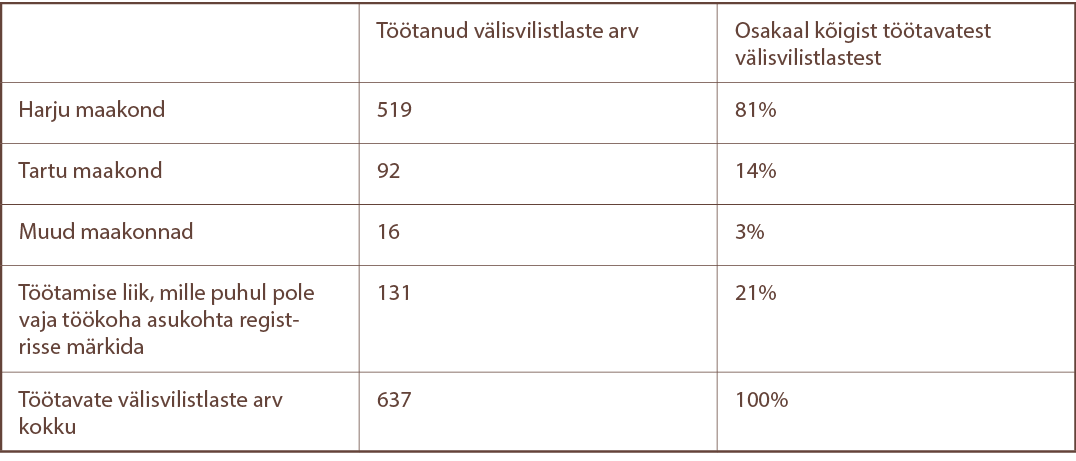
International students enliven regional student life, enhance the academic quality of higher education institutions and create an international learning environment for local students. However, fewer than 100 international degree students study outside Tallinn and Tartu. According to Statistics Estonia, the majority of international graduates who remain in Estonia are employed in Tallinn and Harju County (81%), with a smaller share in Tartu and Tartu County (14%).21 The remaining counties together account for only 3% of international alumni.
Universities are integral to the cities in which they operate, including through their regional colleges. They contribute vitality and innovation to their host cities and play an important role in economic, social and business life.22 However, the share of international students studying outside Tallinn and Tartu is below 2.5%, whereas in many OECD countries international students are seen as important contributors to local economies and talent policy across regions. To maximise the benefits of internationalisation and reduce regional disparities, several countries actively direct international students beyond major urban centres to smaller regions.
The Netherlands offers a useful example. Between 2013 and 2016, the national programme ‘Make it in the Netherlands’ promoted career opportunities to international students and encouraged them to work across different regions of the country.23 In Estonia, the question is not only what education exports could contribute to the counties, but also what the counties – with their distinctive cultural environments and innovative business landscapes – can offer to the world.
THE POTENTIAL OF ALUMNI AS REPUTATION AMBASSADORS: INTERNATIONAL VISIBILITY BUILDS NEW ECONOMIC TIES
Each year, more than one thousand international students graduate in Estonia, and a growing share remain in the country after completing their studies. Of those who graduated in 2018, 33% were active in the Estonian labour market in the 2022/2023 academic year. Among 2020 graduates, the share had risen to 40%, and it is even higher among more recent cohorts.25 Most alumni nevertheless leave Estonia, and their subsequent careers are not systematically monitored.
In the United States, total donations to colleges and universities amounted to US$49.6 billion in 2020, of which alumni contributed US$11.2 billion.26 According to a French alumni survey, studying in France has a direct positive effect on the country’s reputation.27 Nine out of ten alumni reported that their study experience made them more open to cooperation with French individuals (88%) and French companies (85%). Among those who left France, 95% stated that their study experience made them more likely to return as tourists. France also views its alumni as ambassadors of French culture and lifestyle. A majority of alumni who left the country reported a continued habit of purchasing French food (49%) and French products (46%), and of consuming French cultural content, including music and films (58%). Alumni experiences thus strengthen a country’s cultural and economic position in the global context.
In Estonia, the contribution of alumni remains underutilised, but its potential is evident in examples such as the more than €2 million donation to the University of Tartu from an Estonian family in Canada, and the billion-dollar valuation achieved by Glia, a startup founded in Estonia by University of Tartu alumnus Carlos Paniagua. A larger global community of individuals who have studied in Estonia could support the country diplomatically and help tell Estonia’s story on the international stage. Education can thereby contribute to strengthening Estonia’s reputation and security.
THE POTENTIAL OF EDUCATIONAL EXPERTISE: STRONG PISA PERFORMANCE HAS GENERATED INTERNATIONAL INTEREST AND OPPORTUNITIES
The OECD’s PISA assessments have become a significant driver of international developments in education. Countries that consistently achieve strong results attract the attention of experts and media alike. Observers seek to understand the reasons behind success and whether lessons can be applied to address challenges in their own education systems. Although education traditionally falls within national competence, analyses, rankings and recommendations based on PISA data generate broad international interest and a desire to learn from leading performers.
The value of educational expertise is rising further in the context of major global transformations. Knowledge and skills are increasingly viewed as key determinants of national competitiveness. Global trends, such as technological development and rapid population growth in certain regions, are driving demand for new and scalable solutions. The HolonIQ report ‘Education 2030’ notes that many countries, particularly in Asia and Africa, struggle to provide access to modern education due to rapid population growth.28 Shortages are widespread: teachers, knowledge in contemporary teaching methods, school leadership and learning materials, among other areas. In addition to young learners, pressure is growing in adult and vocational education to equip people with new skills. Developments in artificial intelligence, machine learning and other emerging technologies create new opportunities to respond effectively to these challenges.
All these factors increase the value of educational expertise. International rankings and comparison tables are closely followed, and there is strong demand for identifying best practices, learning from them and exchanging experience. Estonia’s strong performance, achieved with financial investments at around the international average and in a country that remains relatively little known globally, has made it a destination for those seeking inspiration. Interest spans a wide range of topics, including school autonomy, the use of digital tools in teaching and administration, social support services and entrepreneurship education.
It is also important that investment in education is growing. According to HolonIQ analyses, the global financial volume of the sector is projected to grow by approximately 8% annually until 2030.29 In addition to governments, private-sector interest – particularly from venture capital funds – in investing in technological solutions has increased. Education reforms in developing countries are financed through multilateral and bilateral initiatives, with such funding instruments amounting to US$16.6 billion in 2022.30 Several countries have recognised these trends as an opportunity to build an export sector focused on educational expertise. Finland provides a nearby example,31 where the export of education services has grown into a €773 million industry over the past 15 years.32
THE POTENTIAL FOR EXPORTING EDUCATION SERVICES: STRATEGIC ACTION DRIVES GROWTH
Education exports are traditionally understood as the expenditure of international students in the host country, but this is a narrow interpretation. In many countries, the range of revenue sources included under education exports is far broader. It extends from international conferences, education tourism and educational technology solutions to international students’ living expenses and labour taxes. A review prepared by the London School of Economics and Political Science for the United Kingdom’s Department for Business and Trade identifies additional sources of national income, including overseas branch campuses of educational institutions at different levels, continuing education and training, the administration of examinations and tests, foreign subscriptions to academic journals, online courses and the living expenses of Erasmus exchange students.33 An analysis of education exports commissioned by the Finnish National Agency for Education shows that publishing and selling educational materials accounts for the largest share of turnover, amounting to €682 million, or nearly 88% of total education exports.34 Universities, applied higher education institutions and school furniture manufacturers each contributed around €15 million. In both Finland and the United Kingdom, compiling a comprehensive picture of education service exports required additional analysis, as these figures are not fully reflected in regular national statistics.
How has Finland managed to expand its education exports so significantly within a relatively short period? The answer lies in strong state leadership, strategic cooperation between higher education institutions, private enterprises and public authorities, a well-designed service ecosystem, clearly targeted support schemes, consistent international branding, and focused engagement with priority countries.35
According to Statistics Estonia, the value of Estonia’s education service exports in 2023 amounted to €26 million, primarily reflecting services provided by private companies. This figure could be substantially higher if other related activities were included. For example, Erasmus+ mobility participants visiting Estonia contributed €7.4 million in the 2023/2024 academic year; international delegations visiting as education tourists generated at least €1.6 million in 2024 (based on EISA methodology); and in the 2022/2023 academic year international students and alumni contributed €23.5 million in labour taxes.36 Furthermore, 68% of Estonian educational technology companies have paying clients outside Estonia,37 and the growth potential of this sector remains far from fully realised. While further analysis is needed to determine the full scope of education service exports, available data indicate that in 2023 their value was at least €58 million, comparable to exports in the accommodation and food service sector.
SUMMARY
Estonian education has strong export potential, which has not been fully realised. International students make a significant contribution to the Estonian economy through tuition fees and living expenses, but more targeted measures are needed to support their retention in Estonia. Expanding language education would facilitate their integration into the labour market and help address labour shortages. International alumni represent a valuable resource for promoting Estonia abroad and strengthening economic ties, but their engagement requires a more systematic approach. In addition, the expertise embedded in Estonia’s education system has the potential to develop into an independent export sector, offering innovative educational solutions internationally.
Finland and the Netherlands have conceptualised the broader societal role of education and built their export strategies accordingly. Estonia could draw lessons from their experience. Fully realising the export potential of Estonian education will require coordinated action among government, educational institutions and the private sector to create a coherent and sustainable system that maximises the international value of Estonia’s educational strengths.