Education at a turning point: the old system crumbling, the new one is still emerging
- Education is at a turning point and is searching for new meaning.
- A metrics-driven system may no longer function adequately in today’s world.
- The art of being human must stand at the heart of education.
A NEW ERA, OLD ANSWERS? EDUCATION REQUIRES A PARADIGM SHIFT
From time to time, education arrives at a point where long-established ways of thinking and acting no longer work, while new solutions have yet to take shape. Such situations are described as anomalies, signalling that existing explanations or methods can no longer adequately make sense of the new reality. In education, as elsewhere, these situations can be understood through the theory of scientific revolutions proposed by philosopher Thomas Kuhn.1 According to Kuhn, fundamental changes in science occur when the prevailing worldview, or paradigm, can no longer address new problems and is replaced.
The same applies to education. When old ways of thinking no longer help us understand the world or solve problems, they must be replaced by new ones. A paradigm is not merely an agreement or convention; it shapes how we think, teach and act. When problems (anomalies) grow too numerous and too deep, the existing way of thinking loses its validity. Estonian education today stands precisely at such a turning point. Contradictions are mounting, familiar solutions no longer work – clear signs that the old paradigm is in need of renewal. What is more, anomalies no longer appear in isolation but accumulate and amplify one another. As a result, crises in education are becoming increasingly frequent. Let us look at a few examples to illustrate this trend.
ANOMALY 1. Work patterns have changed, but education has not caught up. The linear model of a lifelong career is disappearing. New generations are no longer drawn to the idea of a single job or lifelong occupation.2 In fact, many young people do not know where they will be working a year from now, let alone ten years ahead. Research shows that they face a future of frequent job changes, where career shifts are the norm rather than the exception.3 Physical location is no longer a limitation, as remote work – including spending several months abroad – is a growing trend.
This new work culture does not fit easily with the rigid logic of the old educational paradigm. The education system still assumes stability and long-term commitment. Teaching, whether in schools or universities, has traditionally been seen as a lifelong vocation within a career model based on long service. However, today’s work ethic places greater value on flexibility, self-realisation and personal growth than on status or job security.
Educational institutions therefore face a major challenge: how to attract and retain competent teachers in a world where expectations of working life have fundamentally changed?
ANOMALY 2. Pupils of the digital age and ‘pre-internet’ teachers live in different worlds. There has probably never been a greater gap between teachers and pupils in how they consume information. Teachers from the pre-internet generation now face young people who have grown up with smart devices and artificial intelligence. Their knowledge, habits and expectations have developed in a world where information is constantly and universally available. Pupils no longer need the teacher as their sole source of knowledge. With the help of AI, they can find answers to their questions at an early age – often faster and in more varied ways than a teacher can offer. How should we teach children who are already using AI in kindergarten to seek answers to their questions? How should we teach mathematics to pupils who, through AI, can discover seven different ways to solve the same problem – while their teacher demonstrates just one on the classroom board?
Technical adaptation alone (for example, using digital tools) is not enough. What is needed is a deeper understanding of how children think and learn when their cognitive processes are shaped by smart technology and AI. The challenge is compounded by the fact that these two generations may not share the same world of meaning. Teachers and pupils may exist in parallel realities, where their ways of consuming information, their values and their understanding of knowledge do not align. This raises a central question: should education adapt to the logic of the new generation – and if so, how?
ANOMALY 3. The education labour market seeks young people, yet age brings advantages. Education policy discussions tend to focus on the shortage of young teachers, but one striking exception often goes unnoticed – the exceptionally long working lives and life expectancy of teachers and lecturers. Studies in the United States show that male teachers live on average to 88 and female teachers to 90 – longer than most public-sector employees.4 Similar patterns appear in the Netherlands, where male teachers live to 83 and female teachers to 88.5
In Estonia, too, teachers and academics have a significantly higher life expectancy than other occupational groups (see Figure 1.2.1).
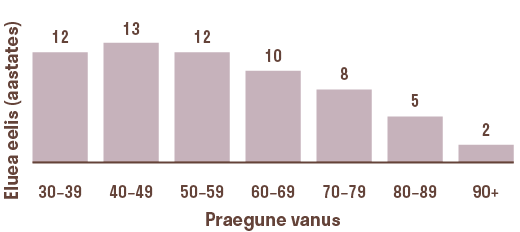
The largest difference occurs among 40–49-year-olds, who have an average life expectancy 13 years higher than that of other occupations. A positive difference remains even in older age groups: five years among those aged 80–89 and two years among those aged 90 and over.
Even more significant is the fact that teachers often remain professionally active to an advanced age. Educational work, with its cognitive demands and high degree of autonomy, enables people to maintain their working capacity well beyond retirement age. This makes education one of the few fields where working in later life is not only possible but also desirable. However, this potential has largely gone unrecognised. In the past, the high average age of teachers drew little attention because labour shortages were less acute. Now that the shortage of teachers has become systemic, those who have reached pension age have become indispensable contributors – yet they are still not regarded as a strategic resource.
This is an anomaly: although the very nature of teaching allows for a longer working life than almost any other profession, the education system remains primarily oriented towards recruiting young people. The issue is not whether teachers should retire – of course they have that right – but whether we know how to value those who wish to continue contributing beyond official retirement age. With population ageing, education could set an example for other sectors by showing how to use the experience and potential of older workers wisely.
ANOMALY 4. The education system is shaped by many voices that are not always in harmony. The education system is both exhausted and pressured by a constant cacophony of interest groups, each voicing its own expectations and demands. Within educational institutions, dozens of actors exert influence: teachers, school leaders, parents, support specialists, school owners, alumni, the media, employers, policymakers, education researchers, communities and international networks. All have their own views and expectations regarding what constitutes good education – and all seek to make their voices heard.
This situation is no accident. Education is a complex system – a living organism shaped by the continual interaction of its parts. Such a system can remain stable even amid change, but sometimes a small shift can lead to vastly different outcomes. Therefore, education cannot be understood by listening only to teachers and pupils; it is also influenced by parents, school owners, officials and even the media, which as a driver of public attention often has a more decisive role than formal decision-making power.
The strength of stakeholder influence depends on three main factors:6
- Need for attention: how quickly and forcefully does the group make its position known? For example, parents have become increasingly demanding, expecting teachers and schools to maintain a work culture of constant availability.
- Impact: how much substantive influence can the group exert? School owners make decisions, but the media can shape public opinion and political pressure.
- Legitimacy: to what extent do groups have the legal or institutional authority to intervene in education governance? School owners do; the media do not – yet the media’s role in steering public debate remains considerable.
In sum, the education system is shaped by many voices that are not always in harmony. The anomaly lies in the fact that numerous, often conflicting forces steer the system simultaneously, without a clear framework of accountability or governance. The result is constant tension: who should decide what constitutes ‘good’ education, and whose voice should ultimately prevail?
ANOMALY 5. Mental well-being as a mirror of systemic strain. The social environment of education is dense, and it remains healthy only up to a limit.7 Teachers and school leaders must manage a vast number of daily social interactions, which makes it extremely difficult to ensure both personal attention and inclusion. For example, in a kindergarten group with 20 children and one teacher, there are at least 210 potential interaction moments each day. When parents and colleagues are added, that number multiplies. The situation is even more complex in schools: a teacher with a class of 24 pupils and 21 contact lessons per week engages in hundreds of interactions each lesson and thousands over the course of a week. Such work requires not only pedagogical skills but also exceptional social intelligence and emotional resilience.
Leadership theory suggests that an effective team size for one manager is 5–15 people, which allows genuine support for each team member.8 However, Estonian school leaders face a very different reality. In the 2023/24 academic year, 25 schools in Estonia had over 1,000 pupils, totalling nearly 31,537 children, or 19% of all pupils in general education. The principal of such a school is directly or indirectly responsible for more than 3,000 people, including more than 1,000 pupils, 2,000 parents, and numerous support and teaching staff. Unlike large enterprises, large schools do not have dedicated departments for finance, human resources and marketing to help manage this complexity.
How loud is the social environment of our schools? High noise levels (over 80 dB) impair concentration and hinder learning, directly affecting the quality of learning outcomes.9
- In classrooms, noise levels typically range from 60–65 dB but can rise to 80 dB.10
- In corridors during breaks, levels often exceed 80 dB.11
- In kindergartens, when two children argue over a toy, the noise can reach 80 dB.12
- In school canteens during lunch breaks, the level can rise to as high as 100 dB.13
For comparison:
100 dB – tractor
90 dB – lawnmower
80 dB – blender or hairdryer
70 dB – busy street
60 dB – normal conversation
Educators’ working environment and the organisation of their work have a direct impact on their mental well-being and carry growing risks. A 2023 study by the Foresight Centre found that teachers are increasingly motivated not primarily by pay but by a supportive work culture.14 This reflects a wider labour market trend – people are ten times more likely to leave a toxic workplace than one that simply offers lower pay.15
Mental health issues affect not only adults. The 2023 Estonian Human Development Report, which focused on mental health,16 revealed that the well-being of Estonian lower secondary school pupils ranks among the lowest in Europe.17 Half of all mental health problems begin before the age of 14 – that is, during school years.18 This makes the school environment a critical factor in the nation’s overall mental health. The issue is not only workload but also systemic preparedness: have we created conditions that enable educators to care for their own mental well-being? If a teacher cannot first ‘put on their own oxygen mask’, they cannot effectively support others. Perhaps the growing strain on well-being and mental health is the strongest signal yet that the old, metrics-centred educational paradigm no longer works – and that the need for a more humanistic, person-centred approach is becoming increasingly urgent.
A PARADIGM SHIFT: THE AGE OF METRICS AND RANKINGS IS COMING TO AN END
For decades, Estonia’s education system has been shaped by a neoliberal paradigm that prioritises performance, standardisation, competition and cost efficiency. It is a system where metrics determine value – whether applied to pupils, teachers or researchers.
The funding of educational institutions often depends on the number of pupils or other indicators related to the school or learner. Results in international assessments such as the OECD’s PISA and PIAAC programmes, along with global rankings, have become the calling card of Estonian education. Meanwhile, the media and parents rank schools according to examination results. Each spring, especially in larger cities, competition intensifies as families seek places in the most sought-after schools, creating considerable pressure around admissions to both primary and upper secondary education.
The same metric-centred logic extends to higher education and research. The number of academic articles, the volume of research grants and the h-index determine whether an academic retains their position. In the Estonian Research Information System, only publications classified in categories 1.1 or 3.1 are recognised as relevant. Lower-category publications written in Estonian may go unrecognised despite their substantive merit. Metrics do not consider for whom or for what purpose research is conducted.
The culture of metrics not only affects content but also fuels increasing bureaucracy. From kindergarten to university, teachers and lecturers find themselves completing reports and applications, often spending more time on paperwork than on teaching, learning or research. Each new performance indicator brings with it another layer of reporting, consuming educators’ time and energy.
This pattern was already described in the 1990s by sociologist George Ritzer19 as McDonaldization – a process through which social institutions, including education, come to resemble the fast-food industry: efficient, predictable, standardised and tightly controlled. The result is that vital themes – well-being, equality, non-formal education or the societal impact of research – are frequently sidelined simply because they are difficult to measure.
A paradigm determines which problems are seen as solvable in the first place. We have now reached a paradigmatic turning point: old and new conceptions of good education coexist side by side. The question is not whether the old will vanish but which new paradigm will take the lead: can a humanist, person-centred and value-based approach finally shift the system’s focus to the individual, to learning and to growth?
A NEW PARADIGM: PLACING THE ART OF BEING HUMAN AT THE HEART OF EDUCATION
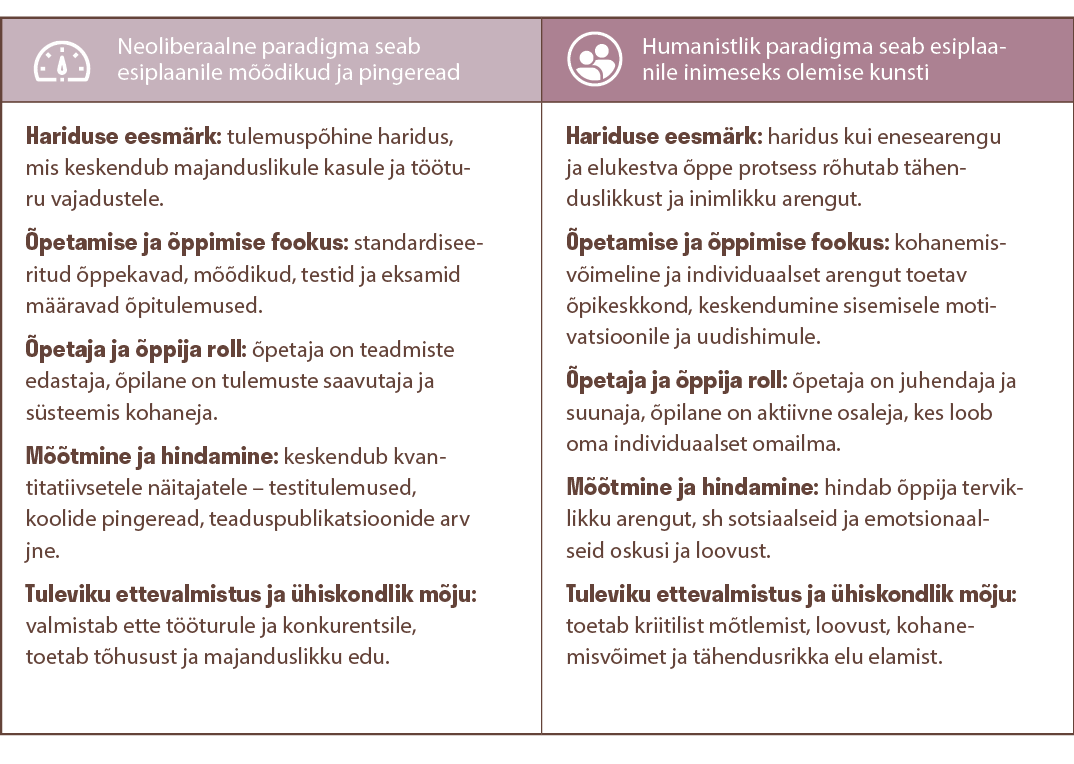
The old educational paradigm is grounded in the belief that a well-functioning system produces measurable, high-level results (Table 1.2.1). The new, humanistic approach instead places the person as a whole at the centre: the goal of education is not merely to transmit knowledge but to cultivate the attitudes and skills needed for life – self-belief, resilience, adaptability and a sense of meaning. Education should nurture not only capable performers but also individuals who can adapt, make sense of their journey and remain true to themselves amid constant change.
The neoliberal mindset viewed school as a preparatory workshop for the labour market, but today’s world of work evolves faster than education can respond. According to the World Economic Forum, creativity, social skills, analytical thinking and lifelong learning are becoming increasingly important – qualities that cannot be taught through facts alone.20 The future demands that people be ready to learn for jobs and roles that do not yet exist.
Education can therefore no longer focus on fixed solutions or standardised competencies. The question ‘Why is education important?’ invites everyone involved – teachers, learners and leaders – to reconsider their roles and purpose. This brings to the forefront deeper questions: what and why do we teach at all? What helps shape a person capable of navigating both their inner world and an ever more complex world? It also requires the ability to let go – not only of outdated content but sometimes of our own role identity. In this sense, learning to learn always requires learning to forget. Perhaps the ones who need to learn forgetting first are not the pupils, but the teachers – and the system itself.
SUMMARY
A paradigm shift occurs when old ways of thinking can no longer explain or sustain a new reality. In education, this means that established practices no longer meet today’s societal needs and are not fit for the future. The transition from one paradigm to another is never smooth – it brings contradictions, value conflicts and clashes of understanding. This tension is clearly visible in Estonian education today: teachers are protesting, parents are challenging school decisions in court, universities are struggling to secure new generations of Estonian-speaking academics, and researchers are caught between two expectations: to serve society while remaining internationally measurable.
Estonia’s education system is approaching change at varying speeds – some institutions are already experimenting with the new, while others still cling to the old. Yet a shared understanding is becoming increasingly evident: things cannot continue as before. The foundation of future-proof education lies not in ready-made solutions but in the willingness to ask essential questions and make decisions that look beyond today’s needs – towards those who are only just beginning their educational journey.