Supporting sustainability in education requires changes not only in content but also in teaching methods
- In Estonian education, sustainability is addressed in diverse and cross-cutting ways, with emphasis on its links with research-informed approaches, values, everyday life and other relevant areas.
- In Estonia, there is insufficient research – including intervention studies – on the impact of how sustainability is taught in general education, environmental education or citizen science. We therefore do not know how effectively sustainability competence is taught, nor do we systematically develop teaching methods on a research-informed basis. Although sustainability is addressed in both formal and non-formal education, this has not led to the desired changes in knowledge, values or behaviour.
- Sustainability competence should be understood as a general competence so that it can be taught in a more integrated way, engaging different dimensions of the psyche. Both environmental education and the expanding field of citizen science offer opportunities to support this approach.
INTRODUCTION
Never before in history has humanity come so close to exceeding the limits of renewal of resources essential for its existence. At the same time, we have never possessed such extensive knowledge about how people learn, what learning entails as a cognitive process and how the development of deep understanding can be supported on a research-informed basis. Sustainability relates to learning and education in two ways: through the content that is taught and through the way learning itself takes place.
In what follows, we use the term ‘sustainability (competence)’ throughout. When referring to environmental awareness studies, we use the terms ‘environmental responsibility’ or ‘environmental awareness’. In addition to examining how sustainability topics are addressed in general education, we also consider participation in environmental education programmes and citizen science. Both are increasingly common ways of addressing sustainability in Estonia, but their impact on sustainable thinking and action has not been systematically studied.
SUSTAINABILITY IS ADDRESSED IN DIVERSE WAYS IN ESTONIAN EDUCATION
In the national curriculum for basic schools, sustainability themes are articulated at several levels. First, they appear among the foundational values of basic education. Under societal values, environmental sustainability is emphasised, and it is stated that individuals with basic education contribute to the ecological development of Estonian society.
Second, sustainability is included among the general competences under cultural and value competences, which include the ability to perceive and value natural diversity and one’s connection to nature. The expected competences at different stages of schooling indicate that by the end of the first stage, pupils act in ways that protect nature; by the end of the second stage, they value a sustainable lifestyle, are able to formulate scientific questions, obtain scientific information, behave appropriately in nature, and show interest in nature and its study; and by the end of the third stage, they understand the relationship between humans and the environment, act responsibly towards their living environment, and live and act in ways that conserve nature and the environment.
Third, sustainability is included among the cross-curricular themes,a notably ‘Environment and sustainable development’. This theme aims to shape pupils into socially active, responsible and environmentally aware individuals who protect the environment and, valuing sustainability, are prepared to seek solutions to environmental and human development challenges.
Despite the cross-cutting presence of sustainability in the curriculum, the Estonian pilot study on pupils’ environmental awareness (2024)1 indicates that, across various dimensions, young people’s environmental responsibility is lower than that of adults.2 Since the sampled pupils should reflect the same overall population, this result may have several explanations. Theoretically, one might conclude either that children do not simply mirror their home environment or that they respond more honestly. This raises the question of whether sustainability competence is taught in a sufficiently comprehensive and systematic way to counter other societal influences.
Research has identified a range of affective, cognitive and attitudinal factors that predict sustainability-related competences, including behaviour. These include knowledge, systems thinking, self-efficacy, risk perception, perceived behavioural control, autonomous motivation, life aspirations, personal responsibility, behavioural intention, personal attitudes and social norms (see also Article 6.1).3 Interventions that support the development of sustainability competence have also been extensively studied and systematised. In adult samples, these include information provision, inducing cognitive conflict, supporting commitment and goal-setting, feedback, social modelling and prompting, rewards and sanctions, and facilitating choices (nudging).4 In child samples, effective approaches include environmental education, social influence, eco-schools (such as the Green School programme) and combinations thereof.5 Both Estonian and international research suggests that a range of educational interventions can support sustainability-related competences. Estonia’s long-standing environmental education system, which provides learning experiences distinct from those of formal schooling, was established precisely to broaden and deepen sustainability themes in the general education curriculum.
A closer look at how sustainability is framed in the curriculum suggests that it cannot encompass all aspects examined in research, either in terms of content or teaching methods. However, certain themes that function as indirect influences could receive greater attention.
First, the teaching of sustainability competences could more explicitly address motivation related to environmental responsibility and self-regulation.6 Participation in citizen science, for example, builds on individuals’ intrinsic interest and motivation. International studies show that key motivations for engaging in citizen science include not only contributing to science but also recognising the intrinsic value of nature and wishing to support practical conservation efforts.7 Estonian environmental awareness studies likewise indicate that autonomous motivation – the sense that environmental protection is personally important and aligned with one’s values – is most strongly associated with sustainable behaviour. Pressuring individuals in any form, such as inducing guilt, fostering excessive competition or promoting rushed and superficial learning, tends to undermine autonomous motivation and limit internally driven efforts to regulate behaviour sustainably.
Second, although deep, internalised knowledge forms the cornerstone of pro-environmental values, motivation and self-regulation, it is not the whole picture. Equally important are the so-called ‘warm’ affective dimensions of environmental responsibility – emotions arising from positive experiences in nature, such as fascination, excitement, a sense of connection to nature8 and nature contact.9 The first of these is particularly strengthened through active and mindful engagement with nature, rather than merely being present in it.10 Negative experiences, such as indignation or sadness in response to environmental degradation,11 are also significantly related to the sustainability of individual behaviour. Estonian datasets contain limited research on the extent to which the education system supports these ‘warm’ variables or recognises which learning practices the scientific literature identifies as conducive to their development.
Third, Estonian education appears to devote limited attention to pupils’ epistemological beliefs – their understanding of the nature of knowledge and of how scientific inquiry works – even though these are important predictors of the acceptance of science-based practices in society.12 Citizen science offers one possible avenue here, providing pupils with hands-on and minds-on experience in conducting research and reflecting on the research process (see ‘Citizen science as an opportunity to strengthen scientific conceptual thinking’).
Fourth, the intrinsic value of nature also requires attention. Although it is mentioned under value competence in the curriculum, it remains unclear how this idea is addressed in general education and how it is supported in ways that cultivate the ‘reverence for life’ referred to there.
THERE IS INSUFFICIENT RESEARCH IN ESTONIA ON THE EFFECTIVENESS OF TEACHING SUSTAINABILITY COMPETENCE
There is limited evidence on the impact of efforts to develop sustainability competence within the Estonian education system. How has work undertaken in general education, as well as various interventions and programmes, influenced sustainability-related competences?
One possible explanation for the limited development of sustainability competence is that merely including sustainability topics in the curriculum is not enough. We must also ask how these topics are taught. The didactics of sustainability competence may require targeted research and development, as suggested by the European Union’s research-informed sustainability competence framework, GreenComp.13 GreenComp organises sustainability competences into four broad areas: 1) embodying sustainability values, 2) embracing complexity in sustainability, 3) envisioning sustainable futures and 4) acting for sustainability. Developing these sub-competences likely requires more time and sustained engagement than pupils typically receive when addressing these topics in Estonian schools. One notable exception is Rakvere State Upper Secondary School, which has adopted a significantly deeper approach to teaching complex interrelated systems.14
What additional data would help us better understand how sustainability is taught? Based on existing evidence and research, what changes could be made in education to better support sustainable ways of thinking and living? Learning about sustainability likely requires drawing on research-informed knowledge about how to teach complex phenomena. Although education increasingly emphasises deep learning and constructivist approaches, pupils’ awareness and use of deep learning strategies remain limited.15 Superficial learning – in which pupils fail to develop a deep understanding of interconnected systems – is unlikely to generate meaningful motivation to live within the limits of nature’s regenerative capacity or to recognise the intrinsic value of nature.
There is currently limited discussion in Estonian general education about how to teach complex systems such as ecosystems and biogeochemical cycles, even though research indicates that these require different approaches from phenomena that are directly perceptible.16 Although studies on teaching such systems have been published in other countries,17 the authors are not aware of any research examining Estonian teachers’ knowledge or skills in this area. Nor have longitudinal or comparative intervention studies been conducted to assess the effectiveness of different methods for teaching complex systems, and there is no evidence on the extent to which such methods are used in teaching sustainability topics in Estonian schools.
Although data from environmental awareness studies among the general population and pupils suggest that general education may not sufficiently support sustainability competence, the available evidence is limited and does not allow firm conclusions. While these studies show cross-sectional associations between environmentally responsible behaviour and various factors – some of which are shaped by the education system – they do not establish causality. To the authors’ knowledge, changes in various aspects of environmental awareness have not been examined in longitudinal or intervention studies alongside other relevant variables.
One hundred years of supporting sustainability competence. In Estonia, environmental education is not merely an extracurricular activity in the conventional sense. The country has more than a century of experience in environmental education and in developing environmental education centres aimed at supporting nature learning and contact with nature for all children and young people. The system of out-of-school nature education grew out of two sources: the nature conservation system and natural history museums in Tallinn and at the University of Tartu.
In 1910, Estonia’s first nature reserve was established on the Vaika Islands. Its founder, Artur Toom, was also among the first in Estonia to promote nature education for children. The reserve later expanded and became Vilsandi National Park. In 1952, the Estonian Young Naturalists’ Station was founded as a voluntary initiative, laying the foundations for today’s Tartu and Pärnu Nature Houses. In 1962, Jaan Eilart began developing nature study trails that linked outdoor learning with conservation and became central to nature education. The contemporary model of environmental education programmes took shape in the 1990s at Sagadi Nature School, where teachers organised summer camps focused on studying nature. Subsequent programmes were designed not only to provide extracurricular activities for children who chose to participate but also to support the national curriculum for all pupils. These programmes, centred on learning in authentic environments, continue to develop.
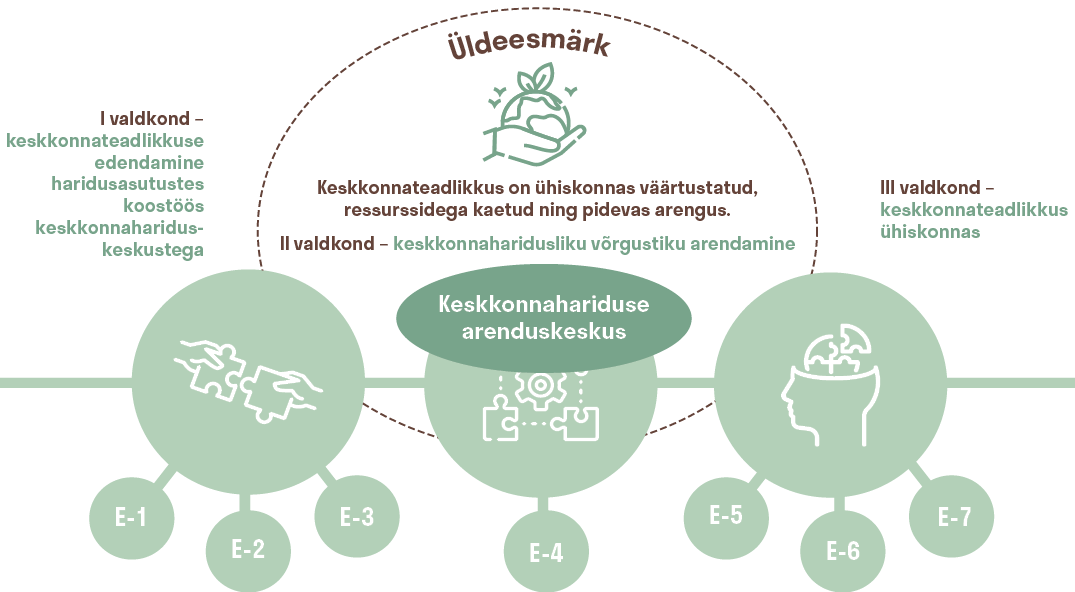
Today, 70% of pupils visit a nature education centre at least once a year. This is likely too infrequent to support the sustained development of sustainability competence. Research on memory suggests that even a high-quality but brief programme cannot produce lasting learning if reflection on the topic is limited to a single occasion. The move towards greater systematisation and research-informed development is illustrated by the first action plan for environmental education and awareness adopted in 2018 (see Figure 6.4.1). A quality assurance system has since been developed in cooperation between the Ministry of Climate, environmental education experts and universities, including a competence model for instructors, a self-evaluation framework and comprehensive guidance materials.19
Assessing impact ideally requires randomised controlled designs with multiple measurement points. To date, however, no studies have examined the impact of environmental education on environmental awareness using such methods.
UNDERSTANDING SUSTAINABILITY AS A GENERAL COMPETENCE AND FOCUSING ON THE TEACHING OF COMPLEX SYSTEMS WOULD SUPPORT A MORE INTEGRATED APPROACH
One possible future direction would be to treat sustainable thinking and action not merely as a thematic topic but as a general competence – a cross-disciplinary competence essential to personal growth – since, for individuals, it is likely to be as existentially significant as other general competences. Like other general competences, sustainability competence should be understood as a combination of knowledge, skills, behaviours, motivation, emotions, values and self-regulation. In research on environmental awareness, psychological perspectives have increasingly complemented sociological ones.20 This shift also highlights an important distinction: although individual knowledge about environmental issues is often associated with the level of formal education, the two are not the same. Knowledge is domain-specific, and higher education in one field does not necessarily entail an understanding of complexity in another.
Research on thinking indicates that knowledge about phenomena that are not directly perceptible – such as ecosystems, climate systems or biogeochemical cycles – may be constructed in qualitatively different ways. This insight is particularly relevant for sustainability, since sustainable ways of living require an understanding of interconnected systems. Over a few centuries, contemporary society achieved social and economic prosperity at the cost of exceeding environmental and planetary limits, a fact recognised only recently. At the same time, some societies do not exceed their ecological limits, even though they could. Living beyond nature’s regenerative capacity is therefore not a universal human condition but a culture-specific phenomenon. It is characteristic of our society that its functioning is rarely understood within the framework of natural processes.
At least three modes of thinking about non-perceptible phenomena can be distinguished.21 First, complex phenomena may be understood through everyday conceptions or misconceptions, with inferences drawn from ordinary experience or analogy (for example, ‘global warming is caused by a greenhouse-like layer in the atmosphere’ or ‘if CO₂ emissions stopped, warming would immediately cease’). Second, thinking may be based on scientific conceptions, meaning that intuitive judgements are inhibited by representations based on scientific understanding (for example, ‘global warming results from an increased concentration of molecules in the atmosphere that trap heat energy’ or ‘climate warming is an inertial process’). Third, systemic concepts-level thinking is possible, whereby a person can reason within multiple scientific conceptual systems at once and understand their interactions (‘the climate system is a dynamic whole formed by the interaction of multiple spheres’). Systemic concepts-level thinking involves understanding how system components relate to one another, how the system develops and functions dynamically, and what emergent phenomena arise; thinking in systemic concepts also means that considering one aspect of the system activates related aspects in the mind (for example, ‘continued degradation of the biosphere brings the climate system closer to tipping points’).
Failure to recognise these differences in modes of thinking may itself contribute to sustainability crises. For thinking in a given domain to become scientifically grounded, learning must proceed at a pace that supports conceptual development and explicitly addresses common misconceptions – cognitive traps embedded in everyday reasoning. In fast-paced learning environments, the underlying nature of phenomena often remains superficially understood in everyday terms,22 and this superficial understanding may go unnoticed by both learners and teachers. It is therefore not merely the possession of facts but the structure of knowledge that determines the depth of understanding in environmental matters.
Although a comprehensive account of how to teach complex systems and support systemic concept-level thinking would require detailed explanation, several guiding principles can be outlined. All learning – and especially the learning of systems characterised by feedback loops, non-linearity, emergence, interdependence, self-organisation, cumulative effects and time delays – requires learning environments in which pupils construct knowledge with teacher guidance,23 become aware of their implicit misconceptions24 or knowledge gaps and, ideally, engage in deliberately designed ‘productive errors’.25
Such instruction may include:
• solving problems that learners cannot yet independently resolve, even with effort;
• predict–explain–observe–revise–explain task sequences;26
• constructing complex models independently;27 or
• using agent-based models and simulations that help learners understand the functioning of individual system components and the system as a whole, the interrelations among components and system outputs,28 while also reducing cognitive load.
It is equally important that the properties of complex systems are made explicit and discussed during learning. In other words, interactivity and the co-construction of knowledge are integral to effective learning. A shared feature of these approaches is sustained dialogue and discussion, without which conceptual change is unlikely. These methods are particularly effective for complex topics – though not necessarily for simpler ones – and especially for themes that are not readily grasped through everyday experience or that run counter to common intuitions. Here, improved outcomes refer to more accurate conceptual understanding of the phenomenon or process in question and a stronger ability to transfer this knowledge to new contexts.
SUMMARY
The concept of sustainability can be seen as one of the central intellectual axes of education. Ecological sustainability – like the preservation of our linguistic space – could be regarded as a foundational value shaping how we perceive and interpret the world, something to be consciously sustained rather than taken for granted. A next step in supporting sustainability competence in curricula and schooling would be to recognise it as a core general competence rather than merely a cross-cutting theme that may remain peripheral within subject teaching. For example, history in general education is rarely taught in connection with ecological dimensions that are inseparable from sustainability. Such a shift would open broader discussion on the nature, development and research of sustainability competence.
A second direction would be to support sustainability learning explicitly through the teaching of system-level thinking. Understanding sustainability involves not only acquiring a more complex knowledge base but also developing different modes of thinking, greater awareness and regulation of one’s own thought processes, and learning approaches that are based on research-informed teaching of interconnected systems. Equally important are deep, emotionally engaged and attentive experiences in nature, alongside learning to recognise the intrinsic value and dignity of nature. Without an affective dimension, sustainability competence remains incomplete.
Third, for various reasons, sustainability education in Estonia has not yet, in any context, been subjected to systematic evaluation of its impact. Initiatives in general education, environmental education and citizen science require robust research designs – ideally including randomised controlled studies – as an integral component. This presupposes the development or adaptation of reliable assessment tools, ranging from observation protocols and scales to instruments that measure conceptual change in understanding complex systems. For example, it has been suggested that museum education in Estonia may currently be more innovative than formal education. This remains a hypothesis until comparative studies assess long-term, transferable knowledge gains and sustained behavioural change across different methods.
Citizen science as an opportunity to strengthen scientific conceptual thinking. Citizen science refers to the involvement of the public in research, specifically the formulation of hypotheses, conduct of research, collection of scientific data or data analysis in which members of the public, as individuals or groups, participate. Most citizen science projects are led by researchers, and volunteers often contribute primarily through data collection. Some initiatives, however, involve volunteers in defining research questions, analysing data or even initiating projects. Many conceptualisations emphasise the educational dimension. Studies indicate that participation most strongly affects knowledge and attitudes, less frequently skills and more rarely behaviour, such as engagement in conservation or lifestyle change.32
The societal benefits of citizen science may be scientific, educational and more broadly social. A pan-European study assessing the contribution of citizen science projects to the Sustainable Development Goals found that quality education ranked second and climate action third among their impacts.33 On the western coast of the United States, coastal bird observers showed increased knowledge and stronger connections to both community and environment, which were associated with more sustainable behaviour.34 In the Netherlands, citizen scientists reported valuing nature experiences and the emotional satisfaction they provided.35 Although comparable studies of Estonian initiatives, such as bird monitoring or the nature observation marathon, are lacking, similar effects on sustainable behaviour can reasonably be expected.
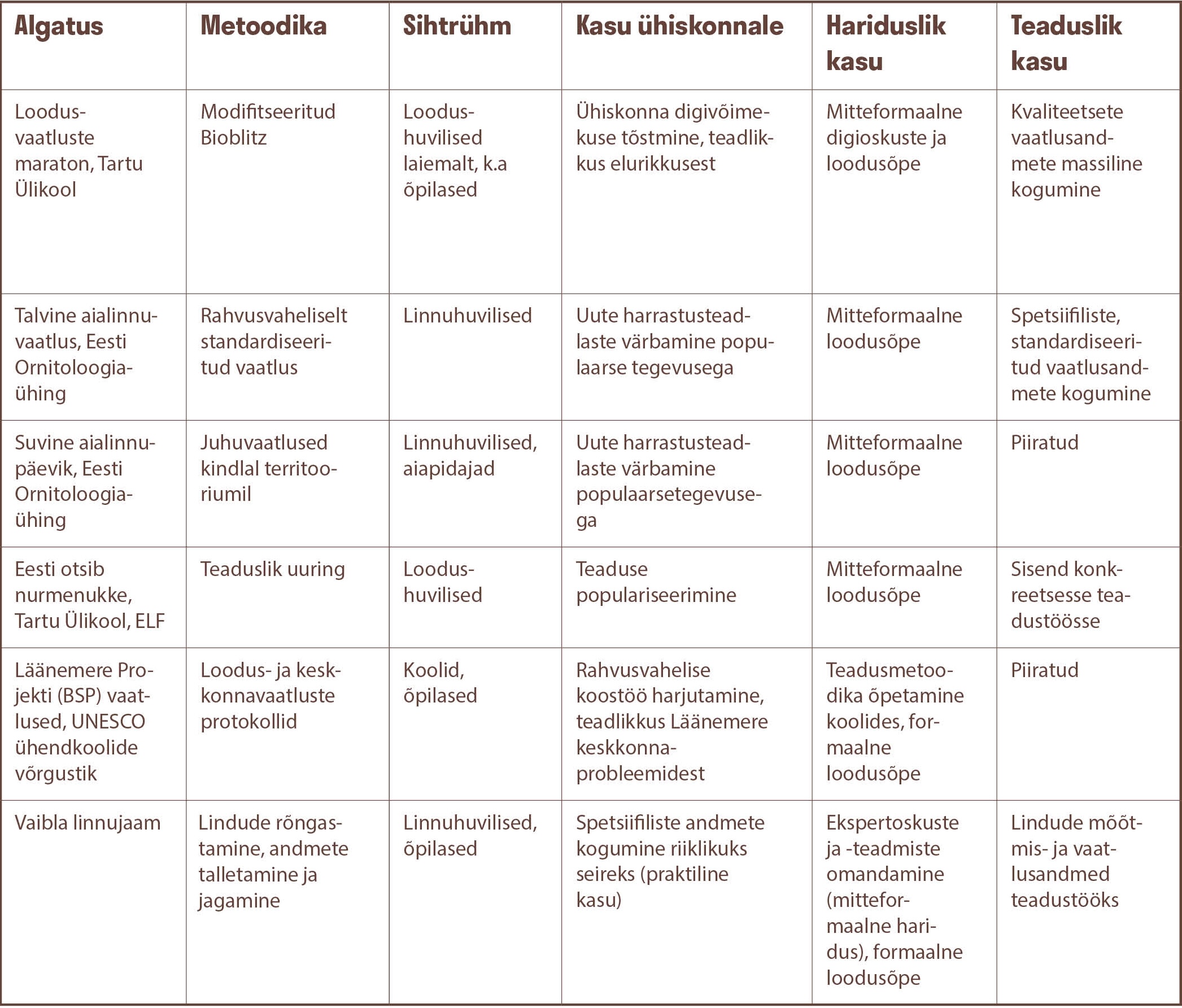
Currently, citizen science in Estonia primarily supports non-formal education (Table 6.4.1) by motivating participants to acquire knowledge and skills. Interest-based engagement in areas such as bird observation or astronomy may prompt deeper learning in languages, natural sciences or technology. Participation in organisations such as the Estonian Ornithological Society also develops social and leadership skills. Because such activities are often sustained over time, citizen science can provide a durable form of learning. In formal education, however, links with citizen science remain more fragmented, but international research has identified four profiles describing how pupils contribute to scientific work.36 In Estonia, environmental projects play an important role in schools, although integrating them into the rhythm of schoolwork can be challenging (Table 6.4.1). For example, the nature observation mini-marathon was adjusted to school timetables, which increased participation. Teacher support and training are crucial for integrating citizen science into formal education. Pupils’ research projects represent one of the strongest formats for meaningful scientific contribution. Table 6.4.1 presents examples of educational and scientific benefits, illustrating how citizen science can support the development of scientific conceptual thinking.