The foundations of education: Human capital, strong institutions and the will to pursue education
- The will to pursue education reflects a society’s values and its commitment to invest in education.
- A strong correlation exists between a nation’s economic prosperity and the average intelligence score of its population.
- The substance of education is shaped not only by formal schooling but also by the experiences of everyday life.
INTRODUCTION
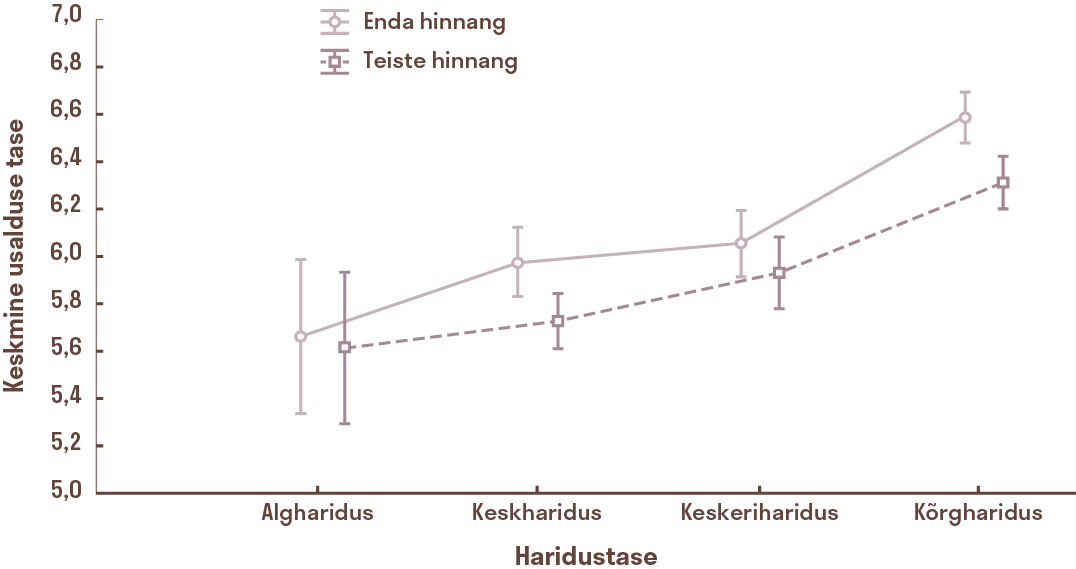
Education is the sum of knowledge, skills, competencies, attitudes and behavioural norms that a person acquires over a lifetime, including through formal learning in educational institutions. However, education can also be seen as the capacity to shape a better world. Better educated people tend to experience fewer social frictions; they are more likely to trust others. This relationship between education and trust is illustrated by a study conducted by the Estonian Biobank at the University of Tartu (Figure 1.1.1).
The relationship between trust and education level indicates that, beyond preparing individuals for specific occupations, a key function of education may be to cultivate democratic culture and a sense of citizenship. A strong argument can be made in favour of education: it enhances a person’s skills and knowledge, which in turn improve well-being.1 When skill-based measures of knowledge capital are taken into account, the explanatory power of long-term economic growth models increases to three quarters. Models that omit skills explain only one quarter of growth.2 Education thus builds individuals’ knowledge and skills and is directly linked to both individual well-being and national economic growth.
In what follows, we explore how, in Estonian society, the will to pursue education has inspired motivation to study, how knowledge and skills have created potential, and how supporting institutions have enabled that potential to be realised.
THE WILL TO PURSUE EDUCATION: A READINESS TO INVEST IN EDUCATION ROOTED IN SOCIETY’S CORE VALUES
The will to pursue education is a driving force – a locomotive of progress – as education remains deeply embedded in Estonia’s value system and is seen as a pursuit worthy of sustained effort. A historical example is the fundraising campaign for the Estonian Alexander School – a nationwide initiative to establish an advanced Estonian-language school – which by 1888 had collected 100,000 roubles in voluntary donations. Throughout Estonian history, education has been a vital tool of self-determination and advancement. In the most difficult times, a good education was regarded as both a hallmark of national culture3 and a testament to the deeply held belief that knowledge is essential for success.4
The importance attached to education in Estonia is reflected in the fact that educational expenditure exceeds the European Union average by about one quarter and is higher than in most member states, ranking below only Sweden and Belgium. Moreover, the share of education expenditure in Estonia’s total government spending is the highest in the European Union, exceeding the EU average by 50%, which demonstrates a long-term commitment to funding education. Estonia’s education spending has remained relatively stable, consistently standing 20–30% above the average.5
The will to pursue education can also be shaped by compulsion. In 1965, the Soviet Union introduced compulsory eight-year schooling. By 1960, a policy of mass secondary education had been adopted, and by 1980, 99% of 18-year-olds had completed secondary education.6 Completion of compulsory schooling, or basic education between the ages of 7 and 18, serves as one indicator of the will to pursue education. According to a 2001 audit by the Estonian National Audit Office, 98.4% of children in Estonia with normal intellectual ability met the compulsory education requirement. In the 2023/24 academic year, 94.7% of lower secondary graduates continued their studies.7 Among Estonia’s 25–54-year-old population, 46% have completed secondary education – slightly above the EU average of 43.4%8 – indicating a willingness to pursue education beyond the compulsory level, although the share remains notably lower than in Slovakia, the Czech Republic, Croatia and Poland.
Education holds both symbolic and practical value. For many people, higher education is important not only for expanding professional opportunities but also as a means of self-realisation and social recognition. Completing a university degree is often associated with self-esteem and social status. Parents, too, take pride in their children’s achievements. For the older generations, supporting education is both a duty and a means of ensuring a secure future for their children and grandchildren, while younger generations see it as a path to a broader worldview and a stronger career.
Perhaps the clearest expression of Estonia’s will to pursue education is reflected in the quality of its universities. Admission remains competitive in many fields, and the most reliable indicator of university quality is research performance. Comparing countries by scientific impact or research performance, measured by the average number of citations received per published article, Estonia ranks among the five most successful nations in the world.9 Notably, Estonia’s strong position in science has not been achieved through exceptional performance in a single discipline, but through a consistently high level of development across all fields of research.10
NATIONAL WEALTH AND THE AVERAGE INTELLIGENCE SCORE OF THE POPULATION
One of the cornerstones of education is human capital – people’s abilities, skills and knowledge. Studies of human capital drive educational innovation by identifying the key points where resources need to be adjusted or processes restructured. As early as the 1930s, Estonian education leaders set out to study the intellectual abilities of Estonian children and to reform the education system accordingly. School director Juhan Tork was assigned to measure children’s intelligence, completing the task with distinction and defending his doctoral dissertation, The Intelligence of Estonian Children, in 1939.11 Tork’s conclusions were encouraging because his results showed that Estonian children’s cognitive abilities matched, and in some areas even exceeded, those of their peers in the United States and the United Kingdom.
Researchers studying cognitive abilities noticed more than half a century ago that the average scores on the same intelligence tests tended to increase over time across countries – a trend later termed the Flynn effect.12 Because all the original test sheets from Tork’s study had been preserved in the archives, Olev Must was able to repeat the same test with Estonian children of the same age 63 years later.13 The results showed that although contemporary children perform less well in mental arithmetic, they were more adept at solving logical problems, and overall there was no significant improvement in scores over the half century.
The Second World War and subsequent Soviet occupation brought several adverse demographic processes, making it important to reassess the cognitive abilities of modern Estonians. This question was addressed in a study by Helle Pullmann,14 which found that although the developmental trajectories of cognitive abilities differ across Estonia, Iceland and the United Kingdom, by around age 14 Estonian children are as capable as, or even more capable than, their peers in those countries.15
One might assume that it hardly matters that, for nearly a century, the mental abilities of Estonian children have matched those of children in advanced Western societies. Yet this helps to explain why Estonian pupils perform so well in international PISA assessments.16 The link is not surprising, as national average intelligence scores are strongly and directly correlated with mean results in education studies such as PISA, TIMSS and PIRLS.17 Although the interpretation of these results has been debated, the underlying fact remains: there is a very strong correlation between a nation’s economic prosperity and the average intelligence score of its population.18 No highly prosperous country has citizens with consistently low cognitive ability. Researchers agree that the growth of modern economies depends less on geography or natural resources than on the twin engines of technological development and human capital, the latter encompassing people’s ability to use new technologies effectively.
EDUCATION IS SHAPED BOTH BY FORMAL SCHOOL AND BY LIFE EXPERIENCES
An important question for the school as an institution is the pupil–teacher ratio, or the number of pupils a teacher must manage. Estonia’s Basic Schools and Upper Secondary Schools Act sets the upper limit for class size in basic school at 24 pupils, which may be increased by decision of the school’s governing body. Existing data show that excessively large classes lead to a moderate decline in academic performance.19 Evidence indicates that when the pupil–teacher ratio is reduced from 1:30 to 1:25, the return on education rises by 0.4 percentage points.20 However, there is no evidence that 1:24 is an optimal ratio. International data suggest that the negative impact of class size is mainly observed in countries where teachers’ salaries are low and the quality of education is poor.21 There is also evidence that school quality – including pupil–teacher ratios and average teacher pay – affects learning outcomes, at least in large countries such as the United States.22 Overall, class size has an impact on academic performance, but the optimal number of pupils per class depends to a large extent on teacher salaries and the overall quality of education.
Formal education institutions play a central role in learning. However, pupils’ academic outcomes, such as PISA test scores, cannot be attributed solely to the school system, teachers and curricula. When the 2016 PISA results placed Estonian pupils among the world’s top performers, representatives of the Ministry of Education and Research interpreted this as proof of the strength and equal accessibility of Estonian education.23 The same interpretation was repeated after the publication of the 2018 results, which were presented as a major achievement of Estonia’s education system.24 Foreign observers have echoed this view to varying degrees.25 Unfortunately, this interpretation is not well supported by evidence.26 The limitation lies in the fact that Estonian pupils’ high performance depends on several factors, among which the quality of formal education institutions is certainly important but not the sole determinant.
The establishment of formal education institutions does not diminish the role of other institutions; on the contrary, it raises expectations of them. Parents are expected to prepare their children for school by, for example, teaching them the alphabet. It is also assumed that part of schoolwork is done at home. Education obtained outside formal institutions – through the family, peers or practical experience – is often referred to as the ‘school of life’.
For example, a comparative study of pupils’ academic success in 31 countries27 found that academic achievement was higher in countries where children had larger home libraries. Estonian children had, on average, 218 books at home, compared with the international average of 160. Naturally, the number of books – many of which the children may never have read – does not in itself make them more intelligent, but it does likely reflect the activities and values practised in their homes. This also serves as a reminder that correlation does not imply causation. Nevertheless, there is no reason for pessimism: in complex systems where everything is interconnected, identifying clear causal links is rarely possible.
When comparing the impact of school type – so-called elite schools versus ordinary schools – on Estonian pupils’ PISA results, any difference disappears once parents’ education and household wealth are taken into account.28 However, the question of whether Estonia’s 28 state secondary schools provide a better education than other schools still requires further research.
The ‘school of life’ can encompass work experience, social learning, community knowledge and cultural practices that impart skills and understanding. For example, in the case of sex education, informal learning often runs ahead of the official school curriculum. Peeter Tulviste examined how schooling shapes thought, showing that the transition from everyday to scientific reasoning occurs primarily at school.29 Compared with the traditional societies he examined during his expeditions, many of the functions once performed by schools have now been assumed by families. It is now common for children to learn to read, or at least to recognise letters, before starting school, whether in kindergarten or at home. Whereas once a child encountered scientific concepts only after entering school, the growing complexity of life has brought such exposure earlier.
Too often, the quality or shortcomings of education are assessed narrowly through practical outcomes – for example, by noting a shortage of vocational schools producing welders or crane operators with sufficient skills. What critics of this situation often fail to recognise is that a narrow focus on occupational training would limit the broader educational mission. The aim here has been to show that education has wider functions whose importance for both society and the individual far exceeds that of specific occupational skills or competencies. Employers must accept that the existence of schools will never absolve them of educational responsibilities and that many practical skills and forms of knowledge are best acquired through work itself.
SUMMARY
Discussions of education often focus solely on educational institutions, the people working within them and the activities they undertake. This article emphasises the need for a broader perspective, as no educational institution can function without learners’ will to pursue education and the ability to acquire knowledge. Generations of Estonians have shared the understanding that education matters and that it is a national value. Just as the will to defend the country is not only about weapons but also about people’s determination to use them in the face of foreign aggression, the will to pursue education determines how strongly people wish to pursue education, whether through formal study or independently.
History has shown that the will to pursue education has helped the nation grow intellectually and culturally even in difficult times. Estonia has invested more in education than many other European countries, and its education expenditure exceeds the European Union average. Higher education is valued not only for its professional benefits but also for its contribution to personal development and social standing.
The development of educational quality is closely linked to human capital – the intellectual potential and skills that form the basis for economic and societal progress. While celebrating Estonian pupils’ strong PISA results is entirely justified, it is too often forgotten that their success also depends on inherited and home-acquired abilities, skills and knowledge, without which such achievements would not be possible. It is essential that education not be limited to teaching vocational skills but also foster broader personal and social values.
The foundations of education – human capital, institutions and the will to pursue education – form the bedrock on which a successful and sustainable society is built. All three must work in harmony for education to function and develop. The will to pursue education is the path that leads into the landscape of knowledge, human capital is the intellectual force that drives each step forward, and strong institutions are the bridges that support and guide the educational journey.