Introduction
We know, but do we dare?
- Education is the foundation of Estonia’s strength, but deepening inequality is eroding it. The most important question facing Estonian education is not whether to focus on fostering excellence or supporting those who fall behind. The question is whether we can build an education system that does both at once: one that allows talented learners to thrive without leaving anyone behind. Educational inequality affects not only schools but also extracurricular education, which should be one of the most effective educational and social investments we can make, because it improves learning outcomes and reduces risk behaviour among young people.
No area of government is untouched by educational inequality. It reaches into health and the labour market, social welfare services and the justice system, family relationships and people’s sense of security. Children who are overlooked do not remain invisible – they reappear on hospital waiting lists, in police statistics, in cases of domestic violence and in social assistance registers. The question is not whether inequality will impose costs on society, but when the bill will come due and what price we will have to pay.
- Smart education must support smart development across Estonia. Estonian education is internationally recognised, but our real challenge is not reaching the top of the rankings. More important than international comparisons is ensuring that education drives development across Estonia, not only in a few major urban areas. Although our educational indicators are strong, this is not sufficiently reflected in people’s health or in the country’s economic development.
- We know a great deal; now we need the courage to take responsibility and act. Education is one of the most extensively researched and evidence-based fields in Estonia – we have more knowledge, data and analysis than we can fully process. The problem is no longer a lack of knowledge but the failure to translate existing knowledge into decisions. Responsibility is dispersed among different actors and is too often subordinated to day-to-day politics, making research a substitute for action rather than a catalyst for it. We know the problems exist; what we need are decisions that turn knowledge into action.
- As a digital state, Estonia is not using its full potential in education. Estonia’s digital data infrastructure is world-class, but its use in education remains limited. Data are not used effectively enough to identify problems early and respond in time. Data protection barriers and limited data literacy prevent the full potential of the digital state from reaching education. We have built our data protection walls so high that we have forgotten whom and what we are actually protecting. The state has ended up protecting itself from itself.
- Estonian education needs a healthy subtraction exercise. We have become accustomed to asking what more schools should do. Today, a more important question is what schools should no longer be expected to do. Every new responsibility added to education comes at the expense of something we have not had the courage to remove. One of the first things to suffer is teachers’ ability to serve as role models. Today’s young people no longer grow up under the authority of teachers and parents alone, but within a global network of influences. Teachers compete with social media influencers and artificial intelligence; they cannot be motivators unless they are also role models. Relationships are the new currency of education, and teachers need time to build meaningful relationships – from early childhood education through to university.
LEARNING THE ART OF BEING HUMAN
On a sunny day in May, under the watchful eye of the then elected earthly representative of the legendary Seto king Peko, a discussion took place in Obinitsa about the future of Estonian education. Among the assembled adults sat two sofafuls worth of pupils from the Obinitsa community class of Setomaa School. When the children were asked what made them happy at school, the first quick answer left the adults momentarily speechless: ‘What makes me happy is doing mathematics!’ After a brief pause of surprise, the adults asked: ‘Why mathematics?’ The child replied: ‘Because I understand it.’
That day, a child from a remote corner of Estonia answered a question that has occupied philosophers for centuries: what is the purpose of human existence? It is to achieve happiness, though not in a hedonistic sense, but through personal growth. The ancient Greeks called this eudaimonia – the fulfilment of a person’s unique potential and the attainment of inner maturity.1 Eudaimonism is not the same as hedonism: it does not prize momentary pleasure, but rather a person’s growth into the best version of themselves.2
Thus, when a child encountered a profound question, the adults were reminded that the purpose of education is understanding. Education makes people happy when it enables them to make sense of the world.
According to the Education Act of the Republic of Estonia, the purpose of education is to create favourable conditions for the development of the individual and society, shape individuals who respect and abide by the law, and create opportunities for everyone to engage in lifelong learning.3 Education is therefore both personal growth and growing together with others – learning how to become fully human, because a person cannot be fully human in isolation from society. That is why this Human Development Report is titled Education Reflected in Society.
Understandably, this is no easy task. Our education is based on yesterday’s experience, yet pupils will live in a future that we cannot yet fully imagine. How do we prepare people for the unknown? This is why education is more than the transmission of knowledge. It is about nurturing curiosity and a desire to learn, so that people can remain adaptable as the world around them continues to change.
Thirty years ago, on 21 February 1996, President Lennart Meri announced the Tiger Leap programme on an Estonian Television broadcast. This bold initiative, which aimed to equip all Estonian schools with computers and internet connections, laid the foundations for the country’s development as a digital state. As he put it: ‘The entire story of personal growth is really nothing more than the ability to store information within ourselves and to pass it on as accurately and as free from noise as possible.’4
Where social change once unfolded so gradually that people scarcely noticed it, we are now racing from one transformation to the next within a single generation. An 80-year-old Estonian, for example, has lived through changes of political regime, several education systems, the emergence of the internet and social media, the spread of smart devices and now the rise of artificial intelligence. Thirty years ago, Estonia dared to leap into the future on the back of a tiger. Today, we stand at the threshold of another leap – into the age of artificial intelligence. That is why we must continually relearn the art of being human.
EDUCATION IS THE FOUNDATION OF ESTONIA’S STRENGTH, BUT DEEPENING INEQUALITY IS ERODING IT
While Estonians have a habit of downplaying their successes, the view from abroad tells a different story. The Economist describes Estonia as a country where education is not a privilege but a national responsibility.5 The BBC writes that Estonia is emerging as ‘Europe’s newest education powerhouse’.6 According to the OECD, Estonia shows how education can be delivered intelligently rather than expensively.7
Until now, Estonian education has been a success story. Yet a central theme running through this Human Development Report is the need to recognise educational inequality. It is in Estonia’s interest that even those with the weakest starting points are able to succeed in life.
CHILDHOOD INEQUALITIES SHAPE LIVES
We are facing growing educational inequality in general education, adult education and extracurricular education alike. Parents’ income is increasingly associated with their children’s educational outcomes. Between 2017 and 2021, the relationship between mothers’ and fathers’ average incomes and schools’ average mathematics results strengthened, indicating the growing influence of families’ economic background. Educational stratification is particularly pronounced in Tallinn. The data show that schools with a higher proportion of families receiving social benefits consistently achieve weaker results.
In Estonia, 28% of families use private tutoring, which is a relatively high figure.8 On the one hand, this reflects parents’ desire to give their children a competitive advantage in education. On the other, it may indicate that parents increasingly have to compensate from their own pockets for shortcomings in the school system, such as shortages of qualified subject teachers. This suggests that we have entered a negative spiral.
One might ask why mathematics is given greater prominence than other subjects. Yet we have already made that choice through legislation that designates mathematics, Estonian and a foreign language as upper secondary school leaving examinations. If these subjects serve as benchmarks of educational attainment, the state has a responsibility to ensure that every school in Estonia provides the best possible teachers and learning environment in them. Mathematics is not merely the art of numbers; it is the backbone of our digital state and a foundation of national security. The foundations of cybersecurity and engineering are laid in mathematics classrooms in basic school, and even in kindergarten. After all, who will sustain our digital state in the future if not the children sitting in mathematics lessons today?
In Estonia, educational inequality exists not only among individual children but also between generations. According to OECD data, Estonia has the largest difference in information-processing skills between older workers aged 55–65 and younger workers aged 25–44. This is a warning signal: we are losing not only the potential of young people but also that of the older generation.9
Chapter 2 of this report states explicitly that adult education in Estonia is not reaching those who need it most. Instead, it primarily benefits those who already hold higher education qualifications and occupy favourable positions. The most active participants in continuing education are women aged 25–49 with higher education. Rather than reducing inequalities, the system is deepening them.
Chapter 4 underscores the importance of completing the transition to Estonian-language education. While Russian-medium schools tend to reproduce social separation and more limited social networks, Estonian-medium schools give Russian-speaking young people significantly better opportunities to integrate into society, doubling the likelihood that they will live in an Estonian-speaking neighbourhood as adults. Educational choices shape not only individuals’ skills and opportunities but also cohesion between ethnic groups and whether social inequalities are reduced or reinforced.
EXTRACURRICULAR EDUCATION CAN MULTIPLY EDUCATIONAL IMPACT
We tend to think that knowledge is created in the classroom. Research suggests otherwise: lasting interests are often sparked beyond the school building. Studies show that non-formal learning environments – museums and extracurricular activities – are often better able than schools to spark sustained interest in so-called difficult subjects, such as science. Through practical, non-formal activities, theory can be connected to real life.10 Extracurricular education is therefore not peripheral but a powerful complement to formal schooling that directly improves academic outcomes.
At the same time, extracurricular education supports not only academic success but also public safety. As noted in Chapter 7, education has a strong preventive effect on deviant behaviour. When young people feel weak ties to their school and community, the risk of offending rises sharply; a strong sense of belonging reduces that risk by nearly one third.
Data from the Estonian Police and Border Guard Board are sobering. The most vulnerable period for young people is between 14:00 and 20:00 on school days – precisely when parents are at work and children are often left unsupervised. This is also when most offences occur. At the same time, it is the key window for extracurricular activities. High-quality extracurricular education helps prevent offending by providing a safe environment during these high-risk hours while supporting values and social skills. For example, every euro invested in sports programmes for at-risk young people may generate an average social return of 44 euros, particularly when activities target disadvantaged youth.11 Extracurricular education is therefore not simply a leisure activity but a cost-effective preventive investment that contributes to public safety.
Unfortunately, Estonian data point to an uncomfortable truth: extracurricular education is often least available where it is needed most. Among young people aged 16 to 19 – a stage of life when strong ties to both school and community are especially important – only one quarter participate in extracurricular education. The situation is even more challenging for those from less affluent families. Unsurprisingly, young people who do not participate in extracurricular education all too often leave education early.
Research shows that the most important benefits of extracurricular education lie much deeper than the acquisition of specific skills. Where schools alone struggle to provide sufficient support, extracurricular education can help keep young people engaged. Studies indicate that extracurricular activities can also help schools reduce absenteeism by improving pupils’ attitudes towards school, increasing their interest in learning and strengthening their motivation to attend classes.12
HOW DO WE MOVE FORWARD?
Recruitment competitions for teachers and heads of schools increasingly fail to attract suitable candidates, and comments such as ‘there is nobody else available’ or ‘could you stay for just one more year?’ are becoming ever more common. When there is no real competition, quality suffers. The situation will not improve on its own; it requires deliberate action. We should be much bolder in proposing and testing new solutions.
For example, why not invite the private sector to help address shortages in fields where employers themselves face the greatest need? Could businesses help bridge the gap between the state minimum salary for mathematics teachers and a wage that is genuinely competitive in the labour market? If mathematics teachers were offered truly competitive salaries, more might choose to enter the profession and remain in schools for longer. Better pay would mean more teachers, which in turn would allow smaller classes and more manageable workloads. Countries are increasingly trying to address shortages of science and mathematics teachers through private-sector-supported philanthropic foundations.13 Most of these funds support the development of learning materials or the improvement of teachers’ competences, including in Estonia. Yet without competitive salaries, their impact is likely to remain limited. This requires the courage to make difficult decisions, even at the risk of causing dissatisfaction in staff rooms. In time, such an approach could perhaps be extended to other subjects facing the most acute recruitment shortages.
We should show similar boldness in supporting heads of schools. What if the private sector helped recognise and reward leaders who choose to work in schools serving more disadvantaged communities and succeed there?
Education and society are closely intertwined, which requires confronting difficult questions. What is the impact of a good teacher or a good head of school on pupils and, through them, on society? And what is the impact of a poor teacher or a poor head of school? At this point, readers may wish to pause and reflect on an age-old question: how do we distinguish between what is good and what is not?
Alongside fair teacher remuneration, extracurricular education is equally important and should become a key driver of young people’s development in Estonia. Iceland, one of the world’s leading countries in human development, shows that even deep-rooted problems can be overcome. In the 1990s, Icelandic young people ranked among the highest in Europe in terms of risk behaviour and addiction.14 Today, the country is a leader in prevention. The transformation did not come through lectures or campaigns but through a clear decision: every young person, regardless of family background, should have access to high-quality extracurricular education. Not just any extracurricular education but opportunities that genuinely engage and inspire. Iceland achieved this through a data- and evidence-based approach, creating child and youth well-being dashboards that serve as management tools for ministries, local authorities and heads of schools.15 If we want the next generation to be safer and healthier, we must invest in high-quality extracurricular education. Here too, local authorities should be much bolder and experiment with new ways of expanding access. We should not fear the unknown. The real danger lies not in new and untested ideas, but in an old system that no longer delivers.
SMART EDUCATION MUST SUPPORT SMART DEVELOPMENT ACROSS ESTONIA
Each edition of the global Human Development Report has focused on the issues shaping the world most profoundly at the time. In 2019, the focus was inequality, combined with the message that every person matters. In 2020, attention turned to the future of the planet in an era when human activity shapes the Earth’s environment more than any other force. The 2021/22 report emphasised growing uncertainty and a weakening sense of security, while the 2022/23 edition examined deepening social divisions. In 2025, artificial intelligence took centre stage – a technology that brings both opportunity and disruption. In this sense, each report offers a snapshot of its time, showing where we stand and prompting us to ask how human development can continue amidst profound change.
The Human Development Index (HDI), created by the United Nations Development Programme in 1990, is a composite measure of human development. It combines three dimensions: health, measured by life expectancy at birth; education, measured by mean years of schooling among adults aged 25 and over and expected years of schooling for children of school age; and economic well-being, measured by gross domestic product per capita at comparable prices. In the 2025 report, Estonia ranked 36th, down from 31st place in the previous edition.
Figure 0.1 shows two distinct development trajectories. The world’s leading countries in 2023 – Iceland, Norway, Switzerland, Denmark and Sweden – maintained high levels of human development throughout the period from 1990 to 2023. The Baltic states present a more dynamic picture. In the early 1990s, amid economic and political transition, the index declined, but since 1995 the trend has been one of steady improvement. Estonia has maintained a small lead over Lithuania and Latvia and, by the 2020s, had moved significantly closer to the leading countries. In recent years, however, the Baltic states have lost momentum: the earlier upward trend has given way to stagnation and, in some cases, decline.
A comparison of average annual growth rates further illustrates the trajectory of the Baltic states (Figure 0.2). Between 1990 and 2010, Estonia advanced more rapidly than Latvia and Lithuania. Economic growth was the main driver, while education and health provided a slower but steady contribution. Between 2010 and 2023, however, the picture changed: economic growth slowed relative to the other Baltic states, while educational progress approached a ceiling beyond which further gains became increasingly difficult. Latvia has since recorded the fastest rate of improvement. In the 2025 Human Development Report, Estonia ranked 36th, Lithuania 39th and Latvia 41st.
THE INDEX OBSCURES KEY FEATURES OF ESTONIAN EDUCATION
Iceland ranks first in the 2025 report. How has a country with a population three times smaller than Estonia achieved such success? The answer is simple: Iceland started from a higher baseline and continues to outperform Estonia in both health and education.
Estonia ranks 36th in the Human Development Index (Table 0.1). A closer look at the individual components, however, reveals a different picture: Estonia ranks 45th in health and 44th in economic performance. The education indicators tell a more complex story. Estonia ranks 7th in the world for mean years of schooling, but only 44th for expected years of schooling.
The discrepancy arises from an international methodology that does not fit Estonia’s circumstances particularly well. The index calculates expected years of schooling based on participation rates among 5–24-year-olds, whereas mean years of schooling are based on the actual educational attainment of people aged 25 and over.18 In Estonia, a large share of people complete higher education after the age of 25, meaning that their actual educational pathways are longer than the youth-centred indicator suggests.
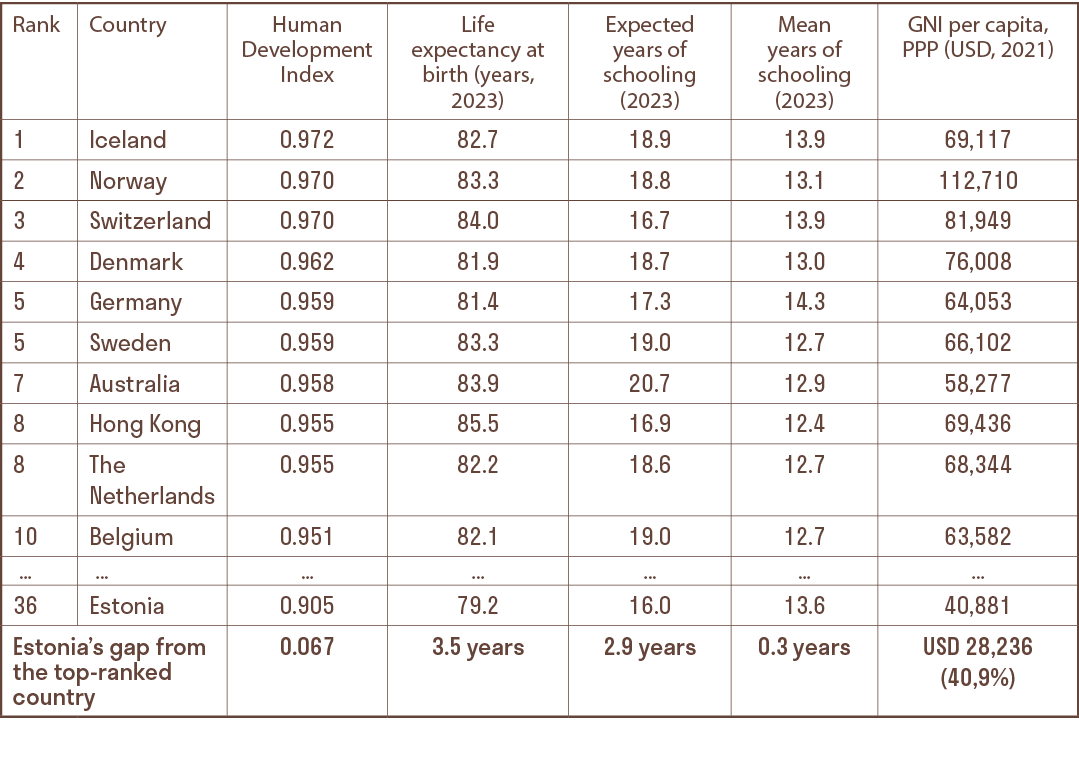
As a result, Estonia ranks among the world leaders in mean years of schooling, while the expected years of schooling indicator places it artificially lower (see Figure 0.3).
International rankings do not always capture the realities of national education systems because their indicators assume similar educational pathways across countries. This assumption does not fit flexible or distinctive education systems particularly well. Estonia’s education system is flexible and supports learning across the life course, which means that part of the educational journey remains invisible to these indicators. Ultimately, a country’s position in a ranking matters less than how well its education system functions under local conditions.
ESTONIA’S STRONG EDUCATION INDICATORS CANNOT FULLY OFFSET SHORTCOMINGS IN HEALTH AND THE ECONOMY
This report explores how education is reflected in broader developments across Estonian society – in the economy, sustainability, the justice system, data governance and other areas of public life. Chapter 1 shows that Estonians place a high value on education, yet unlike Finns, we struggle to translate this into economic gains. Estonian education enjoys a strong international reputation, but its export potential remains largely untapped. Chapter 3 presents an unvarnished economic perspective: each additional year of education increases wages by only 6% in Estonia, whereas 8–10% is more typical internationally. The main exception is the so-called ‘generation of winners’ – those who gained an advantage in the labour market during the transition period in the 1990s. Among younger cohorts, the effect is no longer as pronounced.
To what extent does education truly meet the needs of today’s and tomorrow’s labour market? An audit by the National Audit Office shows that study programmes in Estonia are often opened without adequate consideration of labour market demand – not on the basis of workforce forecasts but according to institutional habit and cost-efficiency considerations.21 Education policy thus emerges not from need but from inertia. As a result, some fields train several times more people than the labour market actually requires. As shown in Chapter 3, graduates of vocational education in some fields earn less than graduates of general secondary education, raising questions about the value of vocational study and of spending additional years in education. This revives an old question: does education fail to understand the labour market, or does the labour market fail to understand education?
Global forecasts are forcing countries to think more carefully about the future of their labour markets, and education must stay several steps ahead. Whereas 20th-century automation primarily displaced blue-collar jobs in manufacturing and logistics, artificial intelligence is now reaching into white-collar occupations. Research suggests that lower-paid entry-level positions are most vulnerable – junior analysts, programmers, assistants and similar roles. Artificial intelligence is therefore likely to affect young people most severely. Forecasts suggest that entry-level positions are particularly vulnerable, threatening young people’s first steps into the labour market.22
INEQUALITIES WITHIN ESTONIA MATTER MORE THAN INTERNATIONAL RANKINGS
Any assessment of human development in Estonia must take account of differences in education, health and economic well-being across the country. Just 100 kilometres east of Tallinn, or 200 kilometres to the south-east, disability-free life expectancy declines by almost ten years while relative poverty doubles. The average number of disability-free life years in Estonia is 58.6, but the gap between counties is nearly 12 years: 51.7 years in Võru County and 63.7 years in Hiiu County (Figure 0.4).
The same pattern is evident in relative poverty. In 2024, the national average was 19.4%, but rates ranged from 16.5% in Harju County to 32.8% in Ida-Viru County (Figure 0.5). In Estonia, life expectancy and well-being continue to depend on place of residence more than we may wish to acknowledge. In the context of this report, we must ask a pointed question: does the same hold true for education?
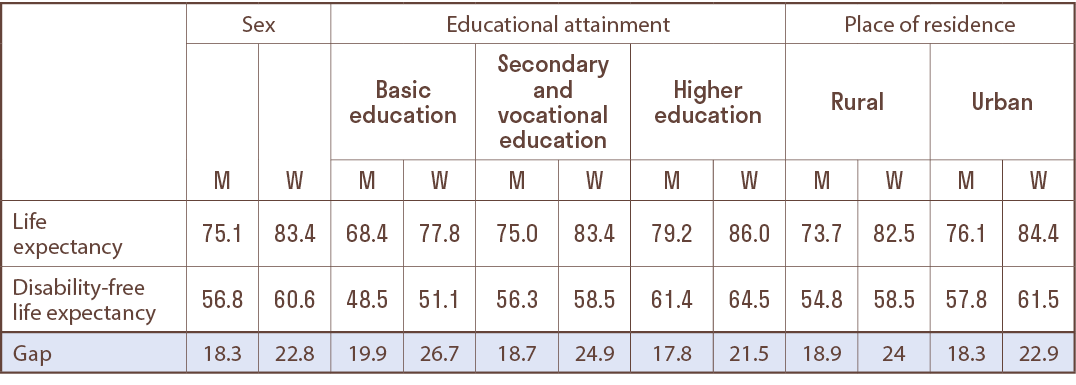
The OECD adds an important labour market dimension that is particularly relevant for Estonia: in an ageing society, we must find ways to increase employment among older people. This means ensuring opportunities for retraining later in life. Otherwise, part of the population risks drifting into a pre-retirement waiting room while labour shortages continue to deepen.25 Estonia’s greatest obstacle is its low number of disability-free life years, which often end before retirement age (see Table 0.2). A man with basic education can expect only 48.5 disability-free years of life despite a life expectancy of 68.4 years, meaning that nearly 20 years are spent living with illness. As noted in Chapter 4, men with higher education live 11 years longer in good health than their peers with basic education. For this reason, inequalities in education, health and economic well-being within Estonia matter more than the country’s position in global human development rankings.
HOW DO WE MOVE FORWARD?
International rankings – whether PISA or the Human Development Index – provide an external perspective, but they do not reveal internal disparities. If life expectancy can be ten years shorter only a short distance from the capital, then our real challenge is inequality within Estonia, not our position in global rankings.
Estonia is moving in the right direction. The strongest part of our education system is not found in university lecture halls or PISA rankings but where the first steps of life begin – in early childhood education. Success there is not measured in medals, examination scores or rankings, but its impact is greater than anywhere else.
According to Nobel laureate James Heckman, environment plays a greater role than genetics in shaping human development.27 When children grow up in a safe, caring and stimulating environment from their earliest years, they develop a stronger motivation to learn. Estonia’s own experience bears this out. A smart country begins with a smart childhood.
Estonia’s education system does not always fit neatly into international frameworks. Indeed, those frameworks are not necessarily designed for us. We have a habit of doing things our own way: entering the labour market at a young age, gaining life experience and then returning to university. Some people even pursue a second master’s degree because completing the first only deepened their appetite for learning.
We are good at identifying where Estonia is succeeding. Now it is time to pay equal attention to where it is not. Above all, we must focus on those who are left out of Estonia’s success stories – those who remain invisible in statistics, rankings and slogans. Whether in health, the economy or education, inequalities exist and will not disappear on their own. They must be reduced deliberately and persistently.
WE KNOW A GREAT DEAL; NOW WE NEED THE COURAGE TO TAKE RESPONSIBILITY AND ACT
Teacher workload and shortages of new entrants to the profession. Excessive homework and growing mental health concerns among pupils. The alignment of vocational and higher education with labour market needs, shortages of engineers and specialists, the transition to Estonian-language education, higher-education funding, brain drain … The list is long and familiar to anyone involved in education policy. It is also a list of expectations that were placed on this report: that it should address every issue and offer solutions to every problem.
However, a Human Development Report is neither a catalogue of solutions nor a toolbox for day-to-day policymaking. The central challenge in today’s educational landscape is no longer a lack of research, but whether we are prepared to act on what we already know. Can we see the bigger picture? Research is not a solution if conducting research becomes a substitute for solving problems.
THE SCALE OF EDUCATIONAL RESEARCH: FROM PIKK HERMANN TO PÄRNU
To understand how much educational research Estonia produced between 2016 and 2025, we examined more than twenty websites, ranging from ministries to research consultancies. Together, they contain more than 20,000 pages of educational reviews and analyses. During the same period, nearly 8,000 education-related theses were completed at Estonian universities, amounting to approximately 360,000 pages. Scientific publications add a further 40,000 pages. A conservative estimate suggests that Estonia produces at least 420,000 pages of educational analyses and reports over a ten-year period.
If all of those pages were printed on A4 paper and stacked one on top of another, the resulting pile would rise to approximately 45 metres – about the height of Pikk Hermann, the iconic tower of Toompea Castle in Tallinn. Laid end to end, the pages would stretch for 125 kilometres, roughly the distance from Tallinn to Pärnu.
And this concerns education alone. Across all fields, more than 90,000 theses were completed during the same period, amounting to approximately 4.4 million pages. Adding government strategies, think tank reports and scientific articles brings the total to more than five million pages over ten years. Stacked one on top of another, those pages would form a tower half a kilometre high.
The question, then, is no longer whether we possess knowledge. The question is whether we use it.
IS THE HUMAN DEVELOPMENT REPORT SIMPLY ANOTHER REPORT?
It is reasonable to ask why we need yet another report. Indeed, while preparing this one, it became increasingly clear how extensively educational issues have already been examined in Estonia – often returning to the same problems time and again. How did we arrive at this situation? We must accept our share of the responsibility. Human Development Reports, too, have repeatedly returned to education. The concerns have remained remarkably consistent across decades: the mismatch between education and the labour market, a continuing education cycle that repeatedly favours the same groups of people, and educational inequality.28 At the same time, this report serves another purpose. It shows not only how much we have studied, but also how much knowledge remains unused. The abundance of research is not a weakness but an untapped resource. We no longer need to keep studying the same problems; we need to turn existing knowledge into action.
A review of recommendations from studies conducted in Estonia reveals five recurring types of recommendation:
- involve and integrate different stakeholders and activities;
- develop and strengthen competences and systems;
- improve processes and the use of resources;
- develop monitoring and evaluation systems;
- conduct additional research.
In most cases, these recommendations fall between ministerial areas of responsibility and therefore become matters of shared responsibility. Why?
First, we have become trapped in an implementation gap. Under poorly coordinated network governance, many actors conduct research, but responsibility for implementing solutions is often left unclear.29 Both the United Nations and the World Bank have shown that reports often vanish into the cloud without reaching either readers or decision-makers, creating a significant gap between investment in research and its actual impact. United Nations Secretary-General António Guterres has noted that in 2024 the UN system supported 27,000 meetings and the Secretariat produced 1,100 reports – 20% more than in 1990.30 The volume of reporting has pushed the system towards a breaking point, as only 5% of reports reach a broad readership. This raises an uncomfortable question: what is the value of research if it remains on a digital shelf?
Over the past two decades, Estonia has moved steadily towards becoming a knowledge-based society. Few countries link education policy as closely to data, research and international comparison as Estonia does. Yet there is a risk that science-based or evidence-based policymaking may become little more than a fad or hype, invoked without the rigorous use of scientific evidence that it requires.31
A second possible explanation is the weakness of institutional memory in the public sector, a phenomenon sometimes described as ‘institutional amnesia’.32 In simple terms, institutional amnesia is an organisation’s inability to recall and make use of existing knowledge.33 When a civil servant leaves, knowledge often leaves with them. Their successor starts again from scratch, commissioning studies that have already been carried out. What repeats itself is not history but bureaucracy, with each cycle generating new costs.
A third problem is the short time horizon of political cycles. Education, by contrast, requires a long-term perspective that is insulated from day-to-day politics. Research can become a form of cover: new initiatives are launched while old ones remain unfinished. Audit culture reinforces this tendency. We measure, monitor and evaluate until measurement itself becomes the objective rather than a tool for achieving change.34 A telling example is that many municipalities commission analyses of their school networks without asking how those networks might function together.
Finally, the deeper cause often lies in the diffusion of responsibility embedded in legislation itself. In practice, collective responsibility often becomes collective irresponsibility.35 The problem, therefore, is not a lack of knowledge but a lack of willingness to use it.
HOW DO WE MOVE FORWARD?
This Human Development Report does not call for less research. Instead, it calls for making smarter use of the knowledge we already possess. The problem is not the volume of analysis but the fact that too much of it fails to inform decisions or generate change. Research cannot be an end in itself. The solution lies not in producing yet another analysis but in reaching the next set of agreements.
- Every study should reach decision-makers.
- Someone must be responsible for implementing the findings.
- Instead of repeating studies, greater emphasis should be placed on implementation.
In the public sector, the value of research should be measured by its impact, not its volume. Every study requires an assessment of its return, not only in financial terms but also in terms of its societal value. As the OECD has observed, no vaccine reaches the public – even during a pandemic – before its effectiveness and safety have been thoroughly demonstrated.36 In education, the situation is often the reverse. According to OECD analysis, nine out of ten education reforms are not evaluated for their long-term impact. This means that educational decisions are frequently made without being tested, measured or assessed according to the standards that are taken for granted in other fields. If we continue producing tens of thousands of pages of analysis that never translate into action, research becomes a cost rather than an investment. The true output of research is not a report but the change it produces.
The problem is not only the volume of research but also the lack of a clear overview. Estonia has no single database that would allow users to quickly identify what has already been studied, what work is underway and which conclusions remain unimplemented. The knowledge exists, but it is fragmented across the websites of ministries, funding organisations, universities and research consultancies. The result is a paradox: studies are repeated because people do not realise they have already been conducted.
Alongside funded research, several thousand theses are completed each year, many of which are read by no more than a handful of people – typically the author, supervisor, reviewer and examination committee. Yet many of these works contain as much data, as many conclusions and as many policy recommendations as analyses commissioned by ministries. For example, the first article in Chapter 4 of this report is based on the doctoral dissertation of David Knapp, which examined the relationship between residential segregation, school segregation and family background.37 The knowledge exists in Estonia; it simply does not circulate.
AS A DIGITAL STATE, ESTONIA IS NOT USING ITS FULL POTENTIAL IN EDUCATION
In 2017, The Economist declared that the world’s most valuable resource was no longer oil, but data.38 Estonia had recognised this long before. We pay taxes in minutes and sign documents digitally in seconds, while many countries still rely on scanned paperwork. Parents can monitor their children’s progress through eKool, patients can access their medical records through the national health portal, and citizens can establish a company or vote in elections without leaving home. These are everyday conveniences that we take for granted, and all of them have emerged within just the past 20–30 years.
ESTONIA NEEDS LESS ‘WHY IT CANNOT BE DONE’ AND MORE ‘HOW IT CAN BE DONE’ THINKING ABOUT DATA IN EDUCATION
As noted in Chapter 2, we continue to rely on slow and often highly subjective surveys even when addressing some of the most important issues, including educational inequality, despite the fact that much of the necessary information already exists in administrative registers. This report invites us to recognise two realities at once: our registers contain enormous potential, and in education that potential is particularly important for early identification and prevention. Data breaches and controversies over the use of personal data have made us cautious, but there is a risk of drifting to the opposite extreme, where everything is prohibited as a precaution.
At a time when the public sector faces significant financial constraints – in education, social welfare and healthcare – Estonia has an opportunity to lead by example. The capabilities of the digital state and the wealth of existing administrative data make it possible to develop smarter education policy without increasing costs.
THE GREATEST WEAKNESS IN EDUCATION IS POOR DATA GOVERNANCE
The problem is not a lack of data but limited awareness of what data exist and how they can be used. The shortage of expertise in data-informed policymaking and the economics of education is particularly acute in the area of education expenditure. Jaak Aaviksoo’s review of education spending reached a striking conclusion: our greatest weakness is poor data governance, as the education system lacks data-based management: ‘Educational institutions, including the Ministry of Education and Research, do not have publicly available budgets. Officials and senior managers lack a clear overview of how education funding is allocated and of the sector’s financial position, relying instead on ad hoc enquiries. Educational governance and financial management operate separately from one another, and cooperation between them rarely extends beyond formal procedures.’39
Estonia spends 6% of its gross domestic product on education, one of the highest shares among OECD and European Union countries, but we are unable to say with confidence where that money actually goes.40
HOW DO WE MOVE FORWARD?
If we want Estonia’s digital state to extend fully into education, we must first ask ourselves about data literacy in the public sector – not in collecting data but in using them. At present, we are diligent collectors but limited users. As confirmed in Chapter 2 of this report, the administrative register data collected and maintained by Statistics Estonia enable education policy decisions to be grounded in facts rather than repeatedly relying on large-scale and costly surveys.
Several countries, including Finland, have in recent years created data-based national dashboards to monitor the well-being of children and young people.41 Iceland, with a population three times smaller than Estonia’s, offers a particularly strong example. Its national dashboard, Farsæld Barna,42 extends all the way to the municipal level. One quarter of its indicators are based on administrative registers and three quarters on youth surveys. The process is so highly automated that a head of school receives a well-being report for their school immediately after the survey has been completed.
ESTONIAN EDUCATION NEEDS A HEALTHY SUBTRACTION EXERCISE
Education is fertile ground for opinions. Parents demand the best teachers, public authorities specify what must be taught, the media debate teachers’ salaries, and employers ask where all the engineers have gone. Heads of schools search tirelessly for teachers, while teachers themselves are no longer sure whether human intelligence or artificial intelligence requires more of their attention. And in the middle of all this stands the pupil, asking the simplest and at the same time the most uncomfortable questions: why am I here, and how does this school relate to a world that is changing faster than my timetable?
EVERYONE KNOWS WHAT SCHOOLS SHOULD DO, BUT FEW DARE ASK WHAT SCHOOLS SHOULD STOP DOING
The journey to adulthood is different for everyone, but there are two places where those journeys intersect every day: kindergarten and school. Today’s classroom is tomorrow’s society. This means that when we shape education, we are also shaping the society we will become. The classroom is both the foundation of the future and a reflection of the present. Family and societal concerns arrive there with pupils, teachers, parents and heads of schools alike. Schools – whether kindergartens, general education schools, vocational schools or higher education institutions – cannot serve as treatment centres for all of society’s problems, particularly given the burden of responsibilities they already carry. Every new requirement comes at the expense of an existing responsibility that we have not had the courage to remove.
We have therefore reached a point where we must decide whether to acknowledge reality or ignore it. The reality is that we have little choice. Schools cannot be merely places where knowledge is transmitted; they must also be places where society learns how to hold itself together. Today’s schools bring together the risks of both the physical and the digital world, while the path from childhood to adulthood has become considerably more complex than it once was. For some children and young people, a head of school or a teacher may be the only adult in their lives who genuinely notices them and perhaps even the only positive role model they encounter. From kindergarten onwards, children and young people spend nearly fifteen years with adults in educational institutions who, alongside parents, help shape their understanding of the world.
If we want educational goals in Estonia – such as personal development, fostering law-abiding citizens and creating the foundations for lifelong learning – to be realised in practice, then in shaping the education system we must decide not only what to add, but also what to remove. We need to create space for schools and higher education institutions to provide a healthy environment for personal development – not only for pupils and students, but also for teachers, academic staff and heads of schools.
Today’s young people no longer grow up under the authority of teachers and parents alone but within a global network of influences. Teachers are no longer competing only with the school down the road, but with a streamer in Tokyo and an influencer in Berlin. If teachers no longer serve as role models, they also lose the ability to shape learning motivation. Interest in learning is therefore determined not only by the curriculum but also by relationships built on trust. Relationships are the new currency of education. Children do not learn simply because they must; they learn because someone believes in them. Building those relationships requires giving all educators – from kindergarten to university – the time to do so.
The OECD has repeatedly noted that countries tend to keep adding new requirements while giving little thought to what should be removed.43 What burdens Estonian education is not a lack of knowledge but an excess of initiatives. Every new minister, official or committee launches another programme, but few ask what is already underway or what could be discontinued. Schools and teachers are overwhelmed by reforms, strategies and projects, but no additional resources appear and existing responsibilities are rarely reduced. The result is a system that tries to do everything at once and therefore struggles to do anything particularly well.
The greatest challenge facing Estonian education today is the combination of pupils’ low enjoyment of learning and poor mental health, combined with the exhaustion of teachers and heads of schools. The priority for the education system should be to free itself from tasks that undermine the joy of learning and teaching. Every educational institution already knows which responsibilities create the greatest burden and contribute least to learning. There is no need to prescribe such a list from above. What is needed is the courage to identify those burdens honestly and then to begin removing them.
HOW DO WE MOVE FORWARD?
The two most dangerous sentences in education are: ‘This subject cannot be taught any other way’ and ‘We have always done it this way’.
Around the world, there is growing discussion about which tasks and practices education systems could abandon. Homework is one example. While excessive work by teachers outside the school day is widely recognised as a problem, work performed by pupils after school is often taken for granted (see Chapter 7). According to a study by Stanford University, more than two hours of homework per evening may be counterproductive, contributing to sleep deprivation and poorer mental health.44
Every technological transformation raises the same question: what purpose will it serve? This report is being prepared at a moment of profound change brought about by artificial intelligence. AI should become a guillotine for educational overload, taking over tasks that teachers, heads of schools and pupils no longer need to perform themselves. At the same time, there is a risk of becoming trapped in an ‘AI policing’ mindset, where energy is directed towards monitoring whether pupils are using AI, thereby creating even more work for educators.
The entire education system is currently developing AI competence, which means that the introduction of AI into education cannot be treated merely as a technological innovation. If schools adopt new tools while leaving teachers’ roles, work organisation and leadership practices unchanged, the impact will remain limited. AI will not transform the system on its own. Change depends on whether the system is prepared to change itself. The question is not only how we use new tools, but whether we are willing to rethink established practices. This is precisely the question posed in Chapter 5 of this report: ‘Software updated – but what about learning?’
SUMMARY
We have burdened the education system with responsibilities it cannot fulfil, and the result is growing inequality. Unless we create room to breathe – room for difficult choices and healthy subtraction – the system will eventually buckle under the pressure.
We must also ask ourselves honestly why we have been unable to translate our educational strengths into broader gains. How is it possible that high levels of educational attainment are not matched by similar gains in people’s economic well-being and health? Estonia’s educational success story will continue only if we have the courage to let go of some things, make wise choices and use existing resources more effectively. Looking towards the future (see the education scenarios presented in Chapter 8), we need a clear understanding of both today’s and tomorrow’s operating environment in order to know how to move forward: charging ahead in a wild boar’s rampage, advancing cautiously with the fox’s stealth in search of the best opportunities, observing events unfold with the measured confidence of the elk’s stride or making agile adjustments with the hare’s zigzag. At the same time, we must avoid the illusion that educational success, once achieved, is permanent. The belief that high-quality education is equally available everywhere in Estonia may already be outdated – and it certainly does not guarantee success tomorrow.
We have reached the top of the PISA rankings and brought Estonia’s digital-state story to the front pages of major international publications. But do the strengths that brought us here still have the power to carry us forward? More importantly, are we smart and bold enough to change direction at the right moment, before habit becomes an obstacle?
ESTONIAN EDUCATION AT A GLANCE
The number of early childhood education institutions has declined the most (–13%)
Most general education schools are small: 48% have fewer than 200 pupils

Demographic pressure on the education system is increasing
The number of 5–19-year-olds will decline significantly by 2050 (compared with 2024)
Pupil and teacher numbers are changing in different directions across educational levels
General education has gained both pupils and teachers, early childhood education has lost both, while changes in vocational education have moved in opposite directions.
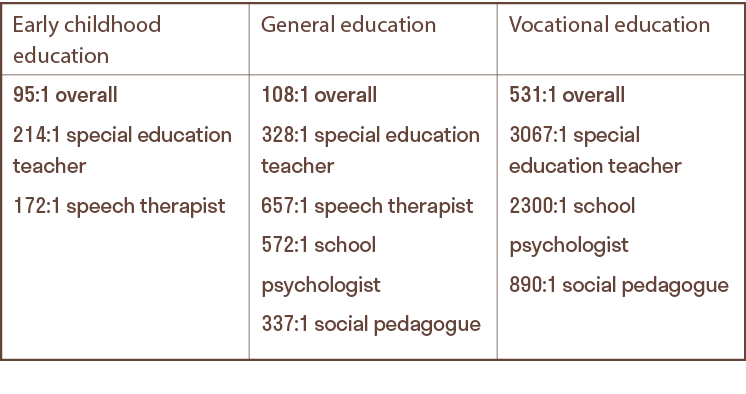
The shortage of support specialists is greatest in vocational education
There are more than 2,000 pupils for every school psychologist in vocational education.
Expenditure has increased rapidly across all levels of education
Costs per learner have risen fastest in early childhood and general education.