Educational institutions can bridge the gap between climate awareness and climate-responsible behaviour
- Individuals with higher levels of education tend to be more climate-aware than other educational groups, but their behaviour and consumption patterns are shaped by higher incomes and related social expectations.
- In Estonia, the lifestyles and attitudes demonstrating limited climate concern are both reflected in and shaped by the wider institutional environment. In education, local government and business, the systematic dissemination of climate-related knowledge and the adoption of climate-responsible practices remain limited.
- Institutions, including educational institutions, can build communities that recognise the seriousness of the climate problem and strengthen climate-responsible behaviour.
INTRODUCTION
Although climate change has increased risks to life and property worldwide, heightening climate awareness, humanity has not brought the problem under control. Greenhouse gas emissions and energy consumption continue to rise. Possible explanations include the gap between awareness and behaviour, barriers that prevent informed individuals from becoming agents of change and the inertia of institutional environments.
To understand these dynamics, it is useful to distinguish climate responsibility from environmental responsibility. Beyond individual preferences, affection for nature or frugal habits, climate responsibility requires attention to the environment in which knowledge is formed, the broader context – including the media and public arena in which these issues are framed – and the conflicts they generate. In Estonia, environmental responsibility enjoys a largely positive reputation, combining pride in the country’s ‘clean nature’, the role of environmental activism in the late 1980s independence movement and the perception of the natural environment as a relatively uncontroversial domain. Environmental degradation is also more directly observable in people’s everyday surroundings, which makes it easier to recognise.
The same cannot be said of climate change. As a relatively recent issue that may appear ‘imported’ rather than locally rooted, it is harder to grasp in Estonia’s geographical context. Its effects have not yet become sufficiently observable here. Although climate change is clearly documented in scientific data, in practice it touches on sensitive areas of Estonian society, challenging the foundations of a relatively recently achieved welfare and consumer society. As European Investment Bank data show, Estonia is consequently among the most climate-sceptical societies in Europe.1 Climate change has become an arena for disputes and conspiracy theories and, for some, a pseudo-issue that is even perceived as conflicting with environmental protection goals. The green transition – state policy aimed at preventing and mitigating climate change, with implications for specific sectors, institutions and regions – has generated doubt and mistrust, and its top-down character is often perceived as coercive.2
The Estonian Environmental Awareness Survey (EKTU 2024)3 provides the basis for a more detailed analysis of environmental and climate responsibility,4 which shows that, among socio-economic indicators, only education is strongly associated with environmental responsibility.a Climate responsibility,b by contrast, is strongly associated with education, social status and income. The data also indicate that climate responsibility is more unevenly distributed across social groups defined by differing views and attitudes than environmental responsibility.
One component of climate responsibility may be the appreciation of scientific knowledge. Where trust in science is weak or declining, climate change is more likely to be treated as a matter of belief rather than fact. Attitudes towards science are linked to education. In what follows, we examine whether climate-responsible behaviour, reported by individuals with higher education, presumably with knowledge and trust in climate science, is actually reflected in their consumption patterns, such as energy saving, reduced car use, limiting purchases and adopting a more climate-friendly diet. We consider both the impact of individual educational attainment on climate awareness and responsibility, and education as an institutionalc environment, including its climate footprint, its own responsibility and its capacity to support knowledge-based behaviour.
CLIMATE AWARENESS AMONG THOSE WITH HIGHER EDUCATION DOES NOT TRANSLATE TO CLIMATE-RESPONSIBLE BEHAVIOUR
Data from recent decades and across societies indicate that higher educational attainment is associated with greater climate awareness. For example, in a European Investment Bank survey, respondents with higher education provided the highest number of correct answers about the nature and causes of climate change.5 According to the Estonian Environmental Awareness Survey 2024, awareness and educational attainment are also strongly associated with self-reported assessments of behaviour,6 reflecting both attitudes and the context in which behaviour is evaluated. However, educational attainment shows no association with readiness to conserve resources.7 Although individuals with higher education report that their behaviour is environmentally and climate-responsible, this is not reflected in a greater willingness to reduce consumption.d Other studies outside the environmental field likewise indicate that those with higher education tend to consume more. In 2020, households headed by individuals with the highest level of education spent 1.5 times more on clothing and footwear than households headed by individuals with lower education, slightly more than twice as much on transport, nearly twice as much on leisure and more than 2.5 times as much on package travel.8 These figures do not, however, capture the footprint of the goods purchased or whether fewer but more expensive items were bought overall.
b In EKTU 2024 (p. 11), this factor includes reducing travel, car use, meat consumption and the use of single-use plastics.
c Here, the term institution is used broadly to refer to organisations, public bodies and their modes of operation.
d This included the energy-efficient use of electricity and heating, purchasing second-hand clothing and consumer goods and products with a long lifespan, repairing items, consciously reducing consumption, and delivering hazardous waste to designated collection points.
Estimates of energy demand based on the amount of heated living space available to households by educational level show that more than 60 sq. m of heated space was available to 65% of respondents with higher education, 54% of those with vocational or specialised secondary education and 41% of those with upper secondary or lower education.9 ,e Differences appear more closely associated with educational attainment than with income. The same study indicates that 12% of respondents with the lowest level of education and 7% of those with higher education believed they could substantially reduce their energy consumption; 42% of respondents with lower education and 48% of those with higher education stated that they could reduce it little or not at all.10 These figures suggest that among those with higher education there are somewhat more individuals who consider themselves already sufficiently frugal or who believe that social or technical constraints limit further reductions in their living standards. Energy-saving efforts are also reflected in home insulation. Drawing on Eurobarometer data, Niitav notes that respondents with basic education insulated their homes slightly more often to reduce energy costs than those with higher education (40% compared with 34–37% in other educational groups) and installed solar panels significantly more often (16% compared with 3–4%).11 As Niitav observes, these differences may be related to residence outside larger cities.12
The Estonian Transport Administration’s mobility survey shows that individuals with higher education are more likely to own a car than those in other educational groups.13 Among respondents with higher education, 52% travel by car on four or more days per week and only 15% do not use a car at all. The corresponding figures among those with basic education are 46% and 20%. In addition, 54% of respondents with higher education travel alone by car, compared with 43% among those with secondary education. Regular use of public transport (four or more times per week) is reported by 13% of respondents with higher education and 21% of those with basic education. Although those with higher education may report a preference for more sustainable modes of travel, their actual mobility patterns indicate more frequent car use, more solo driving and lower reliance on climate-responsible transport than other educational groups.
Meat consumption also serves as an indicator of environmentally responsible choices. Here too, households with higher educational attainment are slightly larger consumers, and their meat consumption increased more rapidly between 2010 and 2020 than among respondents with basic education.14 Additional insight comes from data provided by the National Institute for Health Development on reported positive behavioural changes.15 These show that respondents with higher education were least likely to have reduced their intake of animal fats in the preceding 12 months: 22% among those with higher education, compared with 25% among those with basic education and 28% among those with secondary education. Moreover, EKTU indicates that individuals with higher education are less willing than other educational groups to consume reused products or reduce travel.16 Both tendencies likely reflect lifestyle patterns that may be perceived as less feasible or less desirable to change among those with higher education.
Thus, the actual consumption patterns of those with higher education, as well as higher levels of climate awareness and climate concern, do not fully correspond to their self-reported behaviour. In explaining this, it is important to recognise that educational attainment has both socio-economic causes and consequences. In Estonia, educational level is closely associated with income, and individuals with higher education more likely belong to higher income deciles. Observed consumption patterns and preferences regarding reuse and travel suggest that higher income increases the likelihood of consumption. The most climate-friendly option – not consuming – tends to be triggered when income is constrained. Beyond income, the consumption behaviour of those with higher education is shaped by social status, which can encourage higher levels of consumption – to signal, maintain or affirm one’s position,17 to fulfil associated roles or simply because greater financial resources allow it. Higher income linked to higher education expands consumer choice,18 including symbolic ‘green’ choices (such as avoiding plastic straws) that align with the preferences of an educated and environmentally aware social group. By contrast, avoiding air travel, buying reused goods, lowering home heating or consistently relying on public transport may risk being seen as extreme, invite scepticism from significant others or appear professionally difficult or impractical.
As long as higher income finds expression in material consumption, and belonging to higher income groups entails not only the possibility but also the social expectation to consume more, increased awareness alone will not lead many to reduce their consumption footprint. Greater climate awareness acquired through higher education does not, in itself, prevent climate-damaging consumption choices.
At the same time, EKTU indicates that individuals with higher education are more willing than others to discuss environmental issues within their families and to draw attention to the importance of environmental protection.19 This suggests potential for those with higher education to act as agents of change. However, translating words into action may be particularly difficult in an environment where climate-responsible behaviour can affect prestige and social standing. Where the social context does not support such choices, substantial lifestyle changes may feel like a sharp departure from one’s comfort zone and a risk to social position, especially when others do not make similar adjustments.
THE CLIMATE RESPONSIBILITY OF THOSE WITH HIGHER EDUCATION IS REFLECTED IN AND SHAPED BY THE INSTITUTIONAL ENVIRONMENT
Social expectations are shaped in part by the institutional environment – workplaces, schools and other organisations – which can support individuals in acting as agents of value and behavioural change. The three or four years spent in higher education also play a formative role in developing a scientific worldview and, with it, climate awareness. Studies on awareness suggest that the situation in this respect is relatively favourable. At the same time, institutional environments can serve as practice settings for the future – anticipatory spaces in which the conditions created for climate-aware daily life could complement awareness with practical experience and normalise climate-responsible behaviour.
Higher education institutions’ climate responsibility and capacity to act as role models are reflected partly in their climate footprint. By the end of 2024, the University of Tartu, Tallinn University of Technology (TalTech), Tallinn University, the Estonian University of Life Sciences and the Estonian Academy of Arts had completed greenhouse gas emission assessments.20 The largest shares of emissions stem from electricity and heating used in research and teaching infrastructure, transport (including member mobility, business travel and the transport of goods and services) and the consumption of goods and services. Comparison shows that institutions with less experimental research and teaching activity in their buildings tend to have lower emissions. In 2022, greenhouse gas emissions per university memberf were highest at TalTech (2.6 tonnes CO₂ equivalent), followed by the University of Tartu and the Estonian University of Life Sciences, and lowest at the Estonian Academy of Arts and Tallinn University (0.8 tonnes CO₂ equivalent). The latter has a high student-to-staff ratio and the smallest share of experimental research and teaching.21
A mobility survey conducted at the University of Tartu describes the climate responsibility of commuting.22 It shows that 67% of responding students and 52% of staff predominantly use sustainable modes of transport – walking, cycling or public transport – to travel between their residence and university buildings. On the other hand, 14% of students and 31% of staff are frequent car users. Modal choice is influenced by the location of university buildings, transport infrastructure and available access options. Car use, for example, is particularly high among staff at the University of Tartu’s Maarjamõisa campus. Significant progress remains to be made towards sustainable mobility. As of 2023, university properties provided nearly 1.5 times as many parking spaces for cars as for bicycles. Proposals to reduce parking spaces near university buildings are highly unpopular: the measure is supported by 51% of cyclists, nearly 30% of pedestrians and public transport users and only 11% of staff who drive. The ready availability of parking also reduces motivation among staff and some students to commute without a car.
Higher education institutions are expected to prepare specialists and leaders capable of managing systemic change and societal transformation, who understand the impact of their actions and their responsibilities.23 Yet climate-aware higher education remains at an early stage in curricular terms. Green skills were incorporated into curricula only in 2023 through the Ministry of Education and Research programme ‘Green skills to support the green transition of enterprises’, launched to implement the European Green Deal. Although the programme defines both field-specific and transversal competences, the consortia and fields it covers do not include a substantial share of disciplines taught in universities and vocational higher education institutions. Large fields with high student numbers – such as health and well-being, ICT, services and education – are not included. Graduates in these areas therefore acquire only general green competences. This is particularly concerning in education, given the strong influence of schooling on future behaviour. Limited integration in the highly influential ICT field is also problematic.
Higher education has therefore not yet realised its potential role in disseminating knowledge. More importantly, higher education institutions have not developed into environments24 that place environmental and climate considerations at the centre of everyday decisions or normalise climate-responsible practices such as using sustainable transport for commuting and business travel. In other words, green commitments gain credibility only when they are embedded in daily practice. Universities can serve as practice settings in which climate-responsible behaviour is routinely enacted and sufficiency-oriented attitudes cultivated – that is, consumption within ecologically sustainable limits – alongside leadership skills grounded in eudaimonic, climate-valuing principles rather than materialistic and hedonistic values.25 In Estonian higher education institutions, such teaching is currently largely absent or confined to isolated courses or lectures. Yet developing the skills, attitudes and values required to respond to a changing climate is essential for society as a whole.26
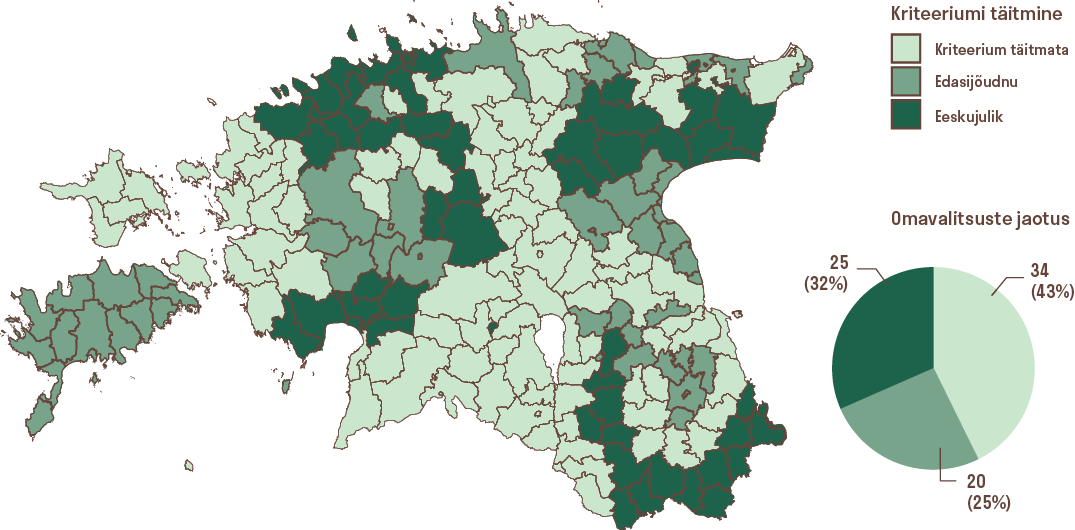
Just as individuals do not act solely as aware or motivated agents but are shaped by their social environment,27 educational institutions operate within a broader institutional framework that influences funding, priorities and prevailing attitudes. While this framework may be less visible in the case of universities, its significance becomes clearer when examining local governments and their role in shaping school environments. Only one fifth of educational institutions have joined the Green School programme, many of them smaller schools. Eighty per cent of school and kindergarten buildings hold a valid energy performance certificate, half of which are rated C class or higher. Vocational higher education institutions stand out for particularly low levels of certification. No municipality has ensured that all educational buildings possess energy performance certificates. As institutions administered by local governments, schools depend on municipal climate objectives. Only a few frontrunner municipalities treat this issue as a priority (see also Appendix, Figure 6.3.1).
A link with income is evident: larger and wealthier municipalities tend to address climate issues in more varied ways. There are, however, exceptions. Municipalities in Ida-Viru County, regardless of size, lag behind in environmental services despite serious regional environmental problems. This cannot be explained by a lack of resources, as municipalities in the county generally perform well financially. Yet not all local governments employ environmental specialists or provide environmental services. In these cases, the issue may not have become a priority, or limited administrative capacity may hinder attention to what is perceived as a ‘luxury issue’.
At the individual level, awareness is shaped by education, which is associated with higher income and, in turn, higher consumption and less climate-responsible behaviour. The cases of Setomaa and Võrumaa (see ‘An inspiring example’), however, suggest that at the institutional level income does not necessarily constrain climate-responsible and environmentally responsible practices. Institutional awareness may be more decisive than individual awareness in translating climate knowledge into action. Unlike individuals, institutions are influenced less by immediate social pressure and more by the broader structural context created by state policy and political recognition of climate issues.28
INSTITUTIONS INTERACT WITH CLIMATE-RESPONSIBLE INTERPRETIVE AND AMPLIFICATION COMMUNITIES
For educational institutions to act as agents of behavioural change, communities of understanding must emerge among those who grasp the scientific basis of climate change and recognise the need for personal and societal transformation. The focus here is on communities grounded in a scientific understanding of climate issues. On this basis, amplification communitiesg may also develop, whose members disseminate sufficiency-oriented lifestyles through example and engage wider society in discussion of their rationale.
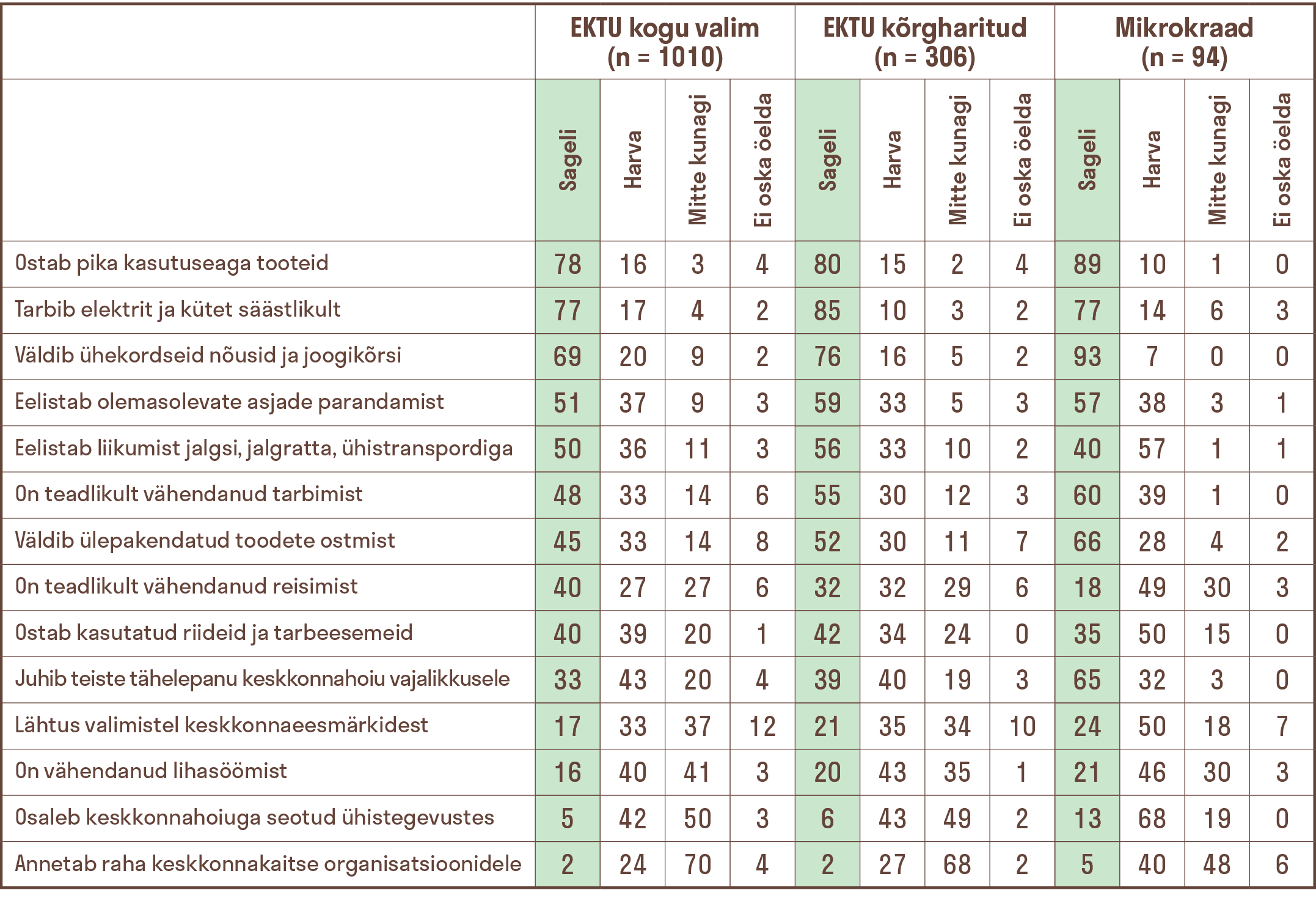
As an illustrative example of such a potential community, we consider a microdegree programme jointly delivered by two universities and focused on translating climate awareness into practice. Between 2023 and 2025, 94 participants completed the programme. The target group comprised senior and middle managers from organisations across sectors in Estonia, as well as other interested individuals. Participants ranged from small business owners to representatives of state and local government and from the financial sector to industrial enterprises. Self-assessments of environmentally responsible behaviour broadly resemble those of respondents with higher education in the EKTU study, although participants (n = 94) reported slightly higher levels of pro-environmental behaviour overall (see also Appendix, Table 6.3.1). The most frequently mentioned climate-responsible actions included preferring long-lasting products and saving electricity and heating. Reducing travel had not been achieved, reflecting income and opportunity structures as well as the tendency to align lifestyle choices with expectations linked to social status rather than with climate awareness or a desire to serve as role models. At the same time, 65% of programme participants reported drawing others’ attention to the need for environmental protection, compared with 39% of respondents with higher education in the EKTU study. This suggests their potential as an amplification community, even if, as a community of understanding, they do not consistently adopt all relevant behavioural changes.
Data from one recent cohort (n = 31) provide further insight into changes over the course of the programme. For several behaviours, self-assessments became more critical after completion. In group discussions, participants noted that the programme had prompted more realistic self-reflection. For example, the share reporting reduced travel declined from 19% to 14%; those describing themselves as consumers who repair items fell from 65% to 50%; and those reporting reduced meat consumption decreased from 23% to 18%. At the same time, some positive shifts were observed. A higher proportion reported often giving up car use in favour of other modes of transport (from 39% to 46%) and drawing others’ attention to the need for environmental responsibility (from 55% to 68%). The share stating that, as voters, they consider politicians’ environmental goals nearly doubled to 29%.
The programme’s experience also clarifies how impact can be strengthened and climate-responsible behaviour embedded as a transversal competence. Climate responsibility cannot be institutionalised solely through a conventional top-down approach that creates a dedicated sustainability post or unit. Change may not reach institutional actors if decisions are taken without involving staff or members. Behavioural shifts and climate-aware working environments are more likely to develop when broad groups of employees are engaged, rather than when isolated individuals attend awareness training and are expected to transform their organisations alone. Discussions showed that even where companies employ sustainability managers, their efforts may have limited effect if not supported more widely. Environmental and climate awareness must be horizontal, cutting across departments and management levels. Two multinational companies represented in the programme reported success precisely because they involved multiple tiers of management. Leadership by example, mindset and commitment are crucial. Young et al. note that behavioural change occurs when employees understand why a practice is environmentally friendly or climate-friendly and follow it because it is embedded in organisational systems, culture and recognition structures.30 Without institutional support, change is difficult to achieve. Individuals who share knowledge can form supportive communities of understanding capable of amplifying both climate awareness and climate-responsible behaviour, as well as the broader transformation required.
SUMMARY
Recognising that education is associated with climate awareness does not explain why generally well-educated societies have not adopted more climate-responsible behaviour. Although higher education tends to increase climate awareness, it is essential to examine whether this awareness translates into action and to identify the barriers that prevent even comparatively climate-aware populations from acting accordingly.
The data indicate that although respondents with higher education describe themselves as more climate responsible, they consume more goods and, by living in larger dwellings, use more energy. They consume somewhat more meat and drive more frequently, including alone. In relation to travel and product reuse, the self-reported behaviour of those with higher education is also less climate responsible than that of other educational groups. Awareness alone does not produce meaningful changes in lifestyle, habits or consumption patterns. A gap persists between knowledge and behaviour because climate knowledge competes with choices shaped by higher income, broader opportunities and social expectations grounded in material values, all of which increase the carbon footprint of those with higher education. From the perspective of mitigating climate change, behaviour matters more than awareness.
This directs attention to higher education institutions and their potential role in narrowing this gap. Institutional environments often reinforce prevailing norms, but in periods of transformation they can also act as accelerators of change, practice settings and role models. Their capacity to shape and guide behaviour remains insufficiently examined and insufficiently recognised within universities themselves. The evidence suggests that everyday decisions in higher education – for example, regarding transport and work organisation – are not yet guided by principles of climate responsibility. Nor is climate change typically addressed in an integrated way that combines climate science with its social dimensions; instead, the topic appears sporadically, confined to individual courses or lectures in selected fields.31
Addressing the gap between climate awareness and climate responsibility within higher education institutions, and creating opportunities to practise climate-responsible behaviour there, is therefore essential. In an environment that values a scientific worldview, communities of understanding can develop that support individuals at different levels of leadership and intervention in practising climate responsibility in daily life and in amplifying climate-conscious thinking through example and reasoned argument. Institutional environments can create conditions in which awareness translates into tangible change and in which sufficiency-oriented social preferences are supported and practised. For individuals, such practices may be difficult to sustain in everyday life, either because they lack the social leverage to influence others or because materialistic and hedonistic elements of social relations appear more pressing in daily social situations. Within a more climate-aware institutional setting, communities can emerge in which the links between climate knowledge and the broader socio-economic and political order, including power relations, become clearer. Under such conditions, the task of communicating climate knowledge widely is coupled with recognition that climate-damaging behaviour and its structural drivers can be transformed. Only then can society move from general awareness to concrete action, and from isolated informed individuals and small climate-responsible groups to collective change.
APPENDIX