Education is only one stone in the foundation of a sustainable lifestyle
- Education updates and harmonises knowledge, but sustainable behaviour is shaped by many other factors that education alone cannot influence.
- Education helps overcome barriers to a sustainable lifestyle by strengthening emotional connection to the environment and supporting self-regulation.
- Environmental aspirations tend to cluster with other aspirations that increase environmental impact within the same individuals. Education may reinforce both.
INTRODUCTION
What role does education play in cultivating sustainable choices in Estonia? An analysis of two decades of Eurobarometer survey data shows that, until recently, Estonians regarded education as the most desirable instrument for addressing environmental problems.1 In this article, we critically assess education’s actual contribution to shaping a sustainable society.
All activities have an environmental impact, but which ones are framed as sustainability issues depends on social norms. In Estonia, for example, a sustainable lifestyle does not imply refraining entirely from transport, but rather preferring public transport where possible. Sustainability is expressed mainly through choosing a more sustainable option within widely accepted practices. Our analysis focuses on activities that are well established in Estonian society as collective choices affecting a large share of the population, such as sorting waste, choosing more sustainable modes of transport and conserving energy. Although we discuss education’s role in sustainable choices more broadly, our primary focus is on levels of formal education, from basic school to higher education.
EDUCATION HAS A LIMITED ROLE, AS SUSTAINABLE BEHAVIOUR IS ALSO SHAPED BY MANY OTHER FACTORS
School, as the central institution of the education system, remains indispensable for disseminating up-to-date knowledge. Results from the 2022 Estonian Environmental Awareness Survey (EKTU) indicate that new knowledge reaches school-age cohorts more quickly than society at large. For example, respondents aged 17–26, who are still largely influenced by the education system, were better informed than those aged 27–49 about the impact of everyday activities on biodiversity, including fast fashion consumption, fossil fuel use, internet use and international delivery of goods. The Estonian school system also harmonises knowledge. PISA 2015 results in science indicated that Estonian pupils’ environmental literacy – their ability to interpret environmental issues – was consistently strong by international comparison.2 According to EKTU data, knowledge among 17–26-year-olds did not vary by level of education. In the 27–49 age group, however, knowledge was higher among those with more years of education. After completing school, individuals must choose which information to follow. Those with more education are more likely to participate in information-rich social networks, follow diverse media channels and engage in further training. As their information environment is broader and their incentives to deepen knowledge stronger,3 differences in environmental knowledge widen over time. School is thus effective in updating the knowledge base of the younger generation, while inequalities in knowledge increase later in life. This does not diminish the value of knowledge acquired outside formal education or over the life course.
Although education plays a key role in disseminating knowledge, sustainable behaviour depends on more than knowledge alone. According to EKTU, only 8% of respondents cited lack of knowledge as the reason for not following the sustainability recommendations listed in the survey. Many studies document the so-called attitude–behaviour gap: attitudes towards environmental problems do not automatically translate into environmentally friendly behaviour.4 The behavioural change perspective explains this gap through insufficient motivation or contextual barriers such as habits, norms or limited public transport schedules, which hinder otherwise motivated individuals. The social practices perspective argues that context and action cannot be separated: everyday practices reproduce the conditions that sustain less desirable patterns.5 For example, commuting by car contributes to continued investment in road infrastructure. While the behavioural change approach assumes that environmentally friendly choices should stem from environmental aspirations, such choices are often driven by financial savings, convenience or health considerations. The social practices approach, in turn, argues that the meanings people attribute to their choices should not necessarily be treated as causes of their actions, but rather as consequences. The morning rush of cars, for example, is likely driven by the shared aim of reaching work, school or shops, regardless of the individual interpretations drivers give to their choices.6
EDUCATION HELPS OVERCOME BARRIERS TO A SUSTAINABLE LIFESTYLE
Neither perspective denies that some individuals find it easier than others to abandon established practices and adopt new ones. Those who initiate new forms of action often have a stronger emotional connection to the environment, environmental problems and proposed solutions. Alongside knowledge acquisition, environmental education typically aims to cultivate an emotional connection to the environment.7 Direct experience of nature plays an important role in developing this bond.8 According to the 2023 pilot study on pupils’ environmental awareness (ÕKTU), pupils who had participated in more outdoor lessons and whose schools were more actively engaged in environmental programmes reported more frequent sustainable practices. This aligns with international research.9 However, 38% of Estonian school leavers reported not having had a single lesson in nature during the past year,10 which indicates substantial scope to strengthen nature-based learning.
An emotional connection can, at times, also hinder engagement.11 When young people confront serious, complex and abstract issues such as climate change, they may experience distress, including eco-anxiety and climate concern.12 Concern about climate change has risen rapidly in Estonia: in 2021, 63% of respondents in Estonia and 78% in Europe reported being seriously concerned, particularly among younger and more educated groups.13 If schools create space to discuss and process these concerns, this can support constructive engagement.14 ÕKTU data indicate that greater concern about environmental and climate issues is statistically associated with more sustainable choices.
Beyond knowledge and emotional engagement, self-efficacy and self-regulation are crucial in changing established routines.15 These refer to the belief that one’s actions can be effective and to the experience of being able to change them successfully. In the EKTU, 22% of respondents, and in the ÕKTU 30%, identified at least one sustainable practice they did not follow because it failed to come to mind at the right moment, was displaced by other priorities or required more persistence than they felt able to sustain. Many respondents report being constrained by everyday overload, which is closely linked to self-efficacy and self-regulation. This suggests that carving out space for sustainable habits may be a greater challenge in Estonia than lack of knowledge. Young people and those with higher education – that is, individuals more likely to remain within the education system – appear less affected by everyday overload. Young people aged 17–26 are often still in education, with fewer structural constraints, while those with higher education may have greater capacity to integrate additional practices, including sustainable ones, into their lives.16 Education also supports the internalisation and reinterpretation of norms. Evidence from a young adult development study17 suggests that those who remain longer within the education system are better able to cope with later societal expectations, including those linked to sustainability norms.
SUSTAINABLE PRACTICES ARE SHAPED MORE BY SOCIETY THAN BY EDUCATION
It must be recognised that social groups engaged in education do not necessarily practise sustainability more consistently than others (Table 6.1.1). Among pupils (Grades 9–12), participation in sustainable practices is markedly lower than among young adults, despite pupils’ more up-to-date environmental knowledge.18
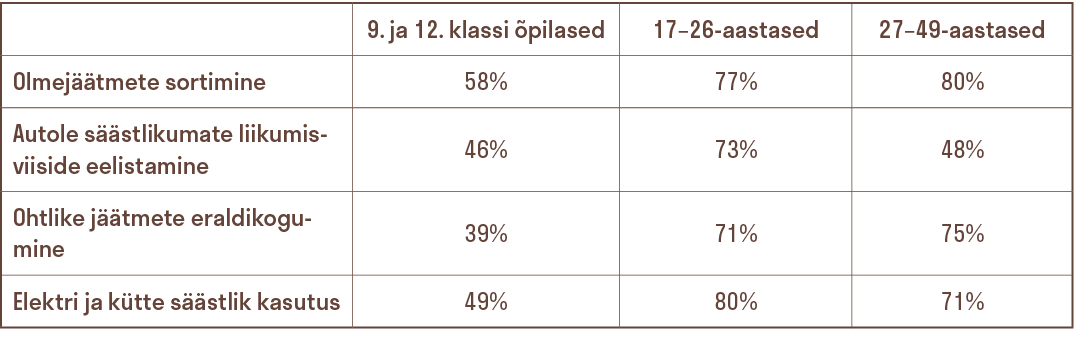
One reason why knowledge does not translate into action is that, compared with adults, children have limited autonomy. Many relevant decisions are made on their behalf. Young people rarely carry responsibility within the household, such as organising waste sorting or managing energy use. They live within environments shaped by parental choices, school policies and broader societal arrangements, including place of residence, transport systems, traffic organisation, school environmental management and food provision. The transition from school age to young adulthood – visible as a sharp increase in sustainable action – coincides with the stage at which young people first gain greater control over their own lives. At school age, behaviour depends less on intrinsic motivation and more on the structured context of family and school. Their competences and skills are still developing and depend largely on external incentives and challenges.21 Unfortunately, pupils encounter relatively few sustainability-related challenges.
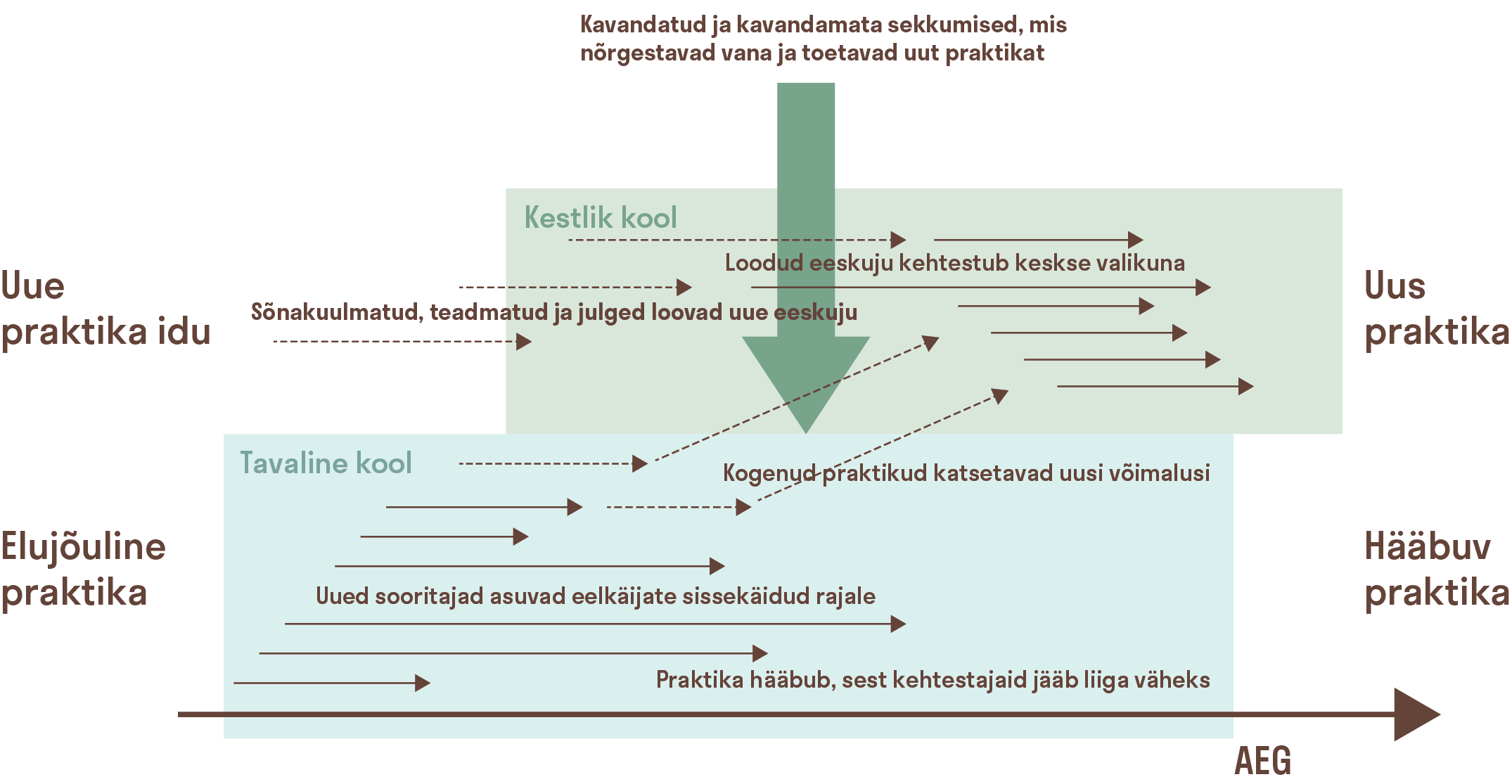
From the social practices perspective, young people are novices who acquire practical wisdom – that is, self-regulation skills – not so much through rational and intellectual processes, as behavioural theorists would assume,22 but by observing and imitating experienced others.23 These predecessors, in turn, quickly correct novices when they fail to follow established practices. Figuratively, a child enters traffic at a parent’s side. By following the parent’s example, the child builds the necessary movements into bodily memory – balancing on a bicycle or setting off at a green light – learns how to interpret the activity (for example, that a bicycle sign marks a cycle path and that traffic keeps to the right), adopts the objects associated with it (handlebars, pedals and fuel tap), masters forms of signalling (horn, hand signal or nod) and grasps the structure of the activity (its frequency, timing, sequence, interweaving and interruption).24 Each collective behavioural pattern endures only as long as new novices are willing to learn and sustain it (see Figure 6.1.1). Where environmentally sustainable practices are not embodied at home or at school, it is unrealistic to expect pupils to challenge environmentally harmful behaviours that they are likely to perceive as normal at this stage of development.
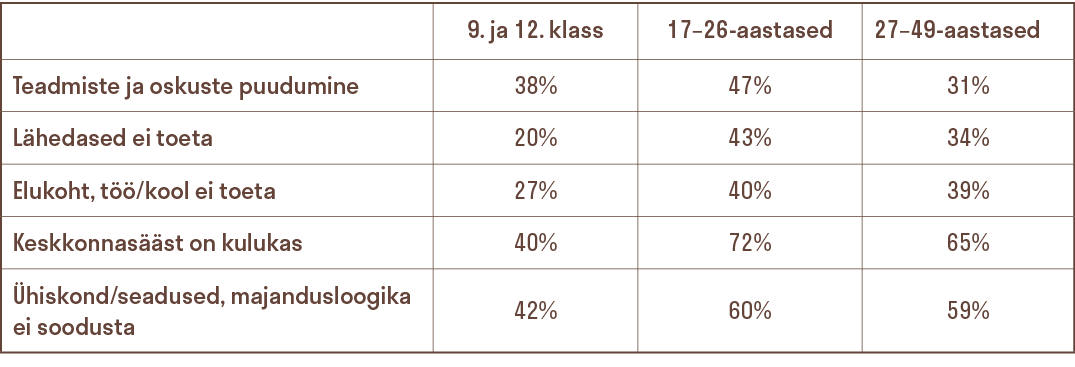
The behavioural change perspective starts from the premise that good intentions are hindered by a flawed system, which policy documents often reduce to rules, prices, infrastructure and similar factors.25 According to the EKTU and ÕKTU surveys (Table 6.1.2), respondents in Estonia most frequently identify legal constraints (for example, restrictions on redistributing food nearing its expiry date), economic logic (it is cheaper to buy new than to repair), and complexity or high costs (such as design work or insulating a house) as barriers. Fewer respondents point to constraints arising from the need to organise their lives around the expectations and norms of school, the workplace or close relationships. When sustainable choices demand additional effort, they can create a sense of struggling against an unfavourable system.
The social practices perspective does not separate sustainable aspirations from the system. On the contrary, by pursuing their ambitions, individuals contribute to weaving ever more of the social fabric that reduces opportunities for environmental protection. Environmental impact does not arise in isolation but through activities, such as visiting friends, searching for recipes online or engaging in hobbies, and not primarily through individual actions but through collective routines or practices embedded in resource use and pollution, reproduced across society. For example, a recipe choice may reinforce deforestation decisions in rainforests and increase the carbon emissions of ships transporting exotic fruit.
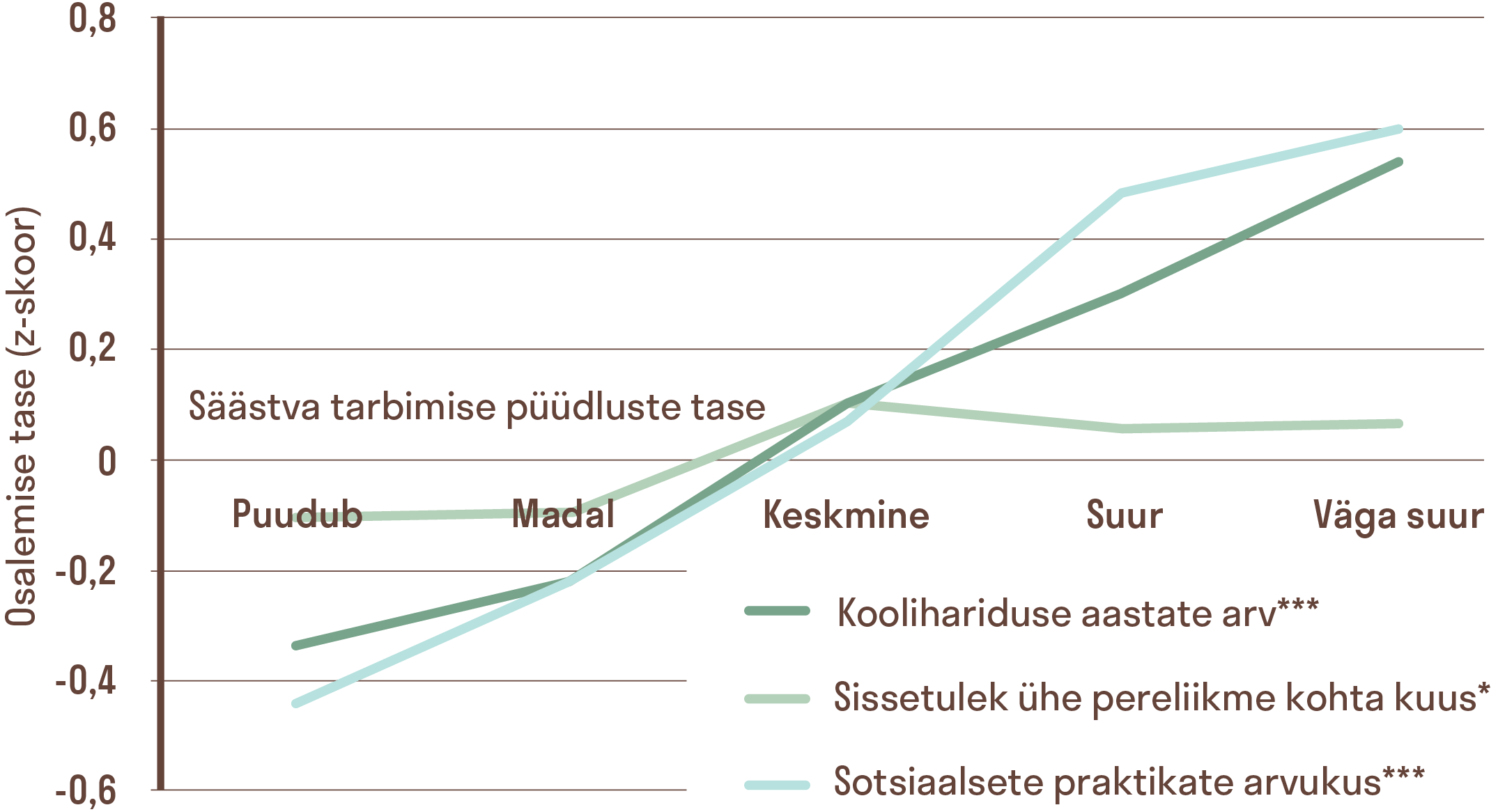
Although educational attainment and environmental aspirations often coincide, higher educational attainment is also associated with higher income – and with higher levels of consumption.28 Sustainability principles may attach more readily to highly educated individuals, but so do environmentally intensive activities such as travel, visits to theatre, cinema and museums, sport, diverse lifestyle products, media and print consumption, and technological devices (see Figure 6.1.2).29 From a social practice perspective, education opens access to patterns of social participation linked to greater economic well-being and less visible forms of consumption, reinforced by a sense of effective self-regulation. Reducing environmental impact would therefore require relinquishing opportunities for which education and income prepare individuals but whose environmental consequences remain largely imperceptible. Accordingly, the social practices approach focuses less on what occurs in people’s minds and more on how the practices that structure society might be reshaped.
SUMMARY
Education plays several roles in shaping sustainable choices. It disseminates knowledge that has been relatively recently produced within the scientific community and translated into learning materials. Later in life, access to up-to-date knowledge becomes more uneven. Education can also give emotional meaning to environmental knowledge, helping people value what is at risk and cope with uncertainty by offering ways to move beyond anxiety. Through the learning environment, education can help instil sustainability-related habits that should likewise be practised outside the education system.31 Education also develops transferable skills relevant to sustainability, including the ability to engage with social norms and decide whether to follow or challenge them.
At the same time, education opens access to patterns of social participation that increase society’s pressure on nature. A central task is therefore to prepare promoters of sustainability, including through lifelong learning.32 According to the EKTU survey, individuals with higher education are more likely to draw others’ attention to the need for environmental protection.
In Estonia, several programmes have recently been launched to equip decision-makers to address environmental crises and identify key decision points for change. Green skills courses have been added to vocational and higher education curricula, teachers are being trained (for example through the ABC of Climate Awareness programme), and new curricula and micro-credentials are being developed to enable those already active in the labour market to reflect on their workplace’s role in shaping a sustainable world.
Alongside learning outcomes, environmental education research is returning to the practice of education itself,33 which is not separate from broader social patterns. Examining societal interdependencies therefore requires looking inside the ‘black box’ of schools: designing learning processes together with practitioners – teachers, school leaders and extracurricular coordinators – and with change agents, such as parents, communities, local government actors and entrepreneurs, in order to mitigate tensions between education and sustainability.34 Even so, the impact of education ultimately depends on the extent to which society as a whole is prepared to embrace change.