Extracurricular education as an investment in Estonia’s security
- The effective prevention of youth offending requires well-timed interventions, as different offences and age groups have distinct risk periods. Violence peaks around midday, theft and traffic offences mainly occur after school, and substance-related offences concentrate late in the evening. Prevention strategies must consider when to intervene, which groups to target and which forms of risk behaviour to address.
- Exclusion in school and in extracurricular education increases the likelihood of risk behaviour among the most vulnerable young people. Children with special educational needs and those from low-income families are more likely to be excluded both in school and from extracurricular education. This double exclusion means they receive support from neither formal nor non-formal learning environments, which deepens learning difficulties and marginalisation and increases the risk of offending.
- Adolescents face the highest risk of offending but participate least in extracurricular education. Among 7–12-year-olds, offences are concentrated during school hours (8:00–14:00), whereas among 13–17-year-olds they occur mainly after school, during the period typically associated with extracurricular activities (14:00–20:00). Despite this, participation in extracurricular education is lowest among 13–17-year-olds, even though their offending patterns are more dispersed, their independence greater and their risk factors more diverse.
INTRODUCTION
The links between education and law-abiding behaviour are often deeper than they appear at first glance. Research shows that reforms in the education system introduced with positive or innovative aims can nonetheless have unintended adverse effects on levels of youth offending. For example, the introduction of a four-day school week has been associated with up to a 20% increase in property offences among pupils in upper secondary school, largely due to the additional unsupervised day without a structured routine.1 An even more striking example concerns teachers’ strikes: during strike periods, property offences committed by young people may rise by as much as 14%.2
Studies indicate that the early onset of offending substantially increases the risk of persistent criminal behaviour. If a young person has not committed an offence by the age of 15, the likelihood of later involvement in crime is low.3 Given that young people spend a significant share of their formative years in school, the school-day environment plays a central role in shaping both risk and protective factors. Protective factors function as buffers that mitigate risks and support healthy development, including a supportive school climate, positive peer relationships, a safe physical environment, opportunities for self-expression through extracurricular education, and the development of self-confidence and coping skills. Previous research has shown that offences involving pupils tend to increase during the school year – particularly in autumn and spring – and decline during the summer months.4
The aim of this article is to analyse the temporal distribution of youth offending on school days in order to identify key risk windows – that is, times when the likelihood of offending is highest. It also provides an overview of the availability of extracurricular education in Estonia, as research identifies it as one of the most effective measures for reducing youth offending.
Data and methodology. From September to the end of May in the 2023 school year, the Estonian Police and Border Guard Board registered 2,701 offences committed by 7–17-year-olds; during the same period in 2024, 2,520 offences were recorded. The offences were mapped across a 24-hour time scale.
THE RISK WINDOW FOR OFFENDING IN ESTONIA IS LONGER THAN IN OTHER COUNTRIES
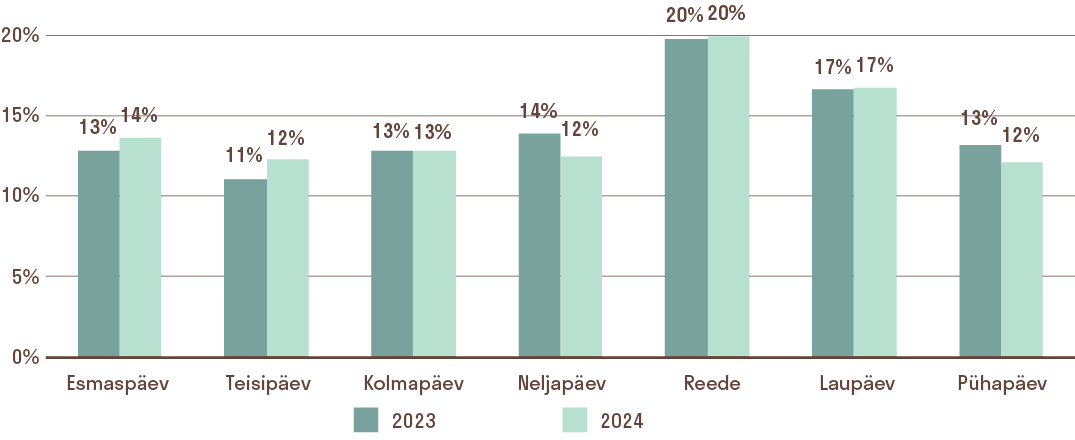
Youth offences during the school months of 2023 and 2024 followed a clear pattern: most incidents occurred on school days, particularly on Fridays (20%), when the risk appears to be highest (Figure 7.4.1). Fewer offences were recorded on Tuesdays and Wednesdays. The midweek decline may indicate that the regular structure and routine of the school week help reduce risk on those days.
A comparison of school days and weekends reflects clearly different daily routines (Figure 7.4.2). The data indicate that youth offending is closely linked to daily schedules and levels of supervision. The end of the school day and late-night hours at weekends constitute risk windows that warrant particular attention in prevention efforts and in safeguarding young people. This pattern is consistent with routine activity theory in criminology, which holds that the likelihood of an offence is greatest when a motivated offender encounters a suitable target in the absence of capable guardianship.5 Such conditions often arise at the end of the school day, when parents are still at work, and during late evening hours outside the home.
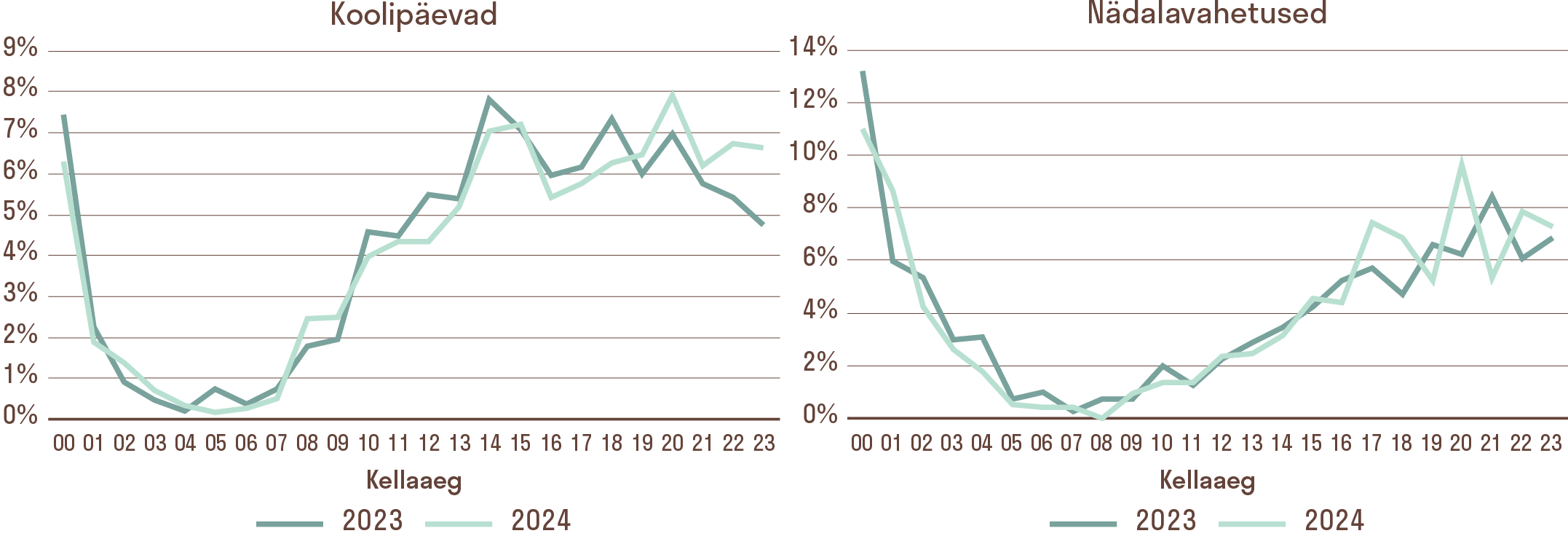
Research dating back to the 1940s has shown that youth offending is not concentrated at weekends but occurs more frequently on weekdays, particularly after the end of the school day.6 Numerous studies have confirmed that both offending and victimisation among young people peak immediately after the final school lesson.7 The most frequently cited risk window falls between 14:00 and 18:00 or 15:00 and 18:00 – precisely the time when school has ended but parents are still at work.8 Estonian data, however, point to an even longer risk window. Figure 7.4.3 shows that the main risk period for youth offending in Estonia on school days extends from 14:00 to 20:00. This may partly be explained by family structure and supervision-related factors. In 2024, single-parent households accounted on average for 12.7% of households with children in the European Union, whereas in Estonia the figure was 36.7% – the highest in the EU.9 Estonia was followed by Lithuania (29.5%), Latvia (24.9%) and Denmark (23.2%). In 2023, one in three single parents in Estonia lived at risk of poverty, and one in four single-parent households experienced material deprivation, meaning an inability to afford several goods and services regarded as standard in society.10
Many parents, including single parents, work long hours or shifts, leaving young people unsupervised more often in the late afternoon and evening. Similar patterns have been observed internationally: young people growing up in low-income single-parent households or in families affected by violence or substance misuse are significantly more likely to come to the attention of the justice system.11
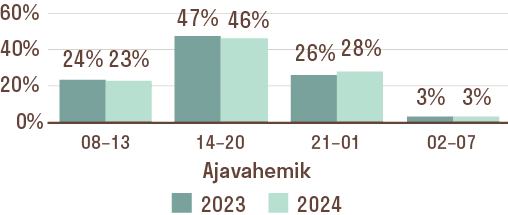
Approximately half of all offences committed on school days occur within the six-hour period between 14:00 and 20:00 (Figure 7.4.3). Offences are particularly concentrated between 14:00 and 18:00, when around one third of the day’s total offences are recorded.
PEAK TIMES IN YOUTH OFFENDING VARY BY OFFENCE TYPE: DAYTIME VIOLENCE, NIGHT-TIME SUBSTANCE OFFENCES, AFTER-SCHOOL THEFT AND TRAFFIC OFFENCES
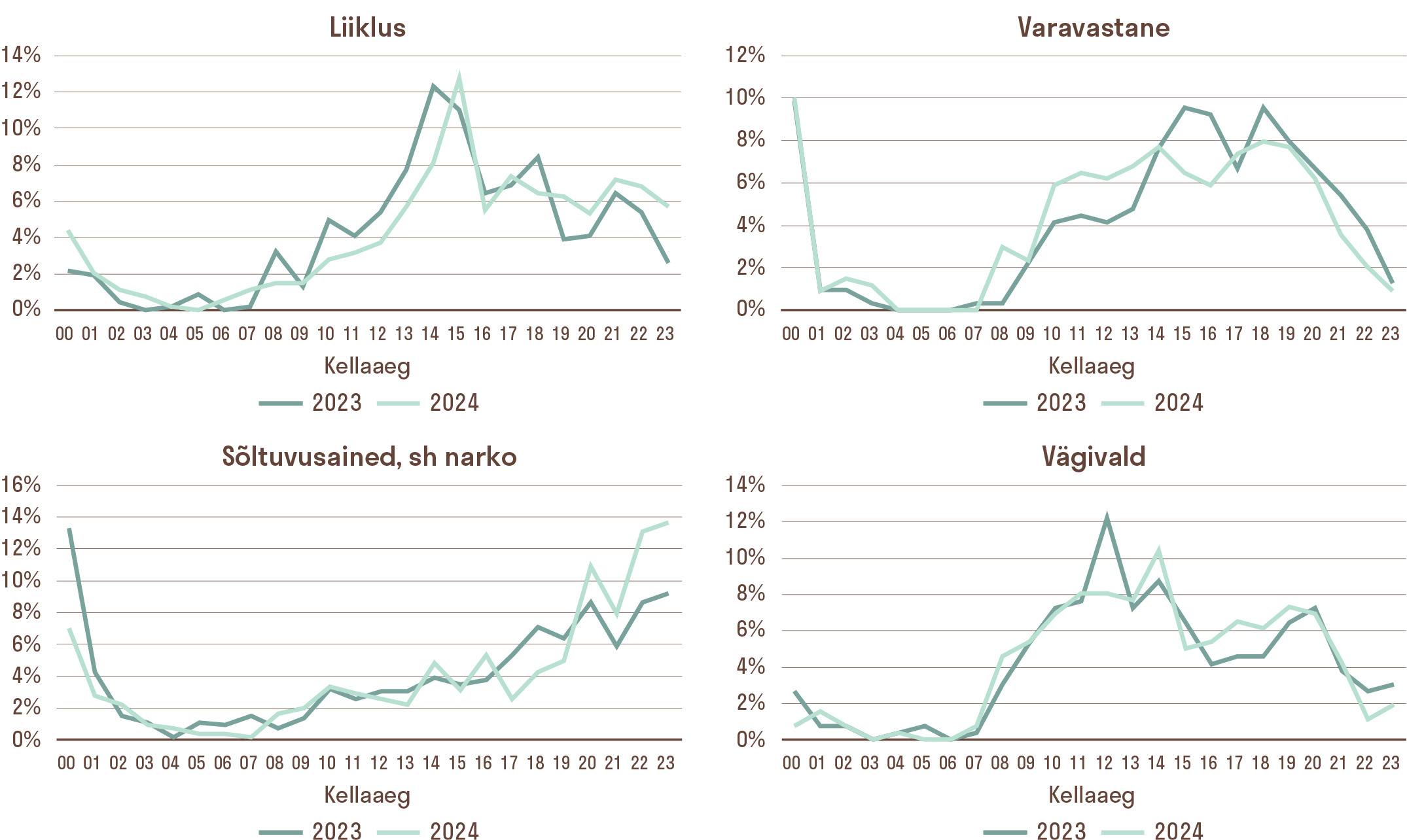
We next examine which types of offences occur at what time of day. Our analysis (Figure 7.4.4) shows that, on school days, each category of offence has a characteristic peak period – a time interval when the risk of that specific offence is highest. Traffic offences peak between 13:00 and 15:00, accounting for nearly 14% of all such incidents; half of all daily traffic offences occur between 13:00 and 18:00. Property offences are concentrated between 14:00 and 20:00, with a peak immediately after the end of the school day. Substance-related offences differ markedly: they occur predominantly late in the evening, between 21:00 and 00:00, when nearly half of all such incidents are recorded. Violent offences are most frequent between 11:00 and 14:00, coinciding with lunch breaks and, in some cases, the end of the school day, when supervision may be weaker and tensions between young people intensify.
Different types of youth offending also tend to cluster on specific days of the week. The highest number of offences occurs on Fridays, when young people’s independence and presence in public space increase. Substance-related offences clearly peak at the start of the weekend: nearly half of all such incidents are recorded on Fridays and Saturdays, suggesting an interaction between leisure time and reduced supervision. Violent incidents, by contrast, are concentrated in the middle of the school week – Wednesday to Friday – pointing to the possible accumulation of tensions in the school environment.
The temporal pattern of offending shifts with age: younger children offend mainly during the school day, whereas adolescents’ offences are spread across the afternoon and evening.
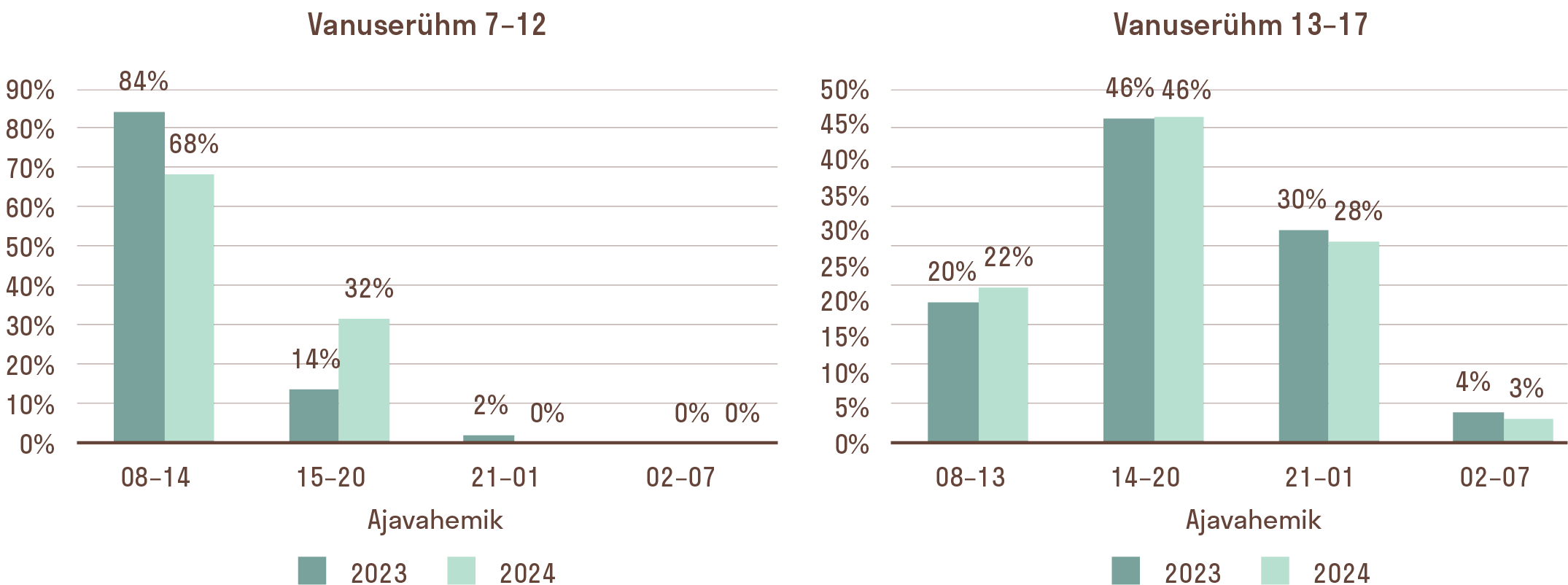
Figure 7.4.5 highlights a marked difference between the two age groups in the distribution of offences on school days. Among 7–12-year-olds, offences are clearly concentrated during school hours (8:00–14:00): in 2023, as many as 84% of incidents occurred during this period, and in 2024 slightly fewer, at 68%. This suggests that problems arise primarily within the school environment, where peer conflicts, behavioural difficulties and insufficient supervision may play a role. After the end of the school day, the number of offences declines sharply, with only isolated cases occurring in the evening and at night.
Among 13–17-year-olds, offences on school days are distributed much more evenly than among younger children. Although 14:00–20:00 remains the main risk window (46% of incidents in both years), a substantial share of offences also occur late in the evening, between 21:00 and 01:00. In 2023, 30% of all incidents occurred during this period, and in 2024, 28%. This reflects greater independence, more active social lives and often limited supervision after the end of the school day.
Age-related differences in risk behaviour indicate that preventing youth offending cannot be confined to the school day alone. Data from the United Kingdom show that nine out of ten young people in custody have some form of special educational need, most commonly emotional and behavioural difficulties and dyslexia.12 Many of these young people do not experience a single success during the school day, which in turn deepens exclusion and behavioural problems. Non-formal education, such as extracurricular education, may therefore serve as a crucial support mechanism. It offers young people opportunities to experience belonging, self-development and positive social relationships outside the structures of formal education, helping prevent escalating risk behaviour and marginalisation.13 Estonian studies indicate that not all youth workers are prepared or equipped to include young people with behavioural difficulties or special educational needs.14 As a result, these young people may face double exclusion – first within the formal education system, where they do not receive adequate support, and then in extracurricular education, where they are not always adequately included.
INEQUALITIES IN EXTRACURRICULAR EDUCATION IN ESTONIA MAY INCREASE YOUTH RISK BEHAVIOUR AND OFFENDING
Criminological research indicates that non-formal education, including extracurricular education and activities, is one of the most effective preventive measures against youth risk behaviour.15 This is particularly important for older adolescents, whose daily lives are marked by increasing independence, reduced adult supervision and more pronounced existential concerns. Miller’s five-year study of 21 youth gangs found that group-based offending is often driven by existential factors, notably boredom arising from a sense that life is empty, aimless and without meaning.16 According to Miller, society must reconsider how it relates to young people and recognise the harmful and potentially destructive effects of existential boredom.17 This applies to both risk behaviour and mental health.
High-quality extracurricular education that genuinely engages young people can reduce youth offending through two main mechanisms. First, it provides a safe setting and supervision during the critical afternoon hours when risk behaviour tends to increase. Second, it supports the development of values and social skills, strengthening internal motivation and a sense of belonging – effects that accumulate over time.18
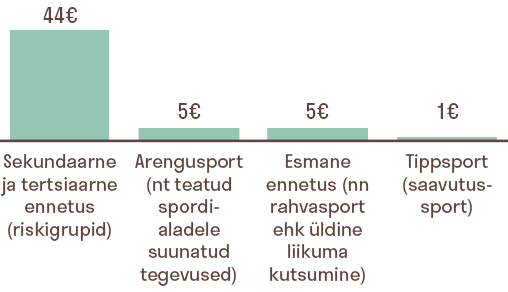
For example, each euro invested in sports activities for at-risk young people has been estimated to generate an average long-term saving of 44 euros for society (Figure 7.4.6). This impact is particularly significant when activities target risk groups – young people from disadvantaged socio-economic backgrounds, those with special educational needs, or those experiencing mental or physical health difficulties.
Participation in extracurricular education is more common among younger children, although the need for prevention is greatest among adolescents (Table 7.4.1). The age groups with the lowest participation rates are also those whose offending is more widely distributed across time and often more serious. Participation declines sharply from the age of 13: only 47% of 13–15-year-olds and 25% of 16–19-year-olds take part in extracurricular education. At the same time, data from the Estonian Police and Border Guard Board show that offences committed by 13–17-year-olds cluster in the critical afternoon and evening hours (14:00–20:00), when this age group is often unsupervised. This points to a clear policy implication: the provision and accessibility of extracurricular education should focus more strongly on adolescents, who need support precisely at the times when they are most vulnerable to risk behaviour.

Data and methodology. Extracurricular education refers to structured, long-term learning provided by licensed extracurricular schools registered in the Estonian Education Information System. Extracurricular activities are less formal and take place in various settings, such as schools and youth centres. As comprehensive national data are available only for extracurricular education, extracurricular activities are not included in this analysis. Statistics Estonia analysed participation in extracurricular schools among 7–19-year-olds in 2020–2023, examining participants’ background characteristics, including parental income and education, place of residence and school dropout. On average, 45% of children in this age group (approximately 84,269) participated annually in extracurricular schools, while 55% (approximately 102,962) did not.
SOCIO-ECONOMIC AND REGIONAL INEQUALITIES IN EXTRACURRICULAR EDUCATION
A 2019 study from the United Kingdom shows that the school a pupil attends, the region in which they grow up and their family’s socio-economic background largely determine which extracurricular opportunities are available outside the classroom.20 What is the situation in Estonia?
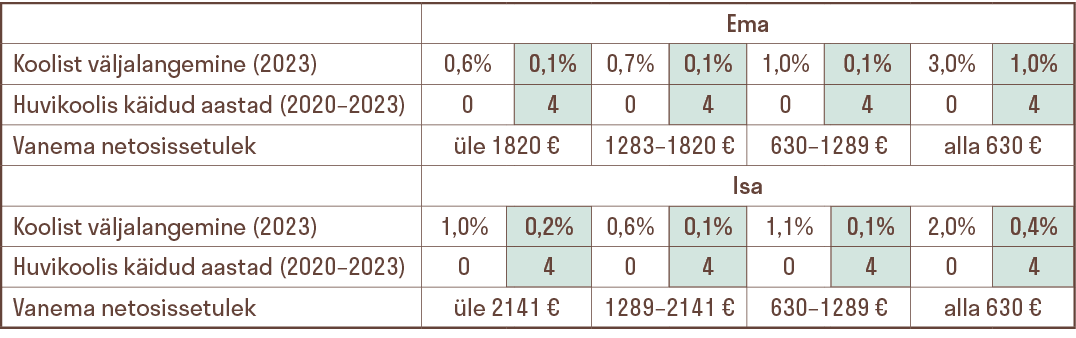
Among children whose parents have a high monthly net income (over 1,800 euros for mothers and over 2,100 euros for fathers), nearly 60% participate in extracurricular education. In contrast, in low-income families (below 837 euros for mothers and below 630 euros for fathers), participation falls to 37–40% (Table 7.4.2). When children from lower-income families are excluded from extracurricular education, they are more likely to spend time unsupervised and to engage in risk behaviour.

Extracurricular schools are located mainly in county centres, particularly Tallinn, Tartu and Pärnu, which may limit access for children and young people in peripheral areas (Table 7.4.3). While more than half of children in cities and small towns participate in extracurricular education (51% and 52%, respectively), only 31% of children living in rural areas do so. This indicates substantial access barriers in rural areas, whether due to distance, limited transport or a narrower range of activities. Rural areas also tend to have lower average incomes than cities, which directly constrains participation in extracurricular schools.

School dropout is more common among those who do not participate in extracurricular education. Table 7.4.4 shows that children from low-income families participate less often in extracurricular education and are more likely to leave school early – both recognised risk factors for offending. For example, among children whose mother’s monthly income is below 837 euros and who have not participated in extracurricular education, school dropout is three times more frequent than among children whose mother has the same income level but whose child has participated in extracurricular education for at least four years (3% vs. 1%). The same pattern is observed for fathers. It should be emphasised that this does not imply a causal relationship.
SUMMARY
A young person’s life rests on four main pillars: family, leisure time, peers and school. While the state cannot intervene directly in family life, it can influence the other three through school and extracurricular education. In Estonia, greater attention should be directed towards adolescents. Adolescence is a developmental stage in which young people seek belonging and role models, and peer influence is particularly strong. The more young people find their place in extracurricular education and organised activities rather than in loosely structured peer groups or unregulated online environments, the better the outcomes for both them and society. At the same time, marked socio-economic inequalities persist in Estonia: participation in extracurricular education is significantly lower among young people from low-income families and those living in rural areas.