From punishment to prevention in youth offending
- The aim of criminal policy for children and young people is to keep them out of the criminal justice system, reduce offending and ensure age-appropriate treatment if they do enter the system.
- The principle of special treatment for children in the criminal justice system is based on their developmental characteristics and social immaturity. Minors who commit offences are subject to appropriate developmental and educational measures corresponding to their needs and risk level.
- The number of recorded crimes and misdemeanours committed by children fell significantly between 2018 and 2024.
- A large share of criminal proceedings involving minors are discontinued by the prosecutor’s office. If the Prosecutor’s Office finds that the child can be influenced without subjecting them to a sanction, the proceedings may be terminated and the child issued a warning. With the child’s consent, the prosecutor may also impose obligations such as community service, treatment or participation in a social programme.
- Children’s and young people’s need for assistance must be identified as early as possible. Preventing their entry into the criminal justice system requires cooperation between education and social welfare systems to provide the necessary support to the child and family.
INTRODUCTION
The Fundamentals of Criminal Policy Until 20301 set the objective of a safe and just society in which few children and young people come into contact with the criminal justice system – one that is independent, effective, smart and supportive of victims. For children and young people, the policy aims to prevent entry into the criminal justice system, reduce offending and ensure age-appropriate treatment where they do enter the system.
The contemporary approach to juvenile offending recommends moving away from fines and detention towards a responsibility-based model that emphasises educational measures and teaches children responsibility. In resolving cases, priority should be given to non-punitive measures, such as reparation for harm, mediation between the parties or participation in social programmes.2
According to international recommendations, responses to juvenile offending must consider the minor’s age, needs and rights.3 The need for the special treatment of children arises from their developmental characteristics and social immaturity. Social factors require intervention by education and social welfare systems, while age-related causes of offending often diminish over time. The consequences of an offence should follow as swiftly as possible and be proportionate, efficient and oriented towards rehabilitation. In low-risk cases, the response should be minimal, while primary attention should be directed towards medium- and high-risk offenders. Responsibility for addressing the offence and finding solutions should rest primarily with the minor, the parents and the community. Where the child can be supported through the family, school, social welfare or other services, recourse to the justice system should be avoided. Responses should reflect the principles of restorative justice,a and the child must be given the opportunity to make amends. The child must be heard and involved in responding to the offence and finding solutions. Measures resulting in the deprivation of liberty should be avoided for children.4
THE REFORM OF SPECIAL TREATMENT OF CHILDREN SEEKS TO SUPPORT A LAW-ABIDING LIFE PATH
In addressing offences committed by children, it is essential to prevent further offending, help the young person understand the consequences and impact of their actions, and support them in remaining on a law-abiding path. Legislative amendments supporting the special treatment of minors,5 based on the principles of special treatment of minors, entered into force in 2018. According to these principles, children and young people who commit offences should be subject to appropriate developmental and educational measures. The choice of intervention must be based on the child’s needs and risk level, and intervention must be limited to the necessary minimum.6 In 2018, the Estonian Penal Code was amended to provide that a child may be sentenced or sanctioned only if other measures are insufficient to prevent further offending (Penal Code, Section 56(3)). This means that before imposing punishment, the authority conducting the proceedings must always consider the possibility of applying non-punitive measures. This applies in both criminal and misdemeanour proceedings.b The environment in which children accused of offences are placed is also important. The Code of Criminal Procedure was also amended to allow courts to place a minor in a closed child care institution instead of ordering pre-trial detention (Code of Criminal Procedure, Section 131(32)).
b Under Section 87 of the Penal Code, various measures may be applied to a minor in misdemeanour and criminal cases: a warning, participation in a social programme, indemnification and remedy for damage caused by the criminal offence or misdemeanour, addiction or another treatment, mediation service, community service (depending on the offence), restriction of freedom of movement (combined with supervision of conduct in criminal cases), placement in a closed children’s institution, and any other obligation voluntarily assumed by the person.
When determining appropriate obligations in response to a criminal offence, account is taken of the legal classification of the act, the young person’s attitude towards the offence, and, where relevant, previous offences and their nature. This means that even where two young people have committed exactly the same offence, the obligations or measures imposed may differ. Analyses show that fines are imposed far less often than before the reform, while warnings, referral to social programmes, coercive fines and other obligations are used more frequently.7
In Estonia, the age of criminal responsibility begins at 14. A person younger than this is automatically deemed incapable of guilt due to age and cannot be held criminally liable or punished. Acts committed by children under 14 are nevertheless investigated in order to clarify the circumstances.
Under the Child Protection Act, a child whose behaviour threatens their own or others’ well-being is considered a child in need of assistance (Child Protection Act, Section 26). In such cases, child protection services are brought in to determine the causes of the behaviour and how to support the child. In complex cases, where the child’s behaviour endangers their own life, health or development or that of others, and the risk cannot be mitigated by any less restrictive measure, the child may, at the request of the local government and by court order, be placed in a closed child care institution under Section 1302 of the Social Welfare Act. The police, the prosecutor’s office and probation officers may also apply to the court for placement in a closed child care institution as a measure under Section 87 of the Penal Code. Where a minor is committed in custody, the prosecutor may request that custody be replaced by placement in a closed child care institution under Section 131(32) of the Code of Criminal Procedure.
A closed child care institution provides a safe environment and supports the child’s psychological, emotional, social, educational and cognitive development. The aim is to help the child cope in an ordinary environment without engaging in behaviour that harms their own life, health or development or the life and health of others. In a closed child care institution, the child’s sleep and waking patterns, as well as time spent studying or working and using screens, are regulated. Individual and group activities, physical exercise, balanced nutrition, leisure activities and support for recovery from trauma are provided. Children are given opportunities to experience success through activities suited to their abilities.8 Upon leaving the institution, the child returns home and to their community, where cooperation with the child protection worker continues. Based on the child’s needs, the child protection worker supports the child and family through case management and appropriate support measures.
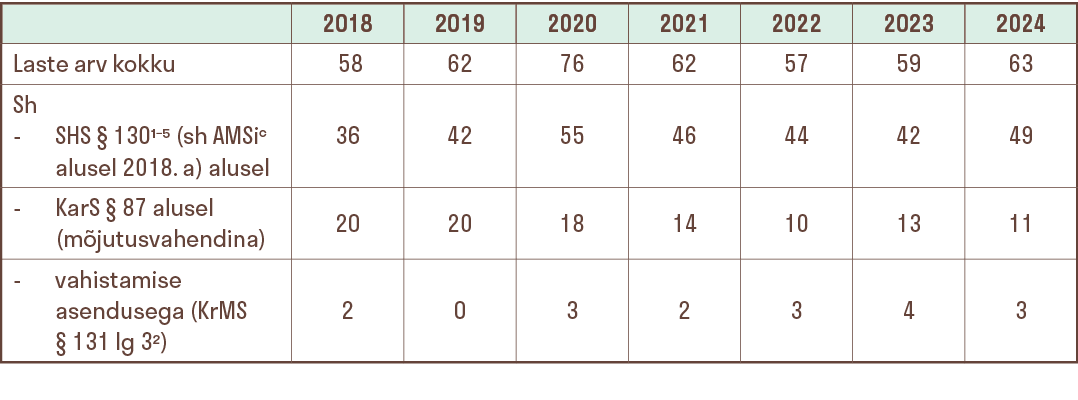
According to data from the Estonian Social Insurance Board, the number of children in closed child care institutions has decreased slightly compared with 2020 (Table 7.3.1). This may be related to the increase in available places as well as to the impact of the Covid-19 crisis. The majority of children placed in such institutions are admitted under the Social Welfare Act, following an application by the local government and consultation with the Social Insurance Board. The number of children placed in a closed child care institution under Section 87 of the Penal Code, as a measure for a minor, or under Section 131(32) of the Code of Criminal Procedure, as a substitute for detention, is significantly lower than the number placed there under the Social Welfare Act. In the years observed, an average of two to four children per year were placed in a closed child care institution as a substitute for detention. The number of children placed there as a sanction applicable to a minor has declined, which is consistent with the overall decrease in registered offences committed by minors (see Table 7.3.1 and Figure 7.3.1).
Over the seven-year period under review, the number of children in prison has also declined significantly (Table 7.3.2). Where possible, placement in a closed child care institution is preferred to imprisonment, as it provides more appropriate conditions for the special treatment of children. Children usually enter prison only in cases involving very serious or repeated crimes.
If a child is nevertheless imprisoned, they can continue their education, participate in therapy and social rehabilitation programmes, and maintain contact with family and relatives. During imprisonment, efforts are made to improve the child’s behaviour so that, on returning to society, they can lead a law-abiding life and have stronger coping skills. Family and community support are essential in this process. The court may release a convicted minor from punishment and place them under probation supervision, taking into account their level of moral and mental development and their ability to understand the unlawfulness of their act or to control their behaviour.

CHILDREN’S OFFENCES: FROM ALCOHOL AND TRAFFIC VIOLATIONS TO VIOLENCE AND THEFT
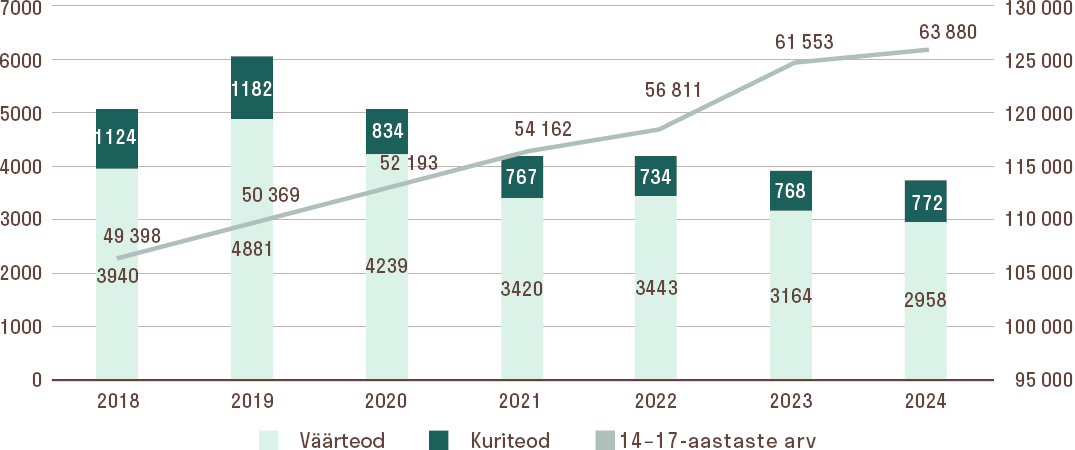
Offences committed by minors are classified as misdemeanours or crimes. This overview draws on administrative data from the Estonian Police and Border Guard Board, covering reported offences in which the perpetrator was identified. Since 2018, the number of registered offences committed by minors has declined. In 2024, the total remained below 4,000, but the number of 14–17-year-olds increased over the period under review (Figure 7.3.1).
Most offences committed by minors are misdemeanours, accounting for 79% of the total in 2024. Between 2018 and 2024, the number of registered misdemeanours committed by minors fell 1.3-fold and the number of crimes 1.5-fold (Figure 7.3.1).
In most cases, children come to the attention of the police because of a single offence. In 2024, 75% of minors who committed a misdemeanour committed only one such offence during the year, while the rest committed two or more. The average age of minors who committed offences in 2024 was 16 for misdemeanours and 15 for crimes. Three quarters of those who committed misdemeanours were boys and one quarter girls. In the case of crimes, one to two out of ten perpetrators were girls and the rest boys.
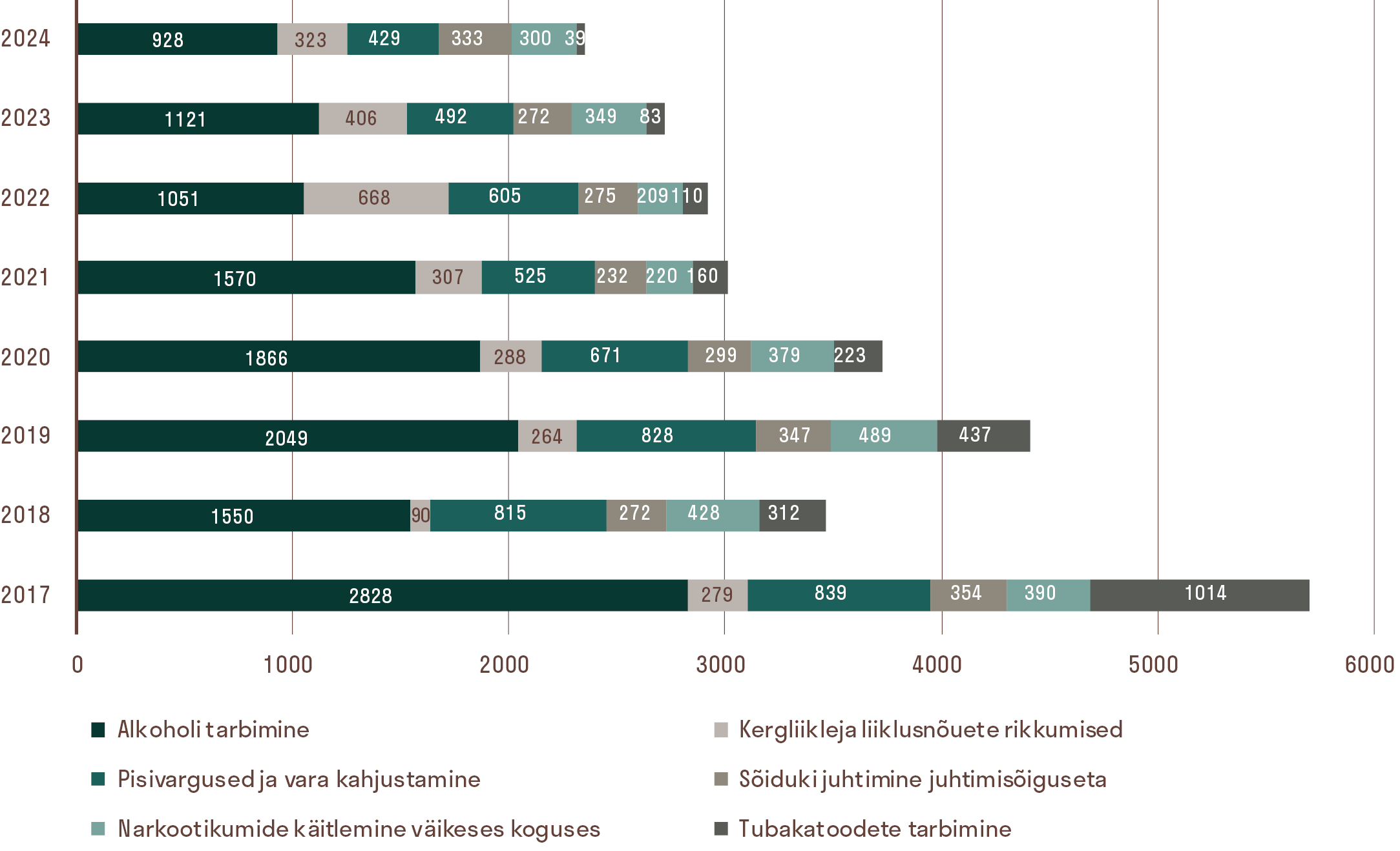
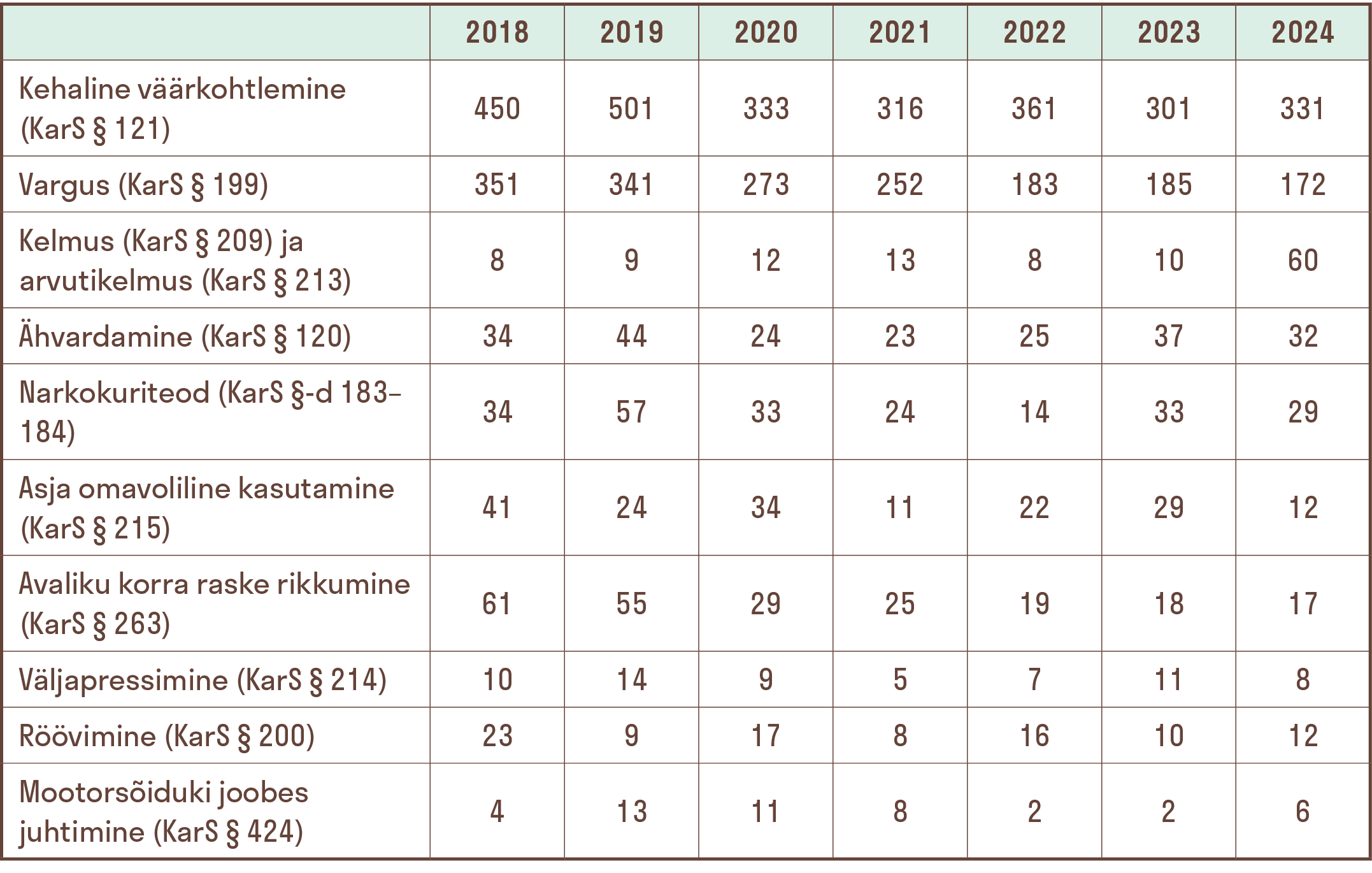
The largest share of registered misdemeanours committed by minors involves alcohol consumption, minor theft and traffic violations by light electric vehicle users. Compared with previous years, driving without a licence increased in 2024, while the number of other registered misdemeanours declined (Figure 7.3.2).
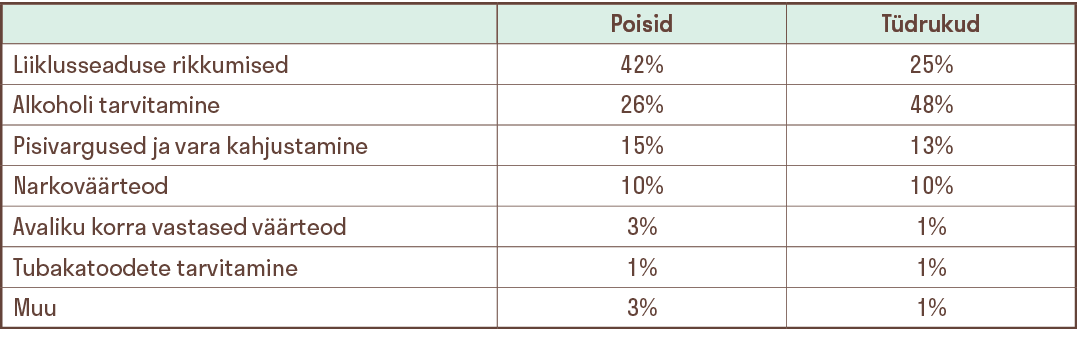
Of the registered misdemeanours committed by girls in 2024, a large proportion involved alcohol consumption (48%), followed by traffic law violations (25%), and minor theft and property damage (13%). Drug-related misdemeanours accounted for one tenth of all registered misdemeanours committed by girls. Among boys, the largest share of registered misdemeanours in 2024 consisted of traffic law violations (42%) and alcohol consumption (26%), followed by minor theft and property damage (15%) and drug-related misdemeanours (10%) (Table 7.3.3).
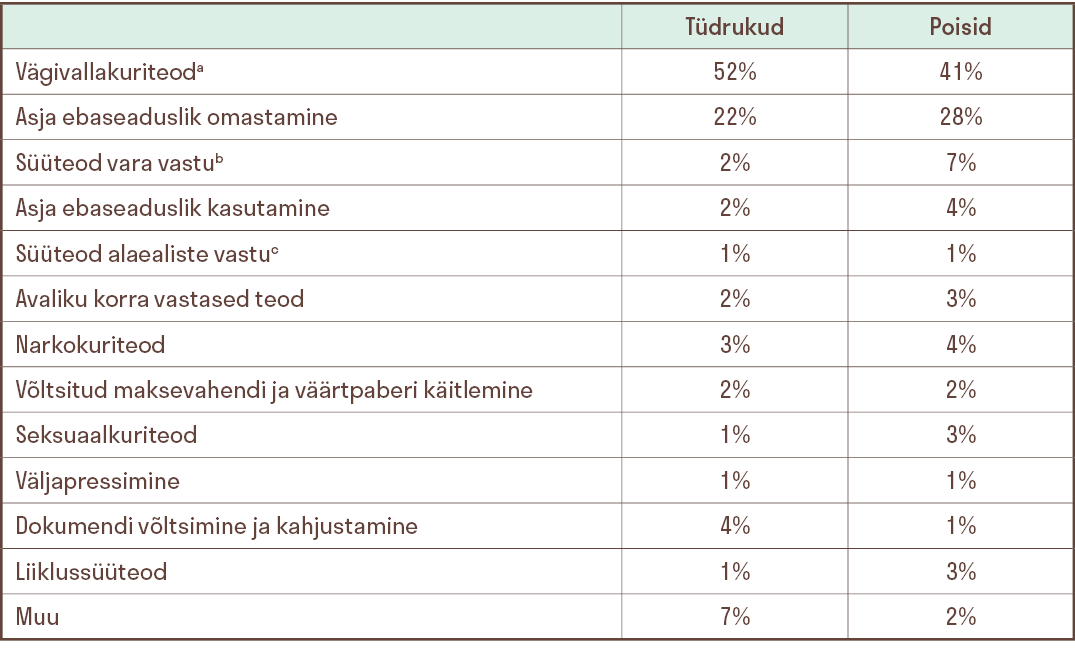
Crimes committed by children generally fall into two categories: crimes against the persond and crimes against propertye. In 2024, the largest share of crimes committed by minors consisted of violent crimes (47%) and unlawful appropriation of property (22%). Other types of crime, such as drug offences and public order offences, were registered considerably less frequently (see Table 7.3.4).
e Crimes against property include unlawful appropriation and unlawful use of property.
For both boys and girls, the most common crimes were violent crimes and unlawful appropriation of property, followed by unlawful use of property (Table 7.3.5).
Serious crimes against the person committed by children are registered only rarely (Table 7.3.6).

If criminal proceedings are not initiated or are terminated because the unlawful act was committed by a minor below the age of criminal responsibility, the investigative authority or prosecutor explains to the minor and their statutory representative the nature of the act that would have constituted a criminal offence and the grounds for terminating the proceedings. The investigative authority or the Prosecutor’s Office may send a notification, and a copy of any materials of the criminal case that are deemed necessary, to the municipality in whose administrative territory the minor’s residence is located (Code of Criminal Procedure, Section 201(1)).
If the Prosecutor’s Office finds that a person who committed a crime at the age of at least 14 but under 18 can be influenced without subjecting them to a sanction or a corrective measure under Section 87 of the Penal Code, the Prosecutor’s Office may terminate criminal proceedings, admonish the person and impose, with their consent, if appropriate, statutory obligations (Code of Criminal Procedure, Section 201(2)).f The prosecutor sets a time limit for fulfilling the obligation, which must not exceed ten months. If the person fails to comply within the prescribed period, the prosecutor may resume criminal proceedings by order. Before the proceedings are terminated, the minor and their legal representative must be informed of the nature of the act and the grounds for termination. When terminating criminal proceedings in respect of a minor, the Prosecutor’s Office may also send a notification and, where necessary, copies of relevant materials to the local government of the minor’s place of residence.
According to 2023 data, the majority (76%) of cases involving crimes committed by minors were terminated by the Prosecutor’s Office. 16% were resolved in court through settlement proceedings, and 4% resulted in an indictment (3% under abridged procedure and 1% under regular rules of procedure).
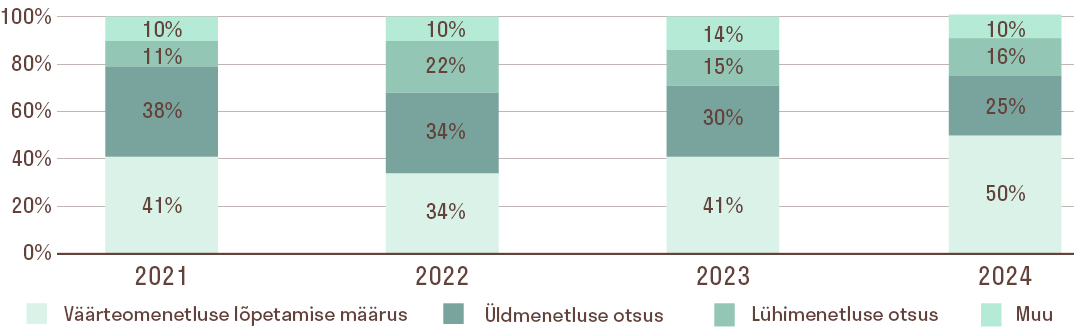
In misdemeanour cases, an out-of-court authority may decide not to initiate proceedings if it considers that an admonition is sufficient. If the authority finds that a person who committed a misdemeanour at the age of at least 14 but under 18 does not need to be subjected to a sanction or to a rehabilitation measure under Section 87(2) of the Penal Code, the authority may admonish the person, terminate the proceedings by order and, if the person is a child in need of assistance within the meaning of Section 26 of the Child Protection Act, send a notification regarding the child, and a copy of the requisite portion of the documents of the misdemeanour case to the municipality in whose administrative territory the child resides. In 2024, half of the misdemeanour proceedings initiated were terminated by order, one quarter were concluded by a decision under regular rules of procedure and 16% by a decision under abridged procedure (Figure 7.3.3).
THE EFFECTIVENESS OF OFFENCE PREVENTION DEPENDS ON COOPERATION BETWEEN SYSTEMS
In addressing offences committed by children, it is considered essential to prevent reoffending, help the child understand the consequences and impact of their actions, and support them in maintaining a law-abiding path. Referring to Article 37 of the UN Convention on the Rights of the Child and General Comment No 24 of the Committee on the Rights of the Child, Meeler and Todres emphasise that deprivation of liberty should be a measure of last resort within the justice system.9 In their view, the justice system’s responsibility towards children begins long before a child comes into contact with the criminal justice system, so every effort must be made to prevent children from coming into conflict with the law. This means promoting children’s well-being, reducing risk factors associated with offending, identifying children in need of greater support and providing measures through which the family, school and community can support the child without involving the justice system. Where a child has already come into conflict with the law, measures should be applied that divert the child from the justice system and favour non-custodial responses over detention and punishment.10 The reform of the special treatment of juvenile offenders introduced in Estonia in 2018 focuses precisely on this approach.
Data on children who have entered the criminal justice system show that those of criminally responsible age have generally reached the end of basic school or are of upper secondary school age. School is the environment where children spend much of their time with peers. When signs of learning difficulties or poor social skills are identified, the school is responsible, within its capacity, for providing support. At the same time, cooperation and information exchange with child protection services are essential, as they can support the child and family where necessary. Children themselves have noted that schools and child protection workers should cooperate more closely and that schools should identify concerns about a child’s well-being and report them to child protection services.11 In children’s view, child protection workers should monitor families’ coping capacity, make more home visits and speak directly with children.12
By law, both basic and upper secondary schools have an educational and developmental mandate. The learning environment must support pupils’ development, and teachers are required to monitor pupils’ progress and coping at school. The law provides for adapted instruction and specialist support where necessary. The school owner must ensure access to specialist support, and the head of the school is responsible for its implementation. Where a need for support is identified, parents are informed and the school organises a pedagogical and psychological assessment of the pupil. If necessary, cooperation with specialists from other sectors and additional assessments are recommended. Where the general support provided by the school does not achieve the intended developmental outcomes, enhanced or special support may be implemented on the recommendation of an external advisory team. To encourage pupils to comply with school rules, respect others and prevent situations that threaten safety, justified, appropriate and proportionate support and corrective measures may be applied. However, where a pupil’s need for support stems from the home environment, support from the education system alone is insufficient, and the state is responsible for identifying the family’s need for assistance and supporting parents in their parental role. Assistance may nevertheless come too late or prove inadequate, and if problems persist the child may end up in the criminal justice system.
It often emerges that a child facing difficulties lacks a safe home environment and may be exposed to violence, substance abuse or other adverse conditions. Children who embark on a criminal path have often grown up in disadvantaged circumstances and experienced trauma, including domestic violence and parental mental health problems. Child protection workers, judges and police officers are aware of this and seek to take it into account when applying measures. Whereas before the reform children were more often fined or sent to special schools or prison, child protection workers, police and prosecutors now focus more on the underlying causes of behaviour and provide educational support, such as referral to therapy or targeted programmes.13 One option is to apply restorative justice practices, which focus not on punishment but on understanding the consequences of the offence and exploring ways to repair harm through agreement.
The purpose of these measures is to prevent children from committing further offences, and the surrounding environment plays a key role. Jonathan Todres and Shani M. King have noted that a lack of feelings of safety and closeness in childhood may cause lasting harm to mental health and affect functioning in adulthood.14 Studies show that children who have a positive and trusting relationship with their parents are healthier, more active and generally more satisfied with their lives than those who lack supportive relationships at home.15 As most offences committed by those under 18 are isolated incidents, appropriate measures can improve coping skills and support a law-abiding life. Research has also shown that the longer pupils remain in the education system, the lower the likelihood that they will engage in criminal behaviour later in life.16 It is therefore particularly important that children’s needs are recognised within the education system and that, through cooperation between education and social welfare services, appropriate support is provided as early as possible. A minor who has committed an offence is a child in need of assistance; it is essential to understand the reasons for the offence, mitigate associated risk factors and strengthen protective factors that support law-abiding behaviour.