Studying in Estonian-medium schools supports the integration of ethnic minorities
- Ethnic residential segregation has stopped increasing, but significant differences in residential patterns between ethnic groups remain.
- The share of pupils studying in Russian-medium schools has long remained stable.
- Studying in Estonian-medium schools helps young people from minority backgrounds break out of the cycle of segregation.
INTRODUCTION
Schools play a dual role in shaping spatial segregation and integration. On the one hand, parents’ residential choices directly determine which schools their children attend. This reflects the allocation effect, whereby parents’ residential and school choices shape their children’s educational pathways and future life trajectories. On the other hand, schools transmit knowledge and shape children’s values, skills and social networks, influencing them throughout their lives. This reflects the effect of schools themselves, where institutions play a decisive role. At school, pupils develop alongside their classmates, often forming friendships that last a lifetime and developing values and attitudes that shape their later educational pathways, career choices and other life decisions.
The 2016/2017 Estonian Human Development Report employed the concept of a vicious circle of segregation.1 Ethnic segregation – or spatial separation based on ethnicity – involves living in different neighbourhoods, studying in different schools and working in different workplaces. Separation across these life domains tends to reproduce and accumulate in a self-reinforcing cycle. Parents’ residential locations and their choice of school for their children are closely connected, while educational attainment shapes employment and income and, in turn, residential choices in adulthood, potentially triggering a new cycle of inequality and segregation (Figure 4.1.1).
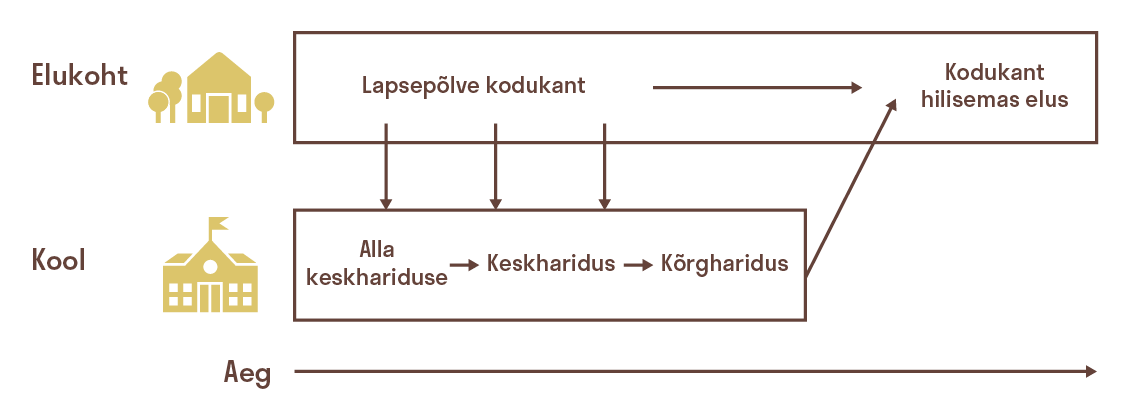
The development of inequality in society depends on the extent to which children from minority groups reproduce their parents’ patterns of segregation or, conversely, whether their life trajectories converge with those of the majority population, thereby strengthening integration between ethnic groups.
In this article, we analyse the residential choices of a cohort of young people whose mother tongue is Russian, using these as an indicator of broader societal integration. Living in similar areas requires two key preconditions directly related to integration: a willingness to live in similar neighbourhoods and comparable opportunities (income) to realise this preference. In the housing market, individual differences are often amplified, as people with similar levels of education are more likely than average to form families together. In other words, while education and labour market success are linked to individual opportunities and choices, housing decisions typically reflect the combined opportunities and choices of two partners.
To better understand the relationship between a school’s language of instruction and pupils’ later residential choices – that is, the link between school segregation and residential segregation – we focus on one generation of young people with Russian as their mother tongue who grew up in a Russian-speaking environment. Some of them studied mainly in Estonian-medium schools, others mainly in Russian-medium schools. We examine the extent to which their residential choices
in adulthood differed according to the language of instruction in the school they attended. Our analysis covers one cohort: young people with Russian as their mother tongue who completed basic education or upper secondary education in the Tallinn urban region in 2005 and 2006. These are the earliest general-education graduates for whom the dataset allows us to observe outcomes over a longer life course. At that time, the implementation of Estonian immersion programmes in Russian-medium schools was still at an early stage, and general education schools operated largely either in Estonian or in Russian. The life trajectories of this cohort can be followed up to the age of 30, by which point most have completed their education, left the parental home and acquired or rented their own dwelling. We focus on the Tallinn urban region because, unlike other parts of Estonia, it has a broadly comparable number of Russian- and Estonian-speaking residents, as well as the widest range of options for both residential location and school choice.
ETHNIC RESIDENTIAL SEGREGATION HAS STABILISED, BUT SIGNIFICANT DISPARITIES REMAIN
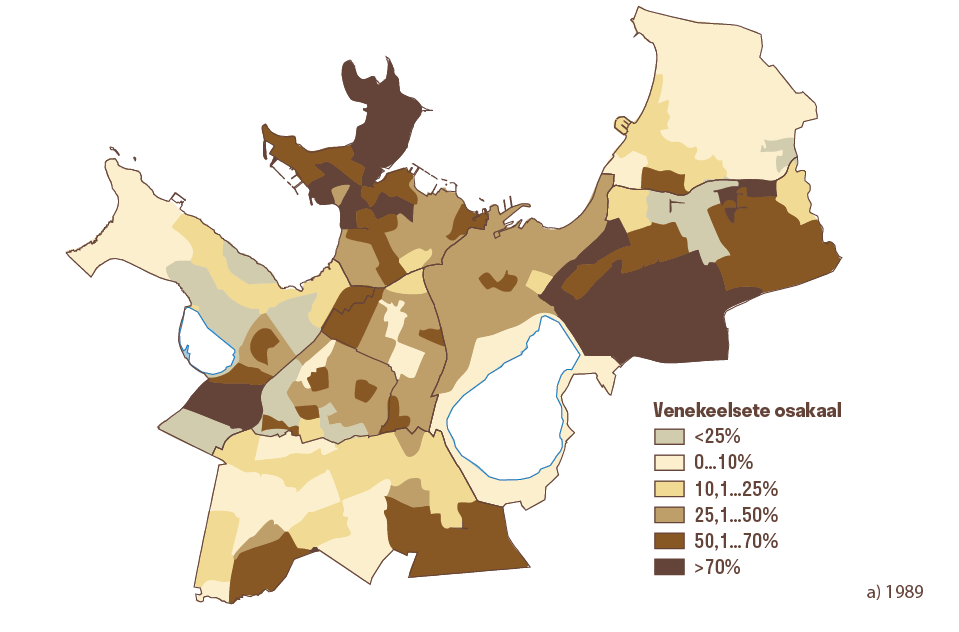
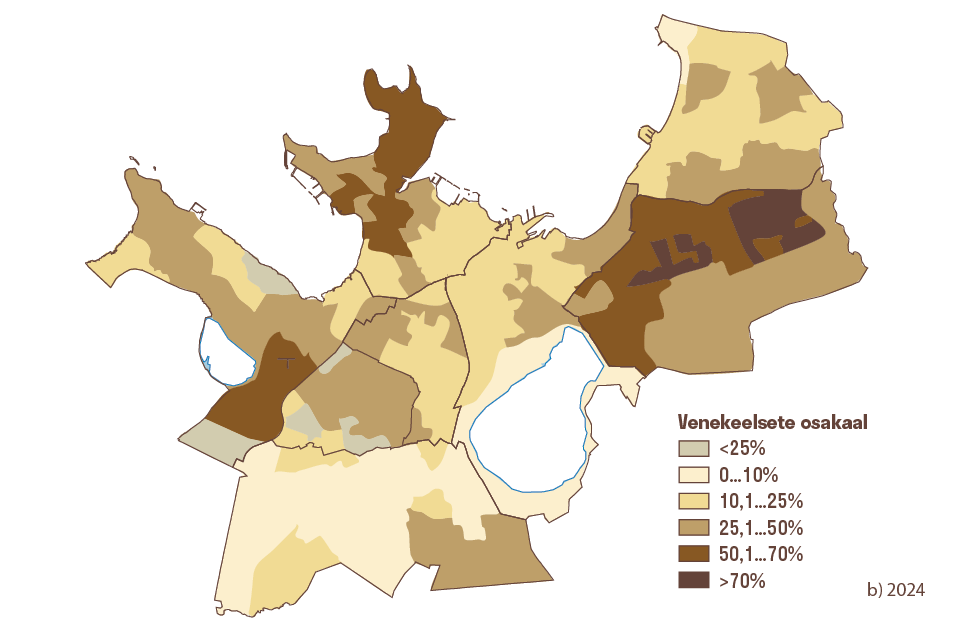
Over the past three decades, the share of people with Russian as their mother tongue has increased in Tallinn and Ida-Virumaa, while declining in all other regions (Figure 4.1.2). The most substantial changes occurred in the 1990s and were primarily linked to emigration from Estonia. Within the country, however, Tallinn has been the main destination for Russian-speaking internal migrants. Notably, there has been sustained migration from Ida-Virumaa to the capital. As a result, the proportion of Estonia’s Russian-speaking population living in Tallinn has steadily grown: from 41% in 1989 to 45% in 2011 and 50% in 2021. In other words, half of Estonia’s Russian-speaking population now resides in Tallinn.
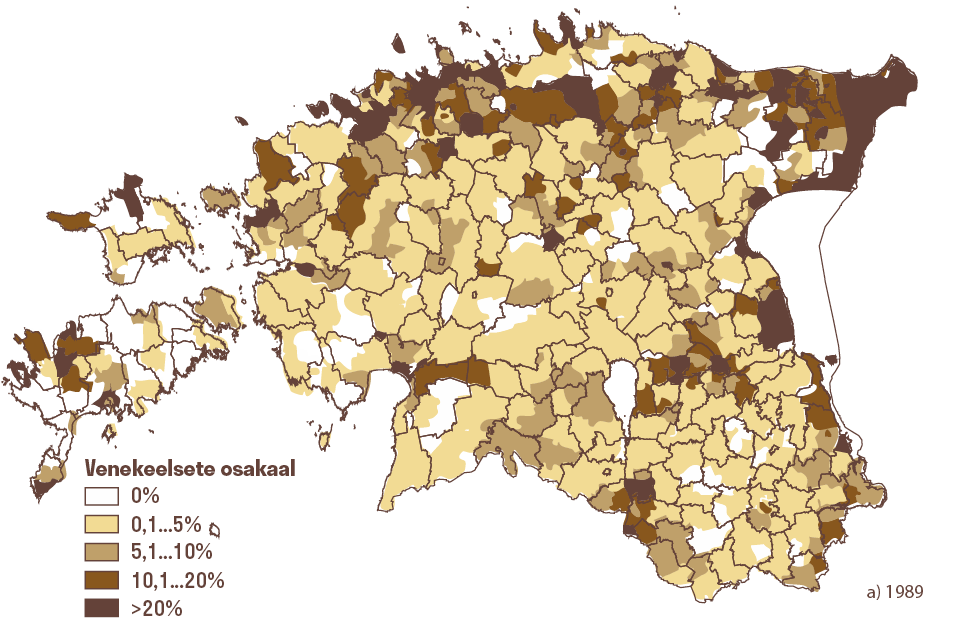
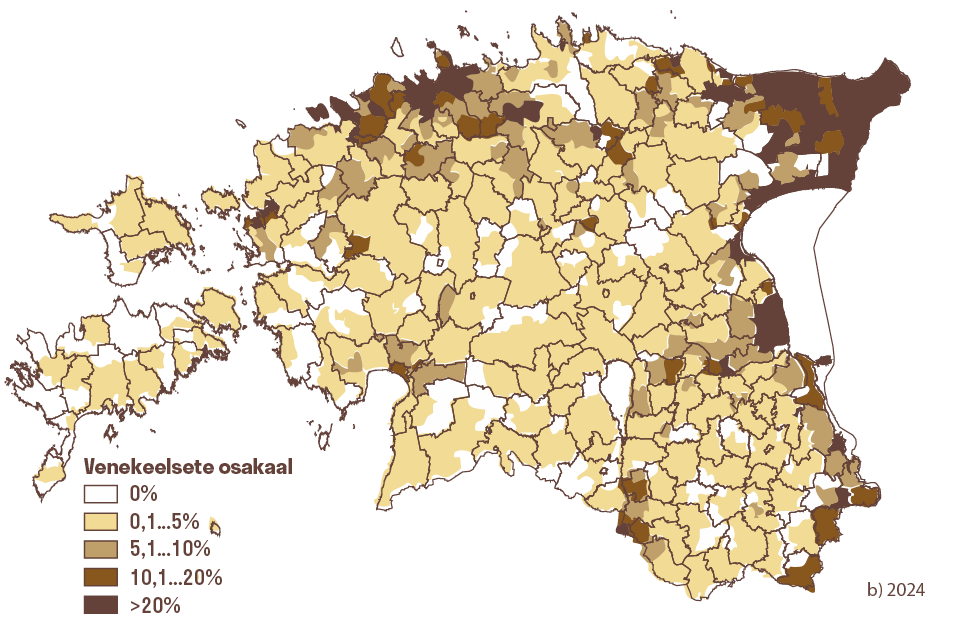
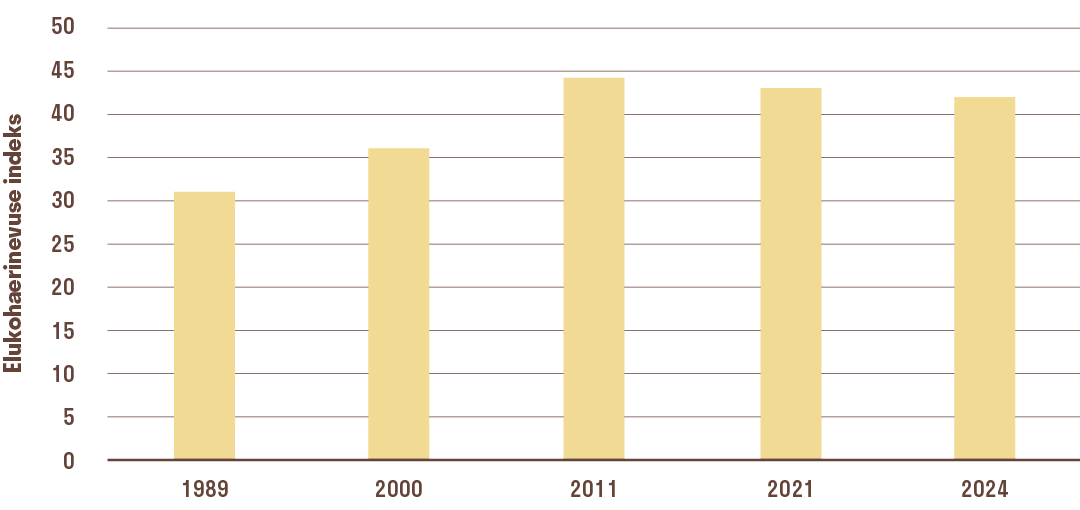
A similar pattern of ethnic concentration is visible in specific areas of Tallinn. In most cases, Russian-speaking residents have moved to neighbourhoods with more affordable housing. Residential segregation is commonly measured using the index of dissimilarity. This index indicates the percentage of members of a specific ethnic group who would theoretically need to relocate for each neighbourhood to reflect the city’s overall ethnic composition. An index value above 40 is interpreted as a high level of spatial separation between ethnic groups. In Tallinn, the index exceeds this threshold (Figure 4.1.3). The separation of Estonian- and Russian-speaking populations into different neighbourhoods occurred mainly in the 1990s and 2000s. Since then, residential differences within Tallinn have neither deepened nor significantly diminished. In other words, the marked disparity in residential patterns between language groups has stabilised. Over the past 10–15 years, the existing pattern of segregation has largely reproduced itself: Estonians are clearly overrepresented in older districts such as Kesklinn and Põhja-Tallinn and in areas of detached housing, while Russian-speaking residents are concentrated in large housing estates (Figure 4.1.4). For example, around 43% of Tallinn’s Russian-speaking population lives in Lasnamäe, the city’s largest district, where they account for approximately 80% of residents.
THE SHARE OF PUPILS STUDYING IN RUSSIAN-MEDIUM SCHOOLS HAS LONG REMAINED STABLE
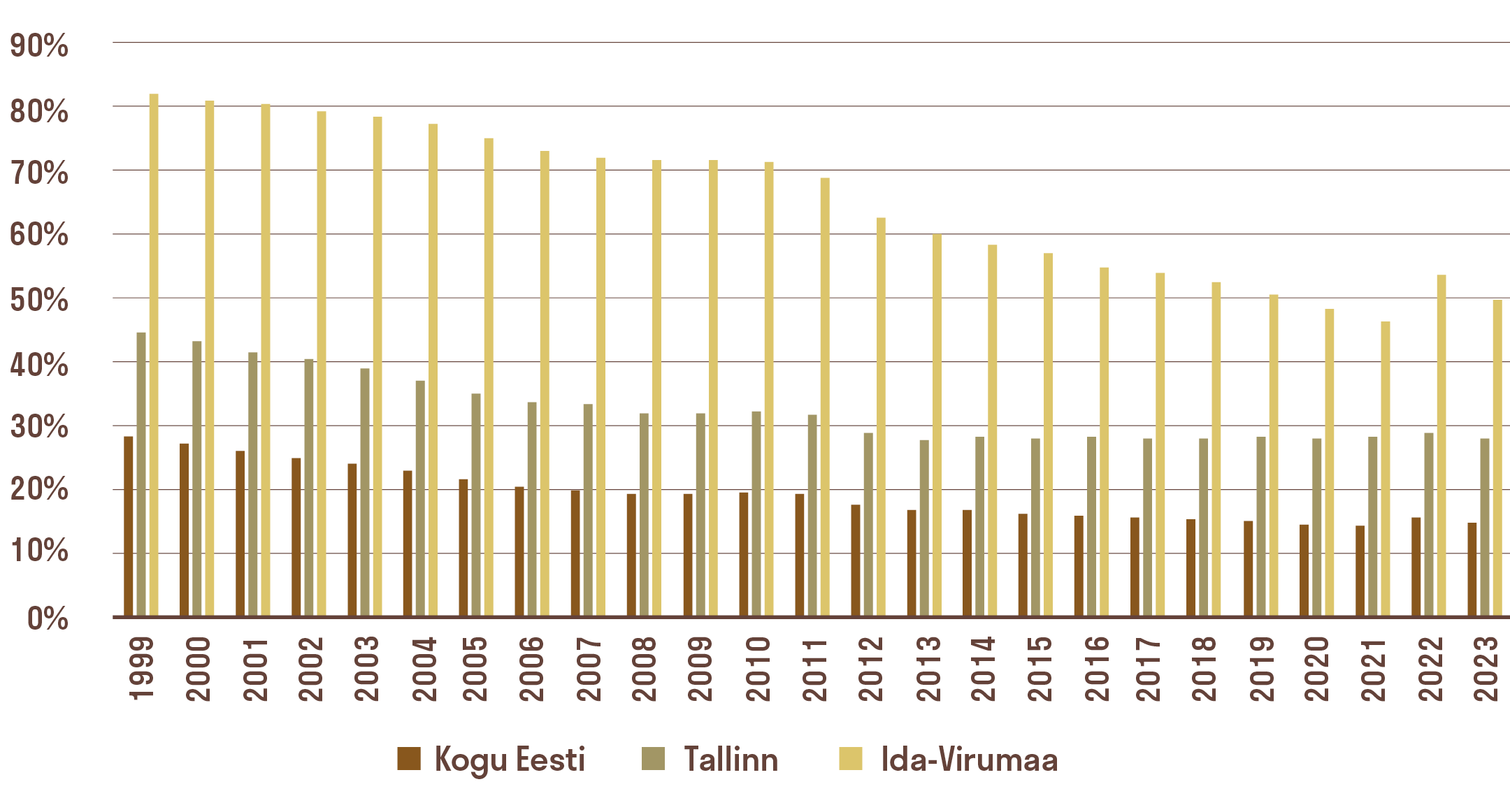
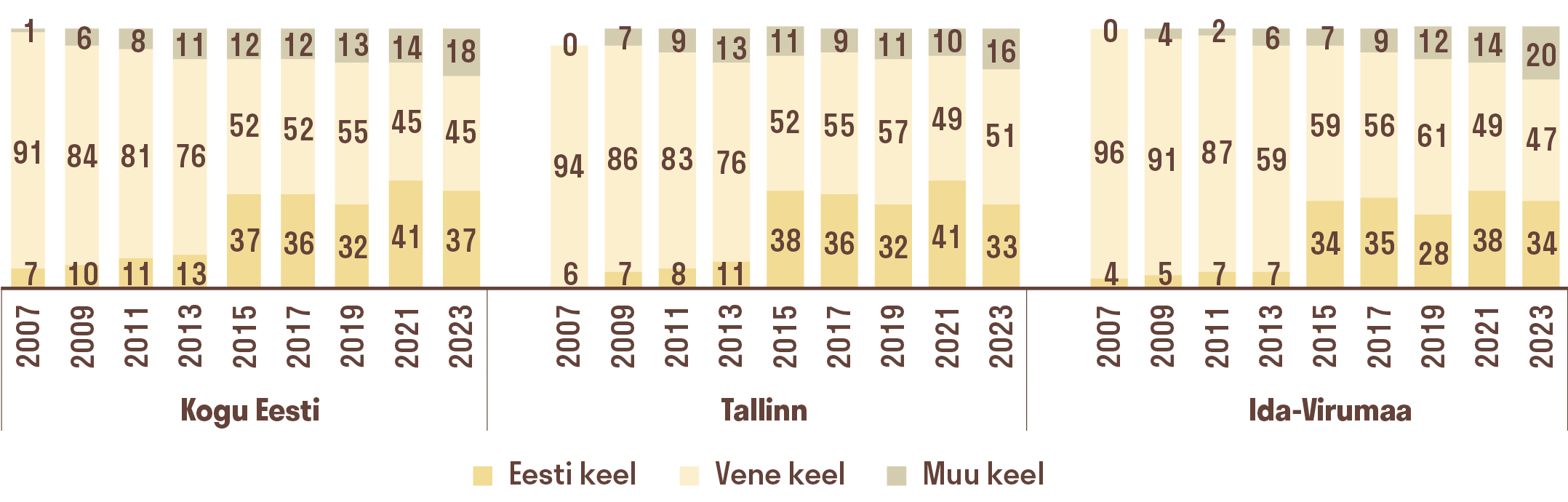
Although Estonia’s integration policy has seen many successes, integration has nevertheless progressed relatively slowly. One key factor has been the early separation of children into parallel language-based educational tracks through the language of instruction in kindergartens and schools. While the share of children studying in schools with a language of instruction other than Estonian (primarily Russian) declined until 2012, this trend has since stabilised. In 2023, around 15% of children in Estonia were still receiving education in Russian (Figure 4.1.5). In both Tallinn and Ida-Virumaa, the proportion of pupils enrolled in Russian-medium education has remained broadly stable over the past decade, at approximately 30% and 50%, respectively. A similar pattern appears when focusing specifically on pupils whose home language is Russian: the earlier decline in Russian-medium enrolment has levelled off, and nearly half of Russian-speaking young people were still studying in Russian in 2023 (Figure 4.1.6). In Tallinn, school choice is primarily shaped by parental preference rather than by limited availability, as Estonian- and Russian-medium schools are often located in close proximity. Parents can therefore choose the language of instruction for their children. Studying in Russian has remained a significant educational pathway, with implications for young people’s later life trajectories and their integration into Estonian society.
Several generations of Russian-speaking young people have completed their schooling in independent Estonia in school environments that have not ensured strong Estonian language skills; many have also had few opportunities to form friendships with Estonian peers. This hinders their integration into Estonian society. Compared with their peers educated in Estonian, young people who have completed upper secondary education in Russian are significantly more likely to envisage their future abroad. Among those who remain in Estonia, many face weaker labour market prospects due to limited language skills and narrower social networks.7 The 2016/2017 Estonian Human Development Report8 showed that unemployment is significantly higher among young people with Russian as their mother tongue than among Estonians of the same age. At the same time, a considerably larger share of Estonians hold higher-level positions, such as managers and senior specialists. These structural differences in labour market outcomes constrain residential choice: lower average incomes mean that people with Russian as their mother tongue have fewer opportunities to live in the same neighbourhoods as Estonians. It is therefore important to examine to what extent the life trajectories of Russian-speaking young people educated in Estonian differ from those educated in Russian.
STUDYING IN ESTONIAN-MEDIUM SCHOOLS HELPS BREAK OUT OF A VICIOUS CIRCLE OF SEGREGATION
There is extensive research on school choice, but relatively few studies examine how attending different types of schools shapes the later life trajectories and residential choices of young people from different ethnic backgrounds. Like the Nordic countries, Estonia uses a register-based census, which enables more complex longitudinal analyses by linking data on the same individuals over time across their life course. Whereas traditional censuses provide a cross-sectional snapshot of society at a single point in time, register-based data allow outcomes to be followed longitudinally.
In this article, we draw on longitudinal data on graduates of Tallinn basic schools and upper secondary schools from 2005 and 2006. We focus on young people with Russian as their mother tongue who, at the end of their studies, lived in Tallinn neighbourhoods where the share of Russian-speaking residents was above the city average.
Our analysis shows that the vast majority (94%) of young people with Russian as their mother tongue who grew up in neighbourhoods with a high share of Russian speakers – which we refer to as ‘Russian-speaking neighbourhoods’ – attended Russian-medium schools. Most (86%) also lived in Russian-speaking neighbourhoods in adulthood. Among those who moved away from their childhood neighbourhood, 68% relocated to another Russian-speaking neighbourhood. This points to a persistent pattern: Russian-speaking young people tend to remain in a familiar linguistic environment, where relatives, friends and acquaintances live and where services and infrastructure are available in Russian – for example, Russian-medium schools. The dominant life trajectory therefore consists of growing up in a Russian-speaking neighbourhood, attending a Russian-medium school and living in a Russian-speaking neighbourhood in adulthood. At the same time, there are indications of modest spatial integration compared with the parental generation. In adulthood, 14% of all young people and 32% of those who moved lived in neighbourhoods with a majority of Estonians, which we refer to as ‘Estonian-speaking neighbourhoods’. Those who moved to Estonian-speaking neighbourhoods were almost exclusively Russian-speaking young people who had studied in Estonian-medium schools; their number was very small.
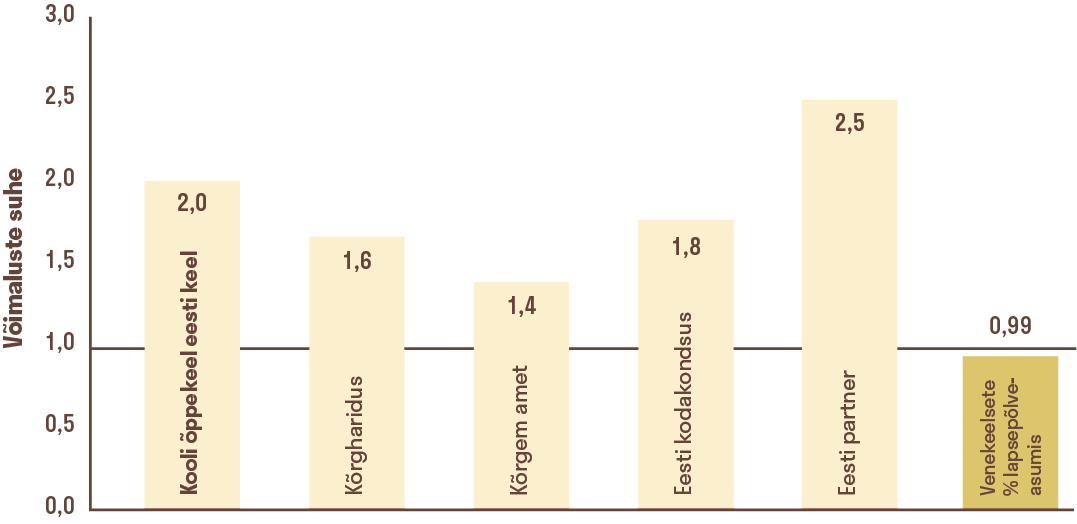
In addition to the language of instruction, several other factors may influence relocation to Estonian-speaking neighbourhoods. Our regression analysis (the final model is presented in Figure 4.1.7) examines the relationship between the language of instruction and residential outcomes in adulthood among young people who grew up in Russian-speaking neighbourhoods. Our primary interest is the extent to which adding other factors reduces the association between the school’s language of instruction and residential choices in adulthood.
We added variables to the model step by step, starting with school characteristics. The results show that the school’s language environment has a significant effect: studying in an Estonian-medium school increases the likelihood that a Russian-speaking young person will live in a neighbourhood with a majority of Estonians in adulthood. To test the robustness of this finding, we then included variables capturing socio-economic outcomes, including occupation. Even after controlling for socio-economic success, the language of instruction remains a significant predictor of residential choice in adulthood, although socio-economic factors also have an independent positive effect. Russian-speaking young people who have attained higher education or who work in higher-level occupations are more likely to live in Estonian-speaking neighbourhoods in adulthood than those with lower levels of education. These findings are consistent with spatial assimilation theory, which holds that higher socio-economic status enables minorities to move into neighbourhoods dominated by the majority population.
We then added variables capturing the young people’s own integration and family background. The language of instruction remains a significant factor, indicating that studying in an Estonian-medium school is positively associated with living in an Estonian-speaking neighbourhood in adulthood. As with socio-economic factors, integration-related variables also have an independent positive effect. Having an Estonian partner increases the likelihood of living in an Estonian-speaking neighbourhood in adulthood. Estonian citizenship is likewise positively associated with residing in an Estonian-language environment. Among parental background variables, both parents’ level of education and mother tongue influence school choice: children of parents with higher education and those from mixed-language families are more likely to attend Estonian-medium schools than children of parents with a lower level of education or two Russian-speaking parents. However, parental background is no longer statistically significant in explaining residential choices in adulthood. In the final step, we added the share of Russian-speaking residents in the childhood neighbourhood (Figure 4.1.7). Even after accounting for a wide range of factors shaping life trajectories, the language of instruction remains significant: studying in an Estonian-medium school doubles the likelihood that a Russian-speaking young person will live in a neighbourhood with a clear majority of Estonians in adulthood. In addition, the higher the share of Russian speakers in the childhood neighbourhood, the lower the likelihood of living in an Estonian-speaking neighbourhood as an adult.
In summary, the association between the language of instruction and the linguistic composition of the neighbourhood of residence in adulthood remains significant after controlling for a range of individual and parental characteristics. Although only a small share of Russian-speaking young people study in Estonian-medium schools, our results show that studying alongside Estonians is strongly associated with moving to Estonian-speaking neighbourhoods in adulthood.
SUMMARY
One of the main findings of this article is that, twenty years ago, most parents of Russian-speaking children living in neighbourhoods with a high share of Russian-speaking residents chose Russian-medium schools for their children, even though an Estonian-medium school was usually available nearby. Although enrolment in Estonian-medium schools has increased over time, more than half of children with Russian as their mother tongue in Tallinn still graduated from Russian-medium general education schools in 2023, despite the introduction of immersion and integrated learning approaches that have diversified the languages used in instruction. Regardless of the language of schooling, these children’s main social networks tend to remain Russian-speaking. In this way, segregation among ethnic minorities is reproduced through educational choices. Our analysis suggests that in a city with a large minority population, integration into the wider society may not rank highly among parents’ priorities.
Choosing a Russian-medium school may reflect not financial constraints or perceived discrimination, but rather a wish to preserve language, culture and community vitality. For this reason, it is difficult to predict the precise impact of the ongoing transition to Estonian as the language of instruction. Substantial ethnic residential segregation continues to reinforce school segregation: young people with Russian as their mother tongue still mainly live in Russian-speaking neighbourhoods and, even when they study in Estonian, often do so alongside peers of the same ethnic background.
Following the transition to Estonian-language education, the next step is to bring the school choices of Estonian- and Russian-speaking young people closer together. More broadly, integration means living and acting together, while segregation means living and acting separately. If the Estonian state seeks to promote minority integration, it must consider how to move towards more aligned educational choices. Studying together in the same schools is important from the perspective of integration, but achieving this is not straightforward. Some Estonian parents may perceive it as a threat to national identity or to the quality of their children’s education. Experience from other countries also points to a potential risk: Estonian families who do not wish their children to study alongside children from Russian-speaking families may begin to avoid residential areas with a high share of Russian-speaking residents. This could, in turn, increase ethnic segregation in both housing and schools.
The need to take this next step and to address the potential challenges it entails is supported by another finding of this article: studying in Estonian-medium schools not only improves educational and labour market outcomes but also promotes the integration of ethnic groups in residential choices. This finding remains valid even after accounting for characteristics of the young people themselves and their parents, and it is significant regardless of parental financial resources. In other words, each incremental increase in joint schooling contributes to reducing future residential differences.
Alongside major reforms to the language of instruction in general education, progress can be accelerated if all policy decisions recognise that integration requires meaningful opportunities for children with different home languages to meet and interact. Extracurricular education offers strong potential in this regard. In cities and regions where both Estonian and Russian speakers are numerous, extracurricular activities are often organised along language lines – for example, in sports clubs or children’s summer camps. Moving from a language-based to an interest-based approach in extracurricular education would help reduce segregation more rapidly among the current generation of children. Although our study focused on Tallinn, extracurricular activities in their various forms also provide an opportunity to strengthen the integration of children in Ida-Virumaa into Estonian society and into an authentic Estonian-language and cultural environment.
ACKNOWLEDGEMENTS
The research underlying this article was funded by the Estonian Research Council (PRG1996, segregationcircles.eu; Infotechnology Mobility Observatory, imo.ut.ee), the Estonian Academy of Sciences (research professor Tiit Tammaru), and the Ministry of Education and Research (Centre of Excellence in Energy Efficiency, ener.ee, Centre of Excellence in Well-being Sciences, estwell.ut.ee).