How do we design a school network that adapts to declining pupil numbers while supporting educational goals and regional development?
- By 2050, many municipalities outside Estonia’s major urban regions will face a sharp decline in the number of children of basic school age.
- Where a local basic school is available, most pupils attend their nearest school.
- Average educational outcomes differ only modestly between municipalities, meaning that a good basic education can be obtained across Estonia.
- Looking ahead, Estonia’s school network has at least four possible development pathways, of which the principle of ‘one municipality – one school’ appears the most promising.
INTRODUCTION
The Estonian school system is built on the principle of a neighbourhood school close to home. However, proximity becomes less decisive at each successive level of education, as other factors gain importance. School choice changes most markedly at the upper secondary level. Even so, the strength of the system depends on maintaining a consistently high standard across the basic school network.
This article focuses on the basic school network, starting from the premise that the education system must prevent educational inequality and ensure that all pupils receive a good education regardless of the school they attend. This is a demanding task, as also noted in a recent Foresight Centre’s report on the future supply of teachers.1 The core principles of the Estonian school system – the comprehensive school model, proximity to home and inclusive education – are under pressure from population decline in most towns and municipalities and from increasing urban segregation. People of different ethnic backgrounds and income levels increasingly live in separate neighbourhoods, which leads to unequal access to neighbourhood schools and reinforces the stratification associated with so-called elite schools.2
At the same time, regional demographic change has made the sustainability of the existing school network a central issue in both education and regional policy. In Tallinn and its surrounding areas, there is a shortage of school places, while in much of the rest of Estonia, especially in rural areas, there is a surplus. Decisions about closing small local schools may significantly shape the future of municipalities and towns. The sections that follow examine current trends and projections in the number of basic-school-age children outside major urban regions, as well as the factors influencing parental school choice and patterns of school-choice-driven mobility. By school-choice-driven mobility, we mean whether pupils attend a school close to home or travel to another locality, with particular attention to current patterns in rural areas.
DECLINING NUMBERS OF BASIC-SCHOOL-AGE CHILDREN OUTSIDE MAJOR URBAN REGIONS BY 2050
Analyses of demographic trends indicate that the number of school-age children in Estonia will decline significantly in the coming decades, though unevenly across regions.3 While decreases are projected in most of the country, growth is expected in the urban regions of Tallinn and Tartu. In addition to existing projections of overall pupil numbers, we present forecasts specifically for basic-school-age children in Estonia’s cities, towns and municipalities.
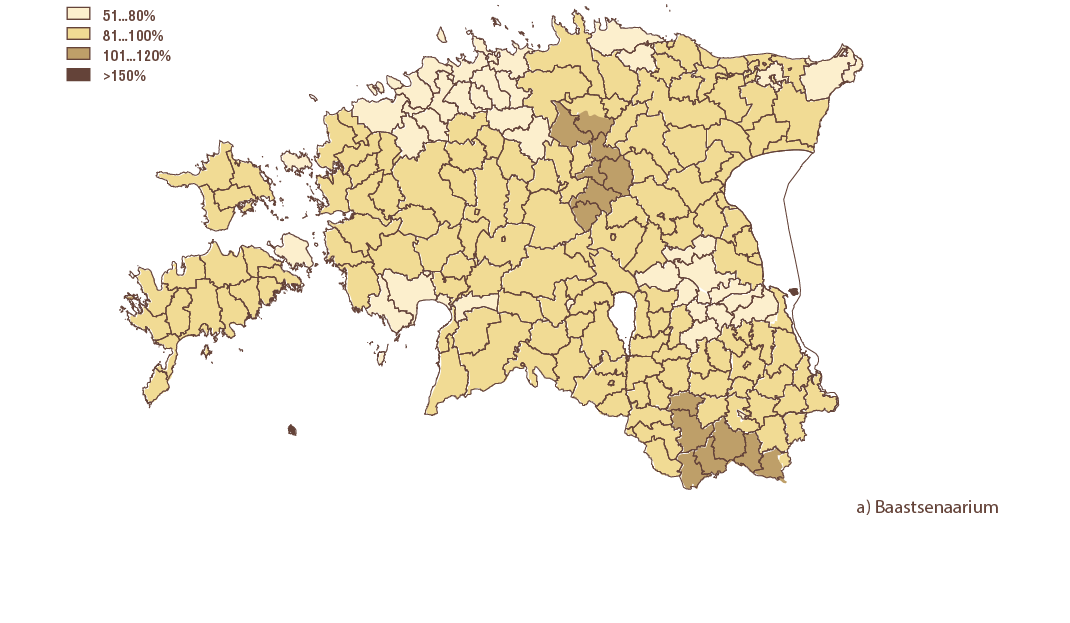
Recent population projections provide a clearer picture of how migration shapes regional demographic change.4 The baseline scenario (Figure 4.2.1a) assumes that current birth and mortality rates continue and that there is no internal or external migration. Under this scenario, the number of basic-school-age children will decline in most municipalities, with growth projected in only a few (e.g. Rõuge, Antsla and Järva municipalities).
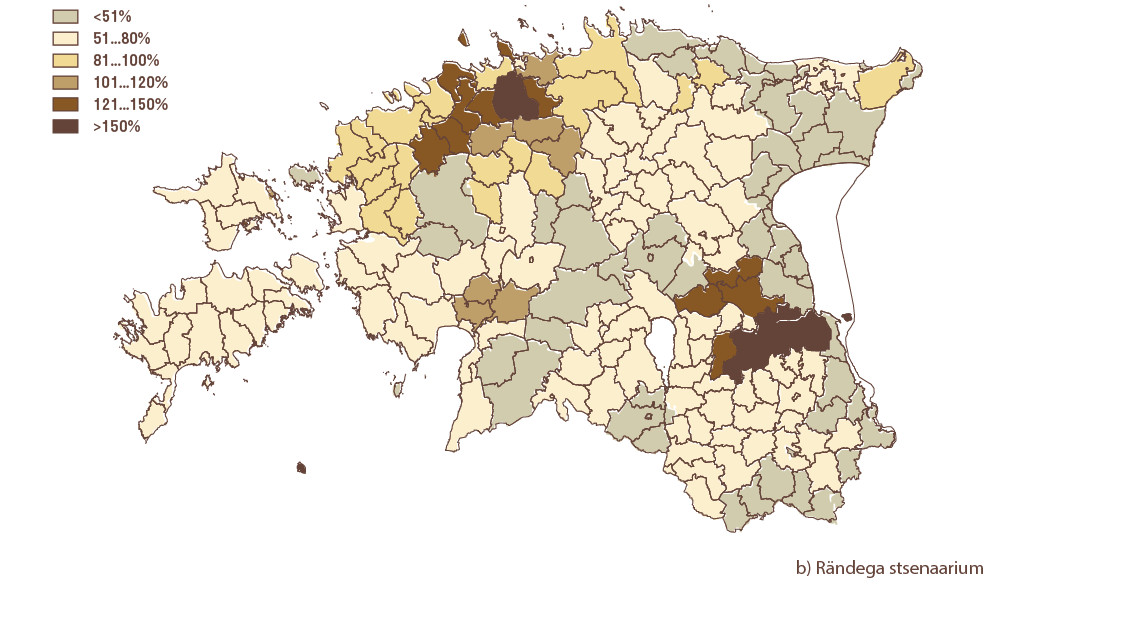
Even in larger urban regions such as Tallinn and Tartu, the number of basic-school-age children would decline by more than 20% if current fertility and mortality trends persisted. This is largely due to the present age structure (with currently large child cohorts) and lower fertility rates in larger cities.5 However, the migration scenario (Figure 4.2.1b), which assumes the continuation of current migration trends, substantially changes the picture. Migration accelerates the decline in municipalities outside major urban regions, while increasing the number of children in the hinterlands of larger cities.
OUTSIDE MAJOR URBAN REGIONS, MOST PUPILS ATTEND THEIR LOCAL BASIC SCHOOL
In addition to broader demographic trends and related changes in the number and distribution of children, parental school choice decisions further complicate the design of the school network. Such decisions reflect a mix of rational, emotional and political considerations.6 Ensuring a strong local basic school therefore requires not only demographic and migration projections but also an understanding of family choices, including whether children attend a nearby or more distant school. School choice has consequences that extend beyond educational and labour market outcomes: the school a child attends and the peers they study with shape social networks and social space over the life course. For example, Russian-medium schools are known to anchor pupils within the Russian-speaking community.8
Despite the importance of school choice for life trajectories, relatively little is known about the decisions of families living outside major urban regions. Existing research largely focuses on selective ‘elite’ schools in cities. At the same time, more than 40% of children in Estonia do not attend their designated local or neighbourhood school,9 a figure heavily influenced by urban areas and the ‘golden circle’ municipalities surrounding cities.
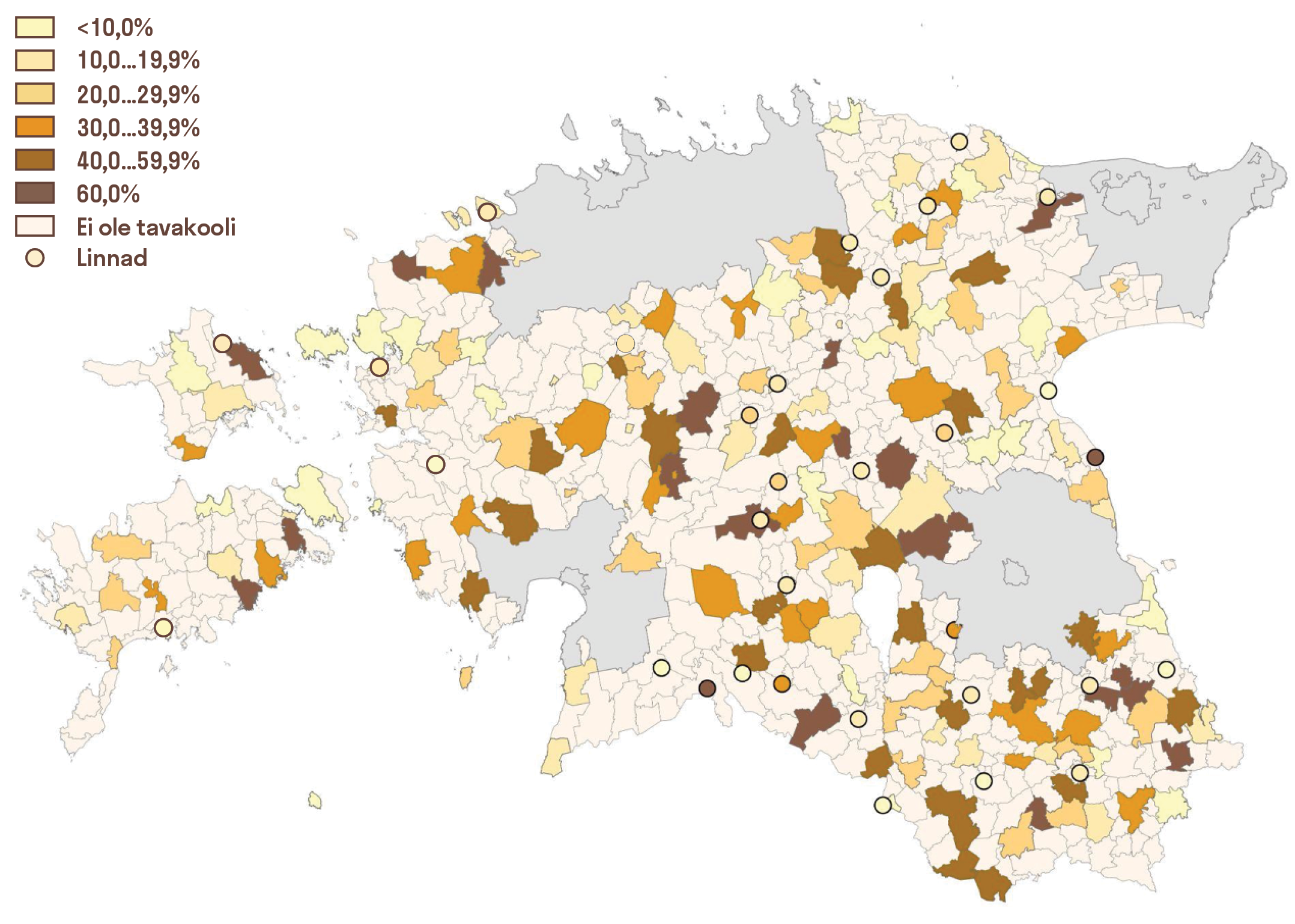
In this article, we analyse data on graduates of general education basic schools from 2022 and 2023, focusing on children who have a basic school in their local area (excluding part-time, evening and special schools). The main spatial unit of analysis, referred to as the local area (see Figure 4.2.2), is a functionally coherent area comprising a single settlement or village, or a group of settlements or villages. The analysis excludes the urban regions of Tallinn and the main regional centres (Tartu, Pärnu and the urban centres of Ida-Viru County), as changes to the school network in areas outside major cities and their surroundings have the greatest implications for local development and school choice. In most local areas in Estonia, there is no basic school (shown as light areas in Figure 4.2.2). However, where a local basic school exists, it is typically the preferred option. In total, 5,640 children (20% of those completing basic school in 2022 and 2023) lived in such areas. Of these, nearly 80% (4,505 pupils) attended the local or neighbourhood school and around 20% (1,135) attended a school elsewhere (Figure 4.2.2). In other words, outside major urban regions, most pupils attend their local basic school if one is available.
WHAT EXPLAINS SCHOOL-CHOICE-DRIVEN MOBILITY?
The following analysis examines which school- and pupil-level factors are associated with school-choice-driven mobility – that is, with studying at a school other than the local basic school. In other words, which indicators of school quality or family background distinguish pupils who attend a school outside their local area from those who remain in the local school? We use binary regression analysis, including pupil characteristics (father’s and mother’s education, occupational status, place of residence, and home language) and school characteristics (average mathematics examination results, teachers’ qualifications and parental income levels). As data were incomplete for 656 children, the final analysis covers 4,984 pupils.
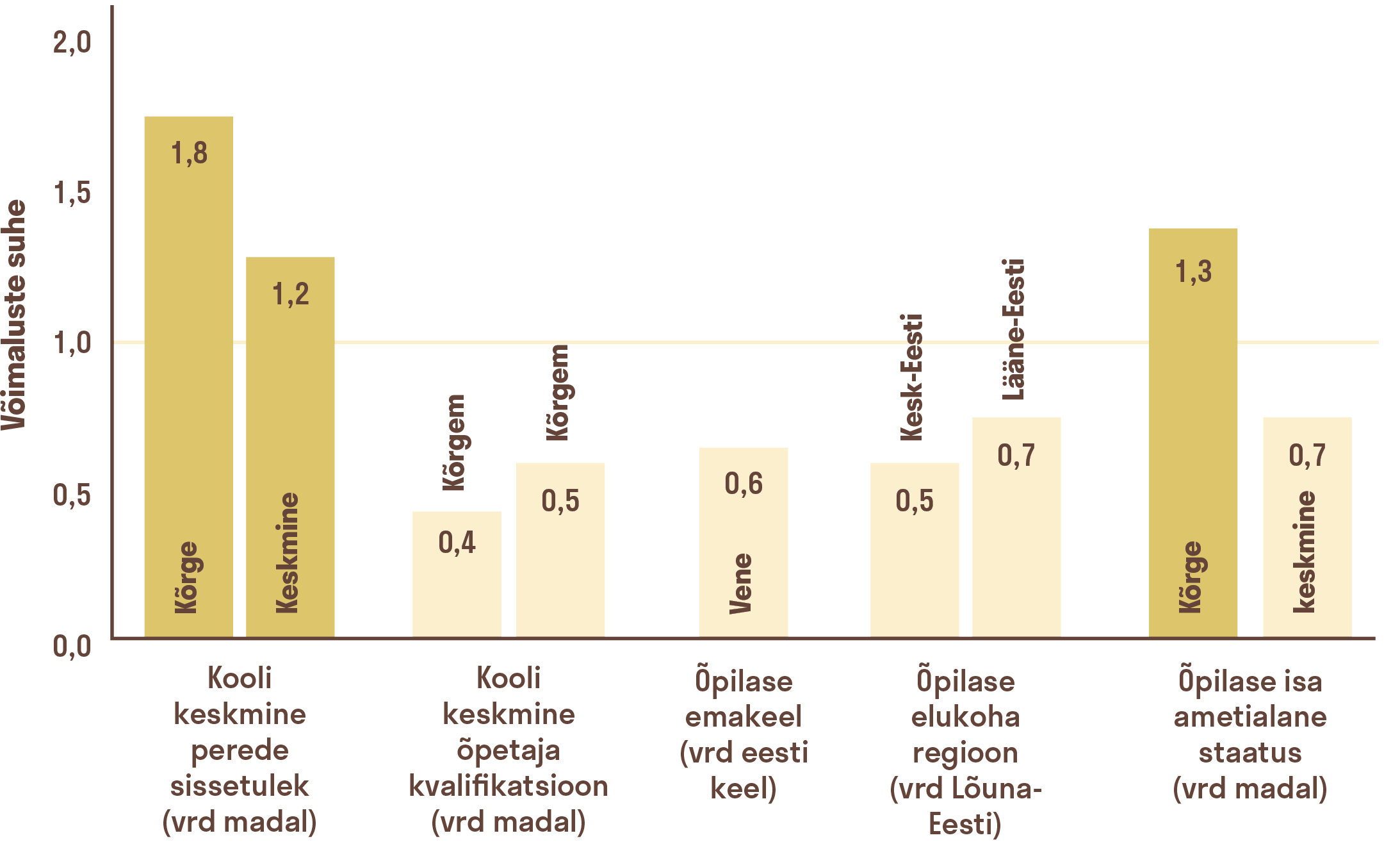
In interpreting the binary regression results, the reference value is 1 (Figure 4.2.3). Values below 1 indicate a negative association and values above 1 a positive association. The results show that higher teacher qualifications in the neighbourhood school reduce school-choice-driven mobility, increasing the likelihood that pupils attend the neighbourhood school. By contrast, the school’s average mathematics examination result is not statistically significant.
Studying outside the neighbourhood school is primarily associated with family background characteristics. Children from families with higher socio-economic status, particularly those whose fathers have higher socio-economic status, are more likely to attend a school outside their local area. Parental income levels are also higher in the schools chosen than in the corresponding neighbourhood schools. The results further indicate that children with Russian as their mother tongue are less likely to study outside their local area than children with Estonian as their mother tongue. The likelihood of school-choice-driven mobility also varies by region: pupils in central and western Estonia are less likely to attend a school outside their local area than those in southern Estonia, while pupils in northern and north-eastern Estonia do not differ significantly from those in southern Estonia.
A GOOD EDUCATION CAN BE OBTAINED IN ANY MUNICIPALITY
Schools fulfil multiple roles in children’s lives. Alongside strong academic outcomes, schools are equally expected to support pupils’ personal growth and prepare them to become full members of society.11 In Estonia, these roles have long been assessed through subject-based tests – final examinations and standardised tests – as well as school satisfaction surveys that capture support for learners’ autonomy, self-efficacy, self-directed learning, sense of belonging and collaboration. It is therefore relevant to ask what trends characterise the education system across the three dimensions of academic outcomes, personal growth and preparation for participation in society. From the perspective of this article, a more specific question arises: when parents of basic school pupils living outside major urban regions choose schools further from home, are these choices justified?
We address this question using three indices of educational outcomes: (1) academic performance (basic-school final examinations and standardised tests in Estonian, mathematics and science), (2) support for personal growth (perceived autonomy, support for autonomy, self-efficacy and self-direction skills), and (3) preparation for participation in society (sense of belonging, perceived usefulness and cost of group learning, and individual recognition).
We analyse data from 2019 and 2024 to assess recent developments. As outcomes depend not only on schools but also on pupils’ socio-economic background and special educational needs, we weighted school results in the analysis of variance between municipalities using two factors: median parental income in 2021 and the share of pupils with special educational needs in 2019 and 2024. For clarity, however, the figures present unweighted average results, allowing the comparison of educational outcomes across municipalities regardless of differences in median parental income or the share of pupils with special educational needs.
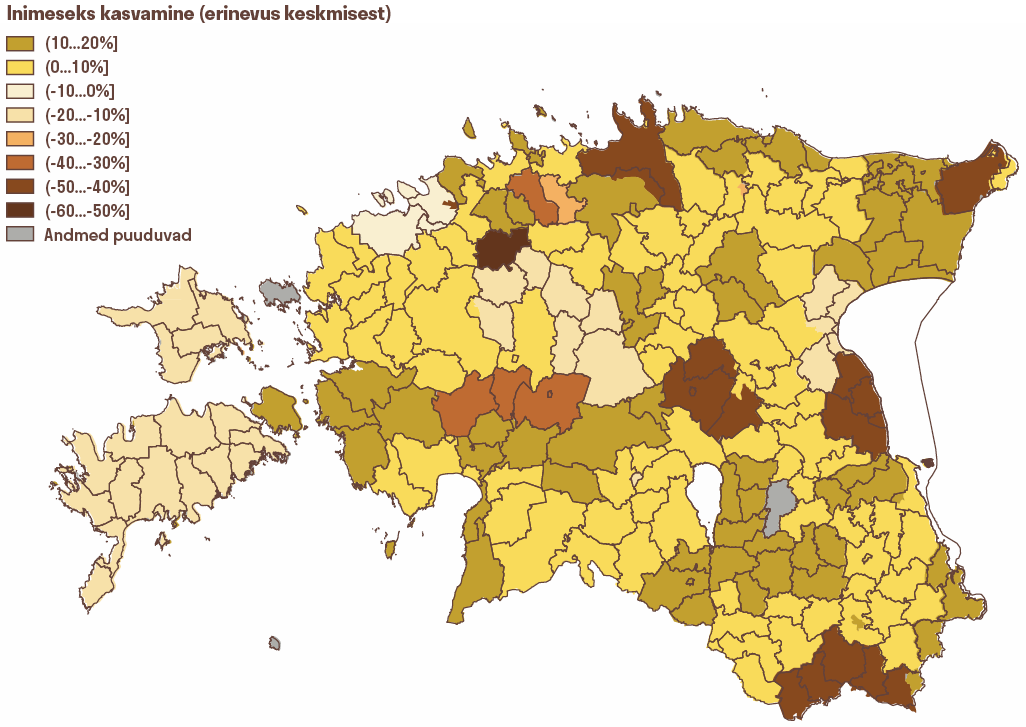
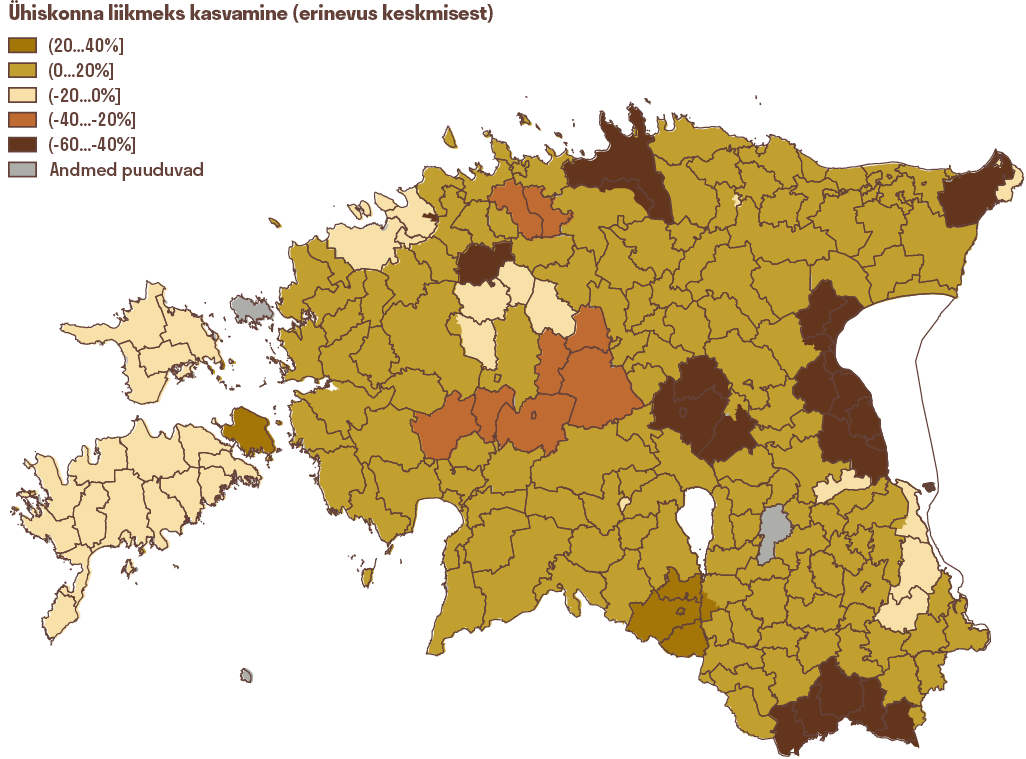
The analysis shows that academic outcomes vary across Estonia’s cities, towns and municipalities, whereas support for personal growth and preparation for participation in society do not. Academic outcomes are stronger in Tallinn, Tartu and the surrounding ‘golden circle’ municipalities. There are also differences between rural and urban schools, but these depend less on location than on the content and organisation of teaching within schools. When municipalities are grouped more broadly, the achievement of goals related to personal growth and social participation shows little association with whether pupils study in Tallinn, Tartu, another urban area or a rural school.
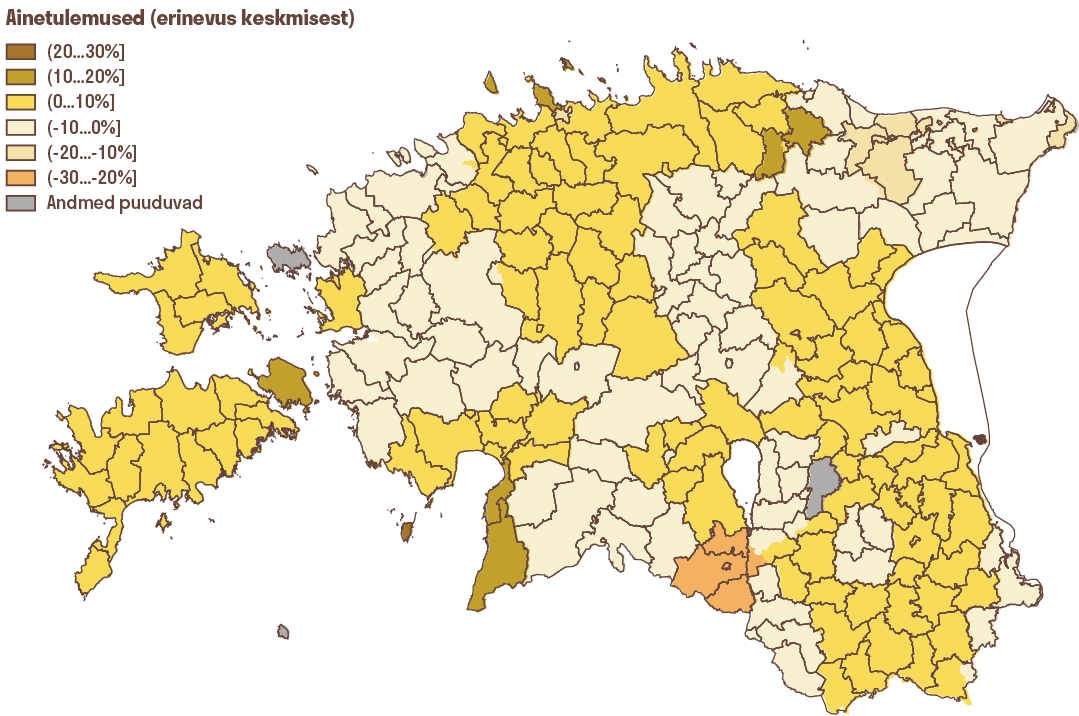
A closer look (Figure 4.2.4) shows that academic outcomes exceed those of Tallinn in schools in 56 municipalities and those of Tartu in 41 towns and municipalities. In 2024, Estonia had 79 municipalities, meaning that in more than half of them average academic outcomes were higher. Although differences exist within municipalities, most Estonian cities, towns and municipalities do not face major concerns regarding basic school pupils’ subject knowledge. Every child has the opportunity to receive a good education. Indices measuring personal growth and preparation for participation in society are higher than in Tallinn and Tartu in 51 and 53 municipalities, respectively. It is therefore understandable that most children living outside major urban regions attend their local school, and that school-choice-driven mobility – or more broadly, population movement from rural areas to Tallinn and Tartu – cannot be justified solely by concerns about educational quality elsewhere in Estonia.
FUTURE PERSPECTIVE: ONE MUNICIPALITY – ONE SCHOOL
In summary, in most cities, towns and municipalities outside major urban regions there are no major concerns regarding average academic outcomes or, more broadly, educational quality, and most families choose the local school. The design of a school network that supports both educational and regional development objectives can build on this evidence and provide families with confidence that, at least until the end of basic school, children across Estonia can receive a good education in their home area. The main challenge is the projected decline in pupil numbers outside major urban regions over the coming decades. Migration-based population projections suggest a steeper decline than earlier forecasts that did not account for migration. Falling enrolment will increase pressure to close schools and, together with school-choice-driven mobility, may affect the viability and quality of rural schools. This could trigger a self-reinforcing cycle, accelerating mobility regardless of the school’s objective quality. On this basis, four possible development pathways can be identified.
1. Maintain the current school network and communicate clearly that its strength will be ensured.
This pathway supports the choices currently made by most families outside major urban regions and may reduce school-choice-driven mobility, particularly if there is a clear commitment that small schools will not be closed and that the state or municipalities will ensure their viability. Such certainty may also encourage families to remain outside Tallinn and Tartu, thereby supporting regional development. However, this option may impose high costs and is constrained by teacher shortages.
2. Substantially reduce the school network without actively supporting school-choice-driven mobility.
This approach runs counter the current choices of families living outside major urban regions and is likely to increase migration to larger cities, with negative implications for regional development. As variation in educational outcomes is greatest in large urban areas, the academic success of pupils who move depends heavily on the specific school attended, a choice often shaped by family background. This pathway is consistent with the limited availability of educational resources but may increase inequality.
3. Reduce the school network while systematically supporting school-choice-driven mobility.
This option also diverges from current family preferences outside major urban regions. If school-choice-driven mobility is well organised and does not depend solely on families’ access to private transport, its impact on regional development need not be negative. However, given the wider variation in outcomes between schools in larger cities, pupils’ academic performance will depend on the school they attend. Although this pathway may respond to teacher shortages, it may prove financially burdensome due to rising transport costs and is not consistent with climate objectives.
4. Develop municipal school networks based on the principle ‘one municipality – one school’.
As municipalities are responsible for basic schools, some have already introduced unified management structures, operating several school sites under a single administration and shared principles. Teachers and, where necessary, pupils can move between locations in a coordinated manner. This pathway aligns with current family preferences outside major urban regions, supports balanced regional development, addresses teacher shortages and may improve cost-efficiency.
These pathways are not mutually exclusive. For example, a reduced number of schools could be combined with the principle ‘one municipality – one school’. However, decisions should be made by the communities concerned. Whatever approach is chosen, society must receive a clear message that different types of schools across Estonia provide good-quality education. Parents need confidence that the comprehensive school model functions in practice and that a pupil in a small rural school can receive education of the same quality up to the end of basic school as a pupil in central Tallinn.
Further development of the school network requires the systematic evaluation of schools’ educational outcomes using modern assessment methods and the refinement of these methods so that assessments of school viability take relevant contextual factors into account, such as family background and class composition. Universities could play a role as independent evaluators of both academic outcomes and schools’ support for personal growth and preparation for participation in society. Research is also needed to assess the effectiveness of new governance and funding models and to inform their further development. Given increasing educational diversity and the extension of compulsory education, it is important to understand how structural decisions affect outcomes, regional differences and the measures needed to support them.
Ultimately, confidence in the future is the most important factor for both education and regional development. This does not preclude ongoing adjustment of the school network, but clarity about the principles guiding its adaptation can strengthen trust. Such clarity can reassure parents that high-quality education is available not only in cities but in rural areas as well. In this way, the school network can contribute to equal opportunities and support regional development across Estonia.
ACKNOWLEDGEMENTS
The research underlying this article was funded by the Estonian Research Council (PRG1996, segregationcircles.eu; Information Technology Mobility Observatory, imo.ut.ee), the Estonian Academy of Sciences (research professor Tiit Tammaru), the Ministry of Education and Research (Centre of Excellence in Energy Efficiency ENER) and the Ministry of Regional Affairs and Agriculture (comprehensive study of settlement development scenarios for the National Spatial Plan 2024). We thank the Education and Youth Board, the Ministry of Education and Research, and the Foresight Centre for collecting and providing the data used in this study. The data analysis and conclusions are the responsibility of the researchers and are independent of the above-mentioned institutions, which bear no responsibility for them.